
Qalandiya - long queues again


The morning after publication of Trump’s program. The world (and the occupation) unchanged.
The place was busy when we arrived at 6.15. Roadworks are still in process. They have been going on for at least two years yet haven’t yet reached the section between the squares in the road that leads to the checkpoint, where there is no sidewalk and where the lights have not worked for years. People walk at the side of the road in the dark and it is hard to see them. It is really dangerous. Remember that this is within Jerusalem’s control.
We parked in a bay along the road. Warmly coated and with umbrellas we made our way to the Palestinian side. Luckily, the rain stopped at this point. On the Palestinian side we were greeted by an almost forgotten sight: there were queues extending right out of the sheltered area, and the three entrances were closed, with red lights. We felt it was years since seeing such a thing, but then remembered that in fact the new automated system of checking was introduced only a year ago.
The beigel seller, Abus Ramzi, stood next to one of the entrances. He is now allowed to be there. He said that such queues tend to form every couple of weeks – the entrances shut and lines form. Apparently inside not all the six checking machines are being operated.
After a short while the lights turned green and the queues disappeared. But when the entrances closed again later, a drizzle started and the lines ‘snaked’ under the shelter. This kept happening while we were there: the lights turned green, entrances opened, the queues vanished. Then, again, red lights … This is peak traffic time. Abu Ramzi says that he arrives at 4.30. At 5 the first workers begin to arrive. In the past they used to come before 4.
M. who sells us tea in his kiosk, is happy to see us after the long interval, and recommends his herbal tea, and offers us herbs to take home. We asked him what he had heard about the Trump plan. His response: ‘I don’t hear anything. I am interested only in my wife, my children, my home, and earning a living. Apart from that I’m not interested. Even my uncle I don’t hear.” Should we laugh or cry at such a response?
An area next to the kiosk is roped off by cords that prevent entry to the upper parking lot. There is work in progress there. M. says that he was told that the kiosk would have to move. He keeps getting moved but doesn’t know what is being built there on land belonging to his family. In the area that had been the parking lot of the checkpoint some work is happening and there are piles of materials. We have still not managed to understand what the plans are for this area. But it does not appear to be a parking lot for the Palestinians.
At about 7 o’clock we entered the checkpoint. Now there were no queues outside, but inside were quite long lines in front of the checking machines, not all of which were being used. After that, most of the Palestinians go through the electronic checking gates without delay. We were not delayed in personal checking and, in spite of waiting in line, we passed in about only 10 minutes.
Qalandiya Checkpoint / Atarot Pass (Jerusalem)
See all reports for this place-
Click here to watch a video from Qalandiya checkpoint up to mid 2019 Three kilometers south of Ramallah, in the heart of Palestinian population. Integrates into "Jerusalem Envelope" as part of Wall that separates between northern suburbs that were annexed to Jerusalem in 1967: Kafr Aqab, Semiramis and Qalandiya, and the villages of Ar-Ram and Bir Nabala, also north of Jerusalem, and the city itself. Some residents of Kafr Aqab, Semiramis and Qalandiya have Jerusalem ID cards. A terminal operated by Israel Police has functioned since early 2006. As of August 2006, northbound pedestrians are not checked. Southbound Palestinians must carry Jerusalem IDs; holders of Palestinian Authority IDs cannot pass without special permits. Vehicular traffic from Ramallah to other West Bank areas runs to the north of Qalandiya. In February 2019, the new facility of the checkpoint was inaugurated aiming to make it like a "border crossing". The bars and barbed wire fences were replaced with walls of perforated metal panels. The check is now performed at multiple stations for face recognition and the transfer of an e-card. The rate of passage has improved and its density has generally decreased, but lack of manpower and malfunctions cause periods of stress. The development and paving of the roads has not yet been completed, the traffic of cars and pedestrians is dangerous, and t the entire vicinity of the checkpoint is filthy. In 2020 a huge pedestrian bridge was built over the vehicle crossing with severe mobility restrictions (steep stairs, long and winding route). The pedestrian access from public transport to the checkpoint from the north (Ramallah direction) is unclear, and there have been cases of people, especially people with disabilities, who accidentally reached the vehicle crossing and were shot by the soldiers at the checkpoint. In the summer of 2021, work began on a new, sunken entrance road from Qalandiya that will lead directly to Road 443 towards Jerusalem and Tel Aviv. At the same time, the runways of the old Atarot airport were demolished and infrastructure was prepared for a large bus terminal. (updated October 2021)
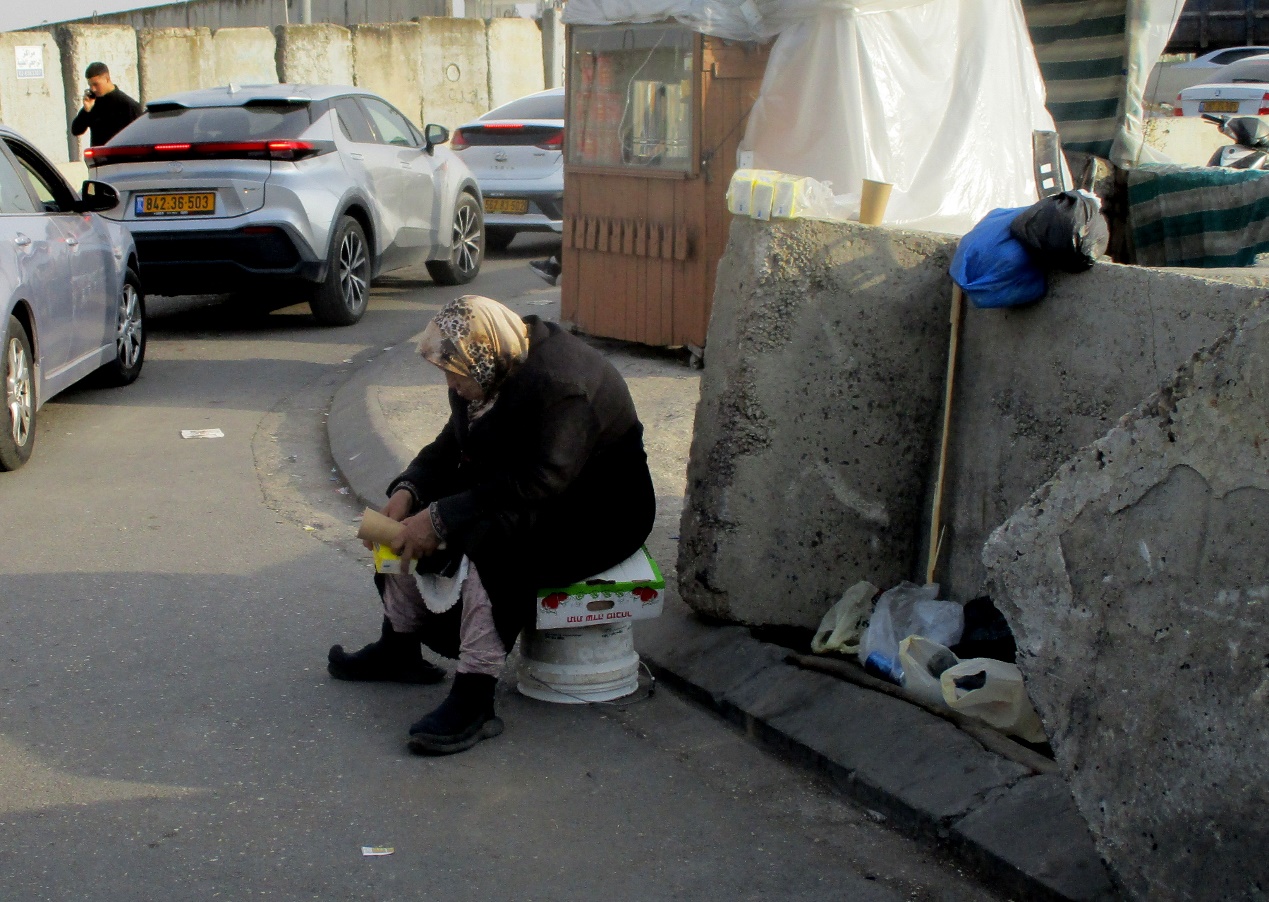 Tamar FleishmanOct-11-2026Qalandiya. Female Beggar
-
