
Qalandiya, Mon 12.10.09, Afternoon
From 14:00 till 17:00
Nebi Samuel, Ramot CP, Beit Iksa, Har Shmuel, Givat Zeev and Qalandia.
At the entrance to Nebi Samuel there were many more cars than expected after the holidays. A nephew of the grocery store owner was manning a little stand with fruit and vegetables. We proceeded to the store to hear even sadder stories than before about life in this miserable place. His brother had just come back from picking olives on the other side of the wall, in the morning the soldiers had let him cross through the Givat Zeev CP, but this afternoon he was told to go around all the way to Qalandia (at great expense) which is not worth his while for the poor harvest of this year – he was appalled about being unable to access his own trees. Another villager came to complain about the fact that a contractor owed him thousands of shekels, but refused to pay. He had had bad experiences with the same man before. He cannot be trusted, but apparently he was convinced that the man had changed his ways and would pay for the huge amount of work he had performed for him. He has no hope that the ‘system’ will be lenient – they only want us to leave this place. We want to apply to Yesh Din on his behalf. At that moment the nephew of the storeowner called to tell him that Micha of the Military Administration had ordered the fruit stand removed until the next morning, or all the produce would be destroyed. The stand is on his own land, whereas the Jews have erected a proper store with souvenirs, etc. on the same land and are never bothered by the authorities. A huge antenna on top of one of the buildings where the collaborators are housed makes them scared. Three 30-year olds have recently died of cancer in the village and the trees are all sick It was pointed out to us that the Figs of Nebi Samuel were famous all around Jerusalem, now the leaves are black and the trees look sad with a kind of gall-nuts along their branches. They will all die unless the authorities (but which authorities) will treat them. The same neglect is apparent from the fact that sewerage is running straight down the hillside. When the villagers started to build a pipeline it was destroyed by the civil administration. It was again reiterated that the only thing Israel is interested in, is getting the villagers away from this desirable real estate and over the wall. A new CP has been erected in Beit Iksa causing them a lot of trouble.
We drove to Beit Iksa and it turns out that the CP is on the other side of the village, close to Bidu – we decided to drive around to Mt. Shmuel and approach the CP from there as we had done in the past. However, instead of a few boulders there is now a closed gate and a tall fence and there is no way we can get close to it with the car. We will try the road via Beit Iksa at another occasion again.
The wall is nearing completion along the road to Givat Zeev and in addition to a security road alongside it there are tall fences and barbed wire. The Givat Zeev CP was almost deserted; there is still no access for cars.
We continued to Qalandia, the Atarot CP moved and soldiers didn’t stop any cars. Nevertheless the queue to go north was long and to enter the roundabout from the south (A-Ram) was practically impossible. We parked and looked what was holding up the cars – they were not stopped, but the flow was slow, because they each had to respect the ‘security zone’ between one car and the next. Then we saw major construction on the Western side of the CP next to the lane of the cars going into Jerusalem. A special covered passage for pedestrians was already in place. We asked one of the workers who told us that this was going to be the crossing for those in possession of blue Id’s (an apartheid lane for privileged Palestinians, often making a separation between husbands and wives too). The Palestinian worker, employed by Barashi, lives in Nablus; he told us with a big smile that he would have work at least for the next ten years.
At the pedestrian entrance to Qalandia from the Israeli side the hand-machines are still not in use. On the way back we heard a lot of shouting to people who had not put their belongings in the tray before the X-ray machine. It turns out that there was only one tray, which has to be picked up from the other end all the time, which slows the queue and also hampers the security.
When we suggested the army provide some more trays, we were told that there is no budget for these things. A man told us not to come in the afternoons, but to observe what happens in the morning. This morning he had waited for over an hour and younger workers, like monkeys had climbed the fences in order to get in front of the long lines.
The long lines and entanglement at the roundabout had evaporated, however, the queue at the Atarot CP stretched all the way to the intersection with the traffic light and the CP to the entrance of Jerusalem.
.
Nabi Samwil
See all reports for this place-
Nabi Samwil - a village literally placed in a transparent cage.
This Palestinian village is 800 years old. It is located on top of a hill, its altitude 890 meters above sea level, and overlooks the entire area. According to Jewish, Christian, and Muslim traditions, the Prophet Samuel was buried here. In recent years the mosque has been turned into a popular Jewish prayer site. Jews use the basement for prayer, and Muslims the upper part of the mosque. New signs are placed here, containing verses from the Jewish scriptures and mention of exclusively Israeli historical times. The nearby spring has become a popular site of ritual bathing. On Iyar 28th, every year, a mass-celebration is held in memory of the Prophet Samuel.
Until 1967 this was a well-off village that developed around the mosque, with a population of 1,000 owning thousands of dunams of farmland. In 1967 most of the villagers fled, and only 250 remained. In 1971 Israel expelled them, and until the 1990s completely razed its houses that were sitting on a Crusader and Hellenist archeological stratum, without any kind of compensation for the expelled inhabitants. Parts of the village lands are at present used for the settler-colony of Har Shmuel, another part has been declared a national park. Villagers have tried to restore their lives on their remaining lands, a short distance from their original homes, in an area that formerly held structures to house the village’s livestock.
Then the Separation Fence was erected in the West Bank, the village remained an enclave caught between the Green Line and the Fence, and its inhabitants were torn away from other West Bank villages. Any exit to the West Bank requires crossing the distant Jib checkpoint, with a permit. The movement to Israel inside the Green Line is forbidden as well. In 1995 the entire village area was declared a national park – not only around the mosque and antiquities around it which take up about 30 dunams, but an area of no less than 3,500 dunams including the new village and all of its land. Any additional construction is forbidden: any room, caravan, fence, a newly planted tree. Work permits are issued sparingly. There is a tiny school made up of several caravans.
Watch the movie by Eran Turbiner and MachsomWatch: NABI SAMWIL 1099-2099, a film by Eran Torbiner
-
Qalandiya Checkpoint / Atarot Pass (Jerusalem)
See all reports for this place-
Click here to watch a video from Qalandiya checkpoint up to mid 2019 Three kilometers south of Ramallah, in the heart of Palestinian population. Integrates into "Jerusalem Envelope" as part of Wall that separates between northern suburbs that were annexed to Jerusalem in 1967: Kafr Aqab, Semiramis and Qalandiya, and the villages of Ar-Ram and Bir Nabala, also north of Jerusalem, and the city itself. Some residents of Kafr Aqab, Semiramis and Qalandiya have Jerusalem ID cards. A terminal operated by Israel Police has functioned since early 2006. As of August 2006, northbound pedestrians are not checked. Southbound Palestinians must carry Jerusalem IDs; holders of Palestinian Authority IDs cannot pass without special permits. Vehicular traffic from Ramallah to other West Bank areas runs to the north of Qalandiya. In February 2019, the new facility of the checkpoint was inaugurated aiming to make it like a "border crossing". The bars and barbed wire fences were replaced with walls of perforated metal panels. The check is now performed at multiple stations for face recognition and the transfer of an e-card. The rate of passage has improved and its density has generally decreased, but lack of manpower and malfunctions cause periods of stress. The development and paving of the roads has not yet been completed, the traffic of cars and pedestrians is dangerous, and t the entire vicinity of the checkpoint is filthy. In 2020 a huge pedestrian bridge was built over the vehicle crossing with severe mobility restrictions (steep stairs, long and winding route). The pedestrian access from public transport to the checkpoint from the north (Ramallah direction) is unclear, and there have been cases of people, especially people with disabilities, who accidentally reached the vehicle crossing and were shot by the soldiers at the checkpoint. In the summer of 2021, work began on a new, sunken entrance road from Qalandiya that will lead directly to Road 443 towards Jerusalem and Tel Aviv. At the same time, the runways of the old Atarot airport were demolished and infrastructure was prepared for a large bus terminal. (updated October 2021)
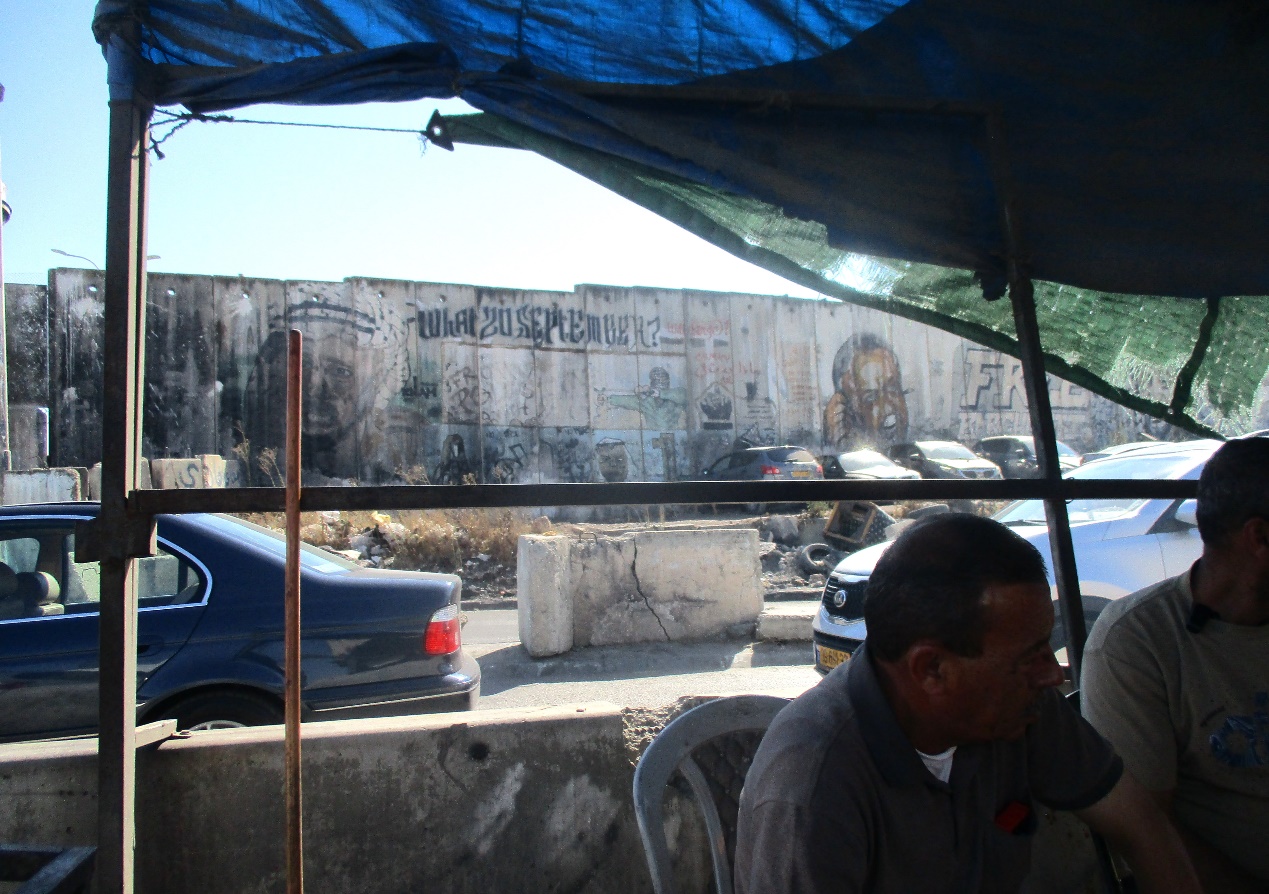 Tamar FleishmanJul-21-2026Qalandiya. Conversation in the shadow of the wall
-
