
Qalandiya, Mon 15.11.10, Afternoon
Eve of the Id al Adha Festival. There were fewer people than usual at the CP. Many of those who arrived were dressed for the holiday, accompanied by their children, and carried presents for their families. There were many mothers with children. Unfortunately, on such a festive day, the filth and dirt at the CP really assaulted the senses. It was almost impossible to put your foot down without stepping in a pile of garbage. And in spite of the fact that there were fewer people than usual (and perhaps because of that….), the soldiers manning the active passageways worked more slowly, or so it seemed, and the lines in the passageways hardly moved at all. In one line people stood for an hour or more, waiting quietly, untila (female) soldier announced in the coarsest manner over the PA system that the passageway was closed and that those waiting should "fly away" (the Hebrew slang equivalent of "get lost").
15:20, Qalandiya: Two internal passageways were active when we reached Qalandiya. From a distance we could see that three people were waiting in the DCO shed. The floor of the CP was covered with garbage – cigarette butts and discarded cans of soft drinks. It looked as if the place was never cleaned. There were not many people in the CP, but the lines were not moving at all. A group of workmen entered the CP and stood in line in Passageway 4 (which was not active at that time). The workers said that the passageway would be opened so that they could get to their work shift at AtarotIndustrial Parkon time (it was).
About 20 people were waiting in Passageway 2 when we got on line. It took us half an hour to get through. The same number were waiting in Passageway 1, but they were not moving at all. After an hour (no exaggeration), we heard a (female) soldier announce over the PA:
"Maslak wachad sacker, oofu hahootza." The first part, in Arabic, was "Passageway 1 is closed"; the second part, in colloquial Hebrew, was "get lost".
Another (female) soldier's voice came at us from the second passageway: "Hutu kol ishi fi salla, yalla!) (Free translation: Put all your belongings in the basket, yalla! The yalla part, in Arabic is markedly disrespectful and sounded much worse over the PA system than it looks on paper.)
Several dozen people were waiting in the northern shed to enter the CP. Even though there was room in the passageways, the (female) soldier on duty was too busy on her phone to open the turnstile and let the people through. We phoned Keinan's stand-in and the gate was opened.
The situation was terrible all afternoon, but got worse toward 5 PMwhen the flow of people increased. In the end, we phoned the Chief of Police at the CP in despair. He must have intervened because a change was quickly felt and the soldiers manning the passageways actually began to do their job.
We left Qalandiya at 17:00to drive back to Jerusalem. There were no lines at Lil/Jabba or at Hizmeh CPs.
Qalandiya Checkpoint / Atarot Pass (Jerusalem)
See all reports for this place-
Click here to watch a video from Qalandiya checkpoint up to mid 2019 Three kilometers south of Ramallah, in the heart of Palestinian population. Integrates into "Jerusalem Envelope" as part of Wall that separates between northern suburbs that were annexed to Jerusalem in 1967: Kafr Aqab, Semiramis and Qalandiya, and the villages of Ar-Ram and Bir Nabala, also north of Jerusalem, and the city itself. Some residents of Kafr Aqab, Semiramis and Qalandiya have Jerusalem ID cards. A terminal operated by Israel Police has functioned since early 2006. As of August 2006, northbound pedestrians are not checked. Southbound Palestinians must carry Jerusalem IDs; holders of Palestinian Authority IDs cannot pass without special permits. Vehicular traffic from Ramallah to other West Bank areas runs to the north of Qalandiya. In February 2019, the new facility of the checkpoint was inaugurated aiming to make it like a "border crossing". The bars and barbed wire fences were replaced with walls of perforated metal panels. The check is now performed at multiple stations for face recognition and the transfer of an e-card. The rate of passage has improved and its density has generally decreased, but lack of manpower and malfunctions cause periods of stress. The development and paving of the roads has not yet been completed, the traffic of cars and pedestrians is dangerous, and t the entire vicinity of the checkpoint is filthy. In 2020 a huge pedestrian bridge was built over the vehicle crossing with severe mobility restrictions (steep stairs, long and winding route). The pedestrian access from public transport to the checkpoint from the north (Ramallah direction) is unclear, and there have been cases of people, especially people with disabilities, who accidentally reached the vehicle crossing and were shot by the soldiers at the checkpoint. In the summer of 2021, work began on a new, sunken entrance road from Qalandiya that will lead directly to Road 443 towards Jerusalem and Tel Aviv. At the same time, the runways of the old Atarot airport were demolished and infrastructure was prepared for a large bus terminal. (updated October 2021)
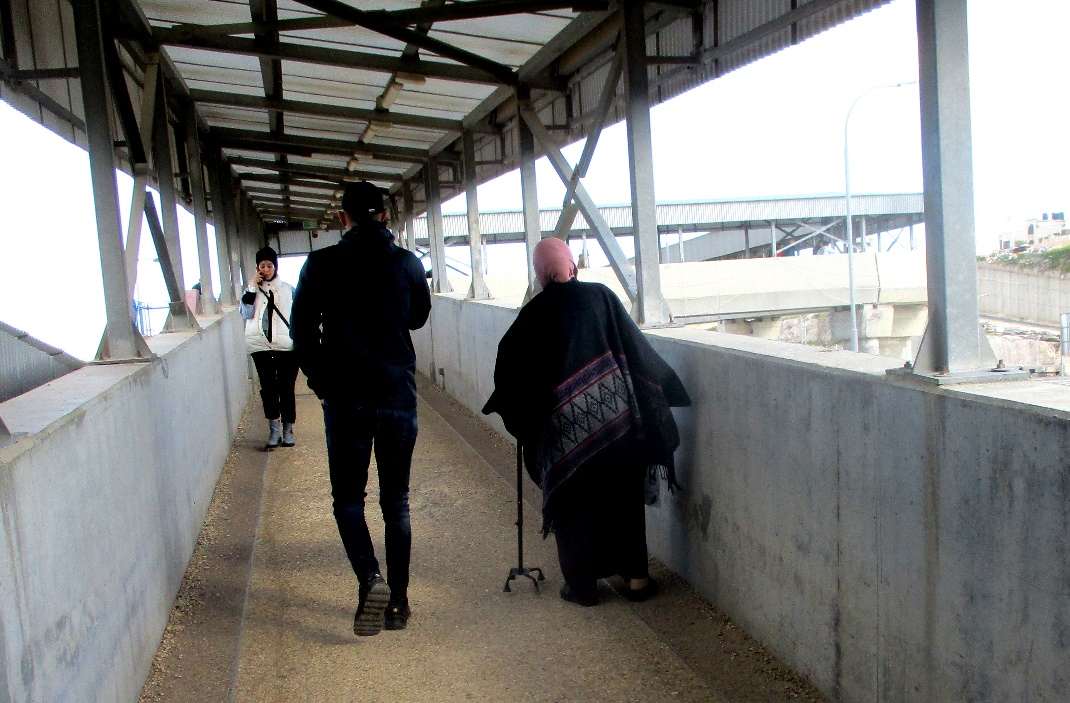 Tamar FleishmanJun-28-2026Qalandiya. The bridge leading from Jerusalem to the Qalandiya checkpoint
-