
Back to reports search page
Donate
Qalandiya, Mon 22.10.12, Afternoon
Observers: Natanya G. and Phyllis W. (reporting)
We arrived in the southern square, the entrance to Qalandiya from Jerusalem, at 15:30 . Traffic in the square was at a standstill and it took us 10 minutes just to reach the parking lot. In the bus station adjacent to the square we saw a Jerusalem ambulance waiting for the ambulance from Ramallah bringing a patient to Jerusalem. The Ramallah ambulance was actually waiting in the vehicle CP, but was being delayed because the soldiers claimed there was no "coordination". (The claim seems a bit ridiculous in view of the fact that the "uncoordinated" Jerusalem ambulance was waiting there.) Natanya jumped out to see what was happening while I went to park. On the way I phoned the "Medical Coordination Hotline" (02/9977929). The female soldier who answered asked me to give her the name and I.D. number of the patient being transferred. She thought that there had been coordination. Unfortunately, before I could stop the Palestinian ambulance, the driver had turned around and driven off, waving me good-bye. This seems to beg the question of how Israeli soldiers work at the CP when they don't even know army telephone numbers that are available to MW staff.
When we finally entered the CP at 16:00, we found 2 active passageways with few people waiting on line. One man was waiting to enter the DCO offices in Passageway 5. Natanya offered to call the DCO and tell them he was waiting, but he asked us not to interfere as this might complicate his interaction with the soldiers. I noticed that there were 2 female soldiers in the aquarium between Passageways 2 and 3, one of them reclining in her chair arranging her hairdo. I called to them and they instructed me to come into Passageway 2. When I entered, I tried to explain to the "hair dresser" that I would like to tell those on line in Passageway 4 to go to Passageway 2, freeing up the soldiers in 4 to deal with the guy on line for the DCO (complicated?). The "hair dresser" went absolutely wild and started to scream at me, telling me that my sons were ashamed of my behavior, that I was a bored old woman with nothing to do but bother her and, in the end, she wished me a short life! For the life of me I can't understand what came over her and how she allowed herself to act the way she did. In the end she opened the turnstile allowing me to leave the passageway.
On my return to the northern (Palestinian) side of the CP, Natanya and I noticed a man standing in the DCO passageway. We approached and offered our assistance. It turned out that he was a merchant from Gaza who had arrived in Ramallah on Sunday with a permit to enter Israel that was valid until November 5. He wanted to return to Gaza on Monday, via Jerusalem, but the soldiers in Passageway 4 confiscated his permit and refused him entry to Jerusalem. I tried to talk to the DCO representative while Natanya enterprisingly called Hannah Barag. Without Hannah's help our friend would never have managed. Even with her help he was delayed until midnight before being allowed to continue on his way home. He reached Erez CP only at 02:00 at which time Hannah spoke with Civil Administration personnel who opened the CP and allowed him through. I just spoke with Habib who was happy to be home and thanked us all for the help given him.
Unfortunately, yesterday was not a boring day at the CP!
Qalandiya Checkpoint / Atarot Pass (Jerusalem)
See all reports for this place-
Click here to watch a video from Qalandiya checkpoint up to mid 2019 Three kilometers south of Ramallah, in the heart of Palestinian population. Integrates into "Jerusalem Envelope" as part of Wall that separates between northern suburbs that were annexed to Jerusalem in 1967: Kafr Aqab, Semiramis and Qalandiya, and the villages of Ar-Ram and Bir Nabala, also north of Jerusalem, and the city itself. Some residents of Kafr Aqab, Semiramis and Qalandiya have Jerusalem ID cards. A terminal operated by Israel Police has functioned since early 2006. As of August 2006, northbound pedestrians are not checked. Southbound Palestinians must carry Jerusalem IDs; holders of Palestinian Authority IDs cannot pass without special permits. Vehicular traffic from Ramallah to other West Bank areas runs to the north of Qalandiya. In February 2019, the new facility of the checkpoint was inaugurated aiming to make it like a "border crossing". The bars and barbed wire fences were replaced with walls of perforated metal panels. The check is now performed at multiple stations for face recognition and the transfer of an e-card. The rate of passage has improved and its density has generally decreased, but lack of manpower and malfunctions cause periods of stress. The development and paving of the roads has not yet been completed, the traffic of cars and pedestrians is dangerous, and t the entire vicinity of the checkpoint is filthy. In 2020 a huge pedestrian bridge was built over the vehicle crossing with severe mobility restrictions (steep stairs, long and winding route). The pedestrian access from public transport to the checkpoint from the north (Ramallah direction) is unclear, and there have been cases of people, especially people with disabilities, who accidentally reached the vehicle crossing and were shot by the soldiers at the checkpoint. In the summer of 2021, work began on a new, sunken entrance road from Qalandiya that will lead directly to Road 443 towards Jerusalem and Tel Aviv. At the same time, the runways of the old Atarot airport were demolished and infrastructure was prepared for a large bus terminal. (updated October 2021)
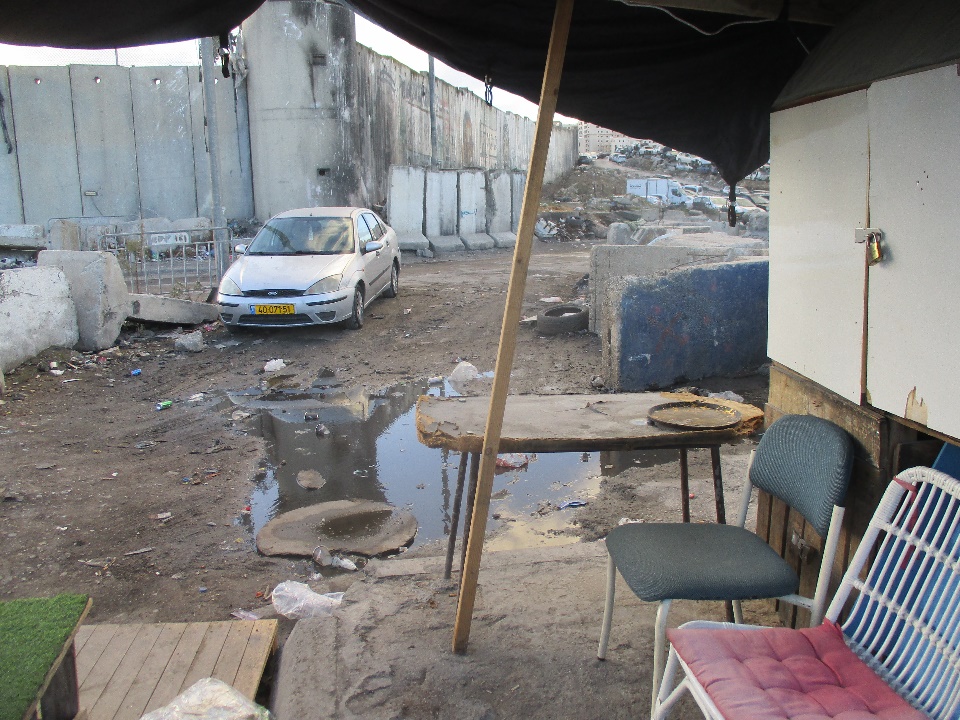 Tamar FleishmanNov-30-2025Qalandiya: Puddles and dirt after the rain
-