Qalandiya, Mon 23.4.12, Afternoon
Whenever you're not expecting any particular difficulty, when you think that there's no reason that the CP should not be operating like a well-oiled machine, that's when the Occupation strikes again! Yesterday, Natanya fell in the morning and her leg was hurting her terribly, but she stubbornly refused to stay home and insisted on accompanying me to Qalandiya. We agreed to do a short shift figuring that things would be as they were last week with no problems.
However, when we reached Qalandiya at 3:30 PM as is our wont, we found the three internal passageways full of waiting people. They complained to us about the length of time they were waiting (one to one-and-a-half hours), and in fact we didn't see that the soldiers on duty were letting anyone into the examination areas. We also heard complaints that the soldiers were just not functioning, but were sitting at their posts playing with their cell-phones. Insofar as we could see, these complaints were well founded. We began phoning these complaints to whoever would answer his phone – headquarters, DCO offices, Officer Alaa, the Humanitarian Hotline and even to the police and the Passageway Unit (who just slammed the phone down when they heard our plea).
The people on line showed a great deal of patience as well as a developed sense of humor, in spite of the crowding and their tiredness, coming home from a day's work or a day's studies, and despite the impatience of the many laborers hurrying to reach their afternoon shifts at the Atarot Industrial Park down the road from Qalandiya. People have become accustomed to the inadequacies of the conqueror, who can't even get the CP to operate efficiently.
And it's not even as if there were that many people at Qalandiya. If the three passageways had been operating anywhere near efficient levels, the lines would have shortened considerably with a quarter of an hour or 20 minutes – if only the soldiers were working. Luckily, the (female) soldier in the northern shed who controls the entrance turnstiles mostly spent her time dozing. Otherwise she might have locked the turnstiles and prevented people from entering the CP – and then go and wake her up every time she should have let people in.
In the midst of all this mess, we saw a young mother waiting with 3 small children, one of them in her arms, to cross to Jerusalem. She was at the head of the line and was one of the first to enter when the soldiers finally began to work. But the soldiers wouldn't let her through with the children. (Despite the fact that she held a permit and that the children were listed in her I.D. card, the soldiers said that the oldest daughter, 6 or 7 years of age, needed to present her birth certificate as well.) The woman came out of the passageway in tears, near the end of her tether and the children of course were very upset to see their mother crying.
In the end, Officer Alaa called them into the DCO offices and promised to see if he could help them. We can only hope that things worked out well as we forgot to ask for the woman's phone number.
Qalandiya Checkpoint / Atarot Pass (Jerusalem)
See all reports for this place-
Click here to watch a video from Qalandiya checkpoint up to mid 2019 Three kilometers south of Ramallah, in the heart of Palestinian population. Integrates into "Jerusalem Envelope" as part of Wall that separates between northern suburbs that were annexed to Jerusalem in 1967: Kafr Aqab, Semiramis and Qalandiya, and the villages of Ar-Ram and Bir Nabala, also north of Jerusalem, and the city itself. Some residents of Kafr Aqab, Semiramis and Qalandiya have Jerusalem ID cards. A terminal operated by Israel Police has functioned since early 2006. As of August 2006, northbound pedestrians are not checked. Southbound Palestinians must carry Jerusalem IDs; holders of Palestinian Authority IDs cannot pass without special permits. Vehicular traffic from Ramallah to other West Bank areas runs to the north of Qalandiya. In February 2019, the new facility of the checkpoint was inaugurated aiming to make it like a "border crossing". The bars and barbed wire fences were replaced with walls of perforated metal panels. The check is now performed at multiple stations for face recognition and the transfer of an e-card. The rate of passage has improved and its density has generally decreased, but lack of manpower and malfunctions cause periods of stress. The development and paving of the roads has not yet been completed, the traffic of cars and pedestrians is dangerous, and t the entire vicinity of the checkpoint is filthy. In 2020 a huge pedestrian bridge was built over the vehicle crossing with severe mobility restrictions (steep stairs, long and winding route). The pedestrian access from public transport to the checkpoint from the north (Ramallah direction) is unclear, and there have been cases of people, especially people with disabilities, who accidentally reached the vehicle crossing and were shot by the soldiers at the checkpoint. In the summer of 2021, work began on a new, sunken entrance road from Qalandiya that will lead directly to Road 443 towards Jerusalem and Tel Aviv. At the same time, the runways of the old Atarot airport were demolished and infrastructure was prepared for a large bus terminal. (updated October 2021)
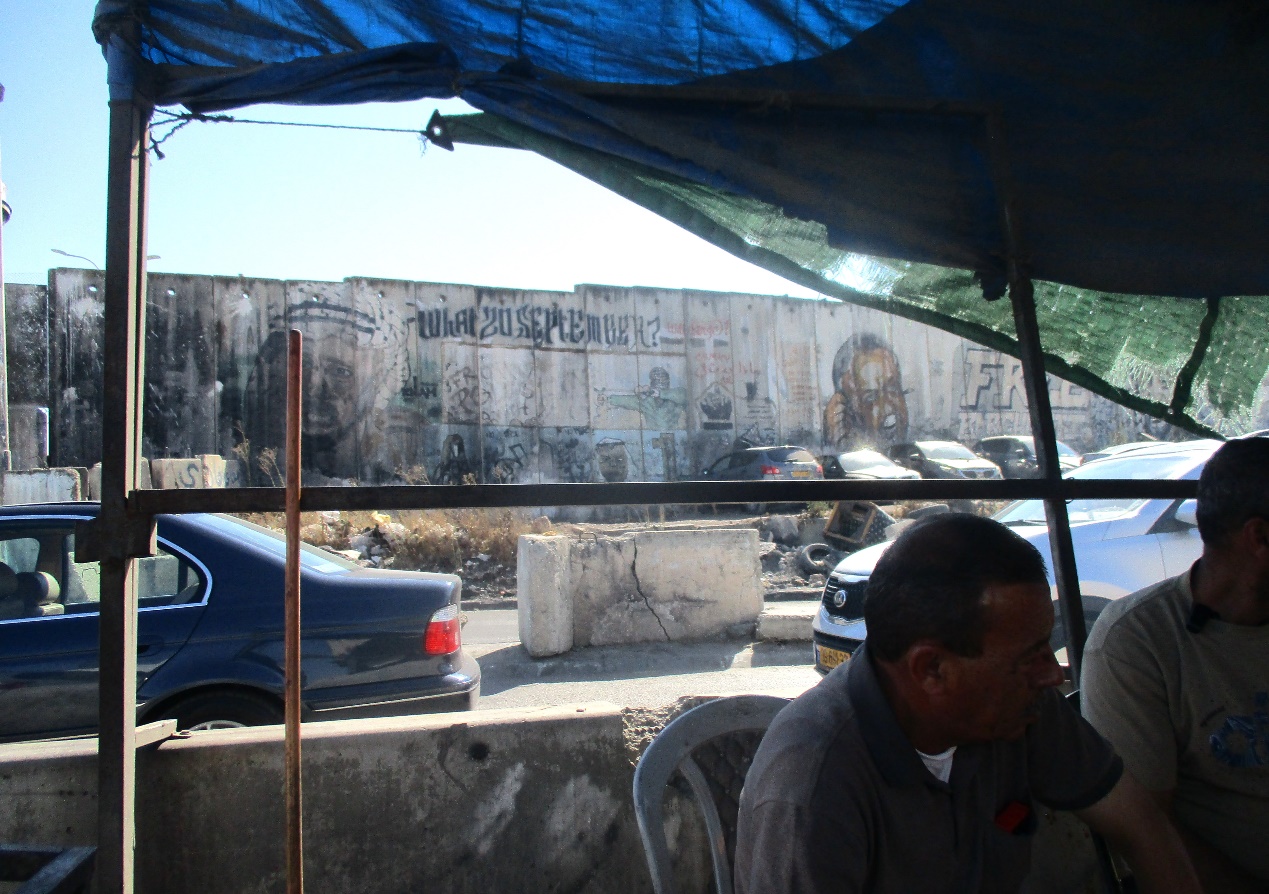 Tamar FleishmanJul-21-2026Qalandiya. Conversation in the shadow of the wall
-