Back to reports search page
Donate
Qalandiya, Mon 9.7.12, Afternoon
Observers: Natanya G. and Phyllis W. (reporting)
We reached Qalandiya at 3:30 PM. Very few people were waiting in the two active passageways and the CP appeared to be functioning with no special problems. We walked over to see what was happening in the DCO offices and through the bars we saw 3 men sitting in the entrance shed waiting room. Suddenly the light over the turnstile turned green indicating that the gate was unlocked, so we went in and were allowed to continue through into the shed where we heard the stories of some of those waiting, fathers and sons.
A middle aged man was accompanying his son, a young man in his twenties who needed crutches to get around. The son had been employed by an Israeli glass company in the Ma'ale Edomim settlement until one day two years ago a two-ton load of glass fell on him and crushed his leg. He hasn't been able to work since. He was invited to the National Insurance offices in Jerusalem on July 10th to meet a medical evaluation team to determine the degree of his injury, but when he asked the A-Ram DCO for a permit to enter Israel he was told that the security forces had categorized him as a security risk and he could not receive a permit. We phoned headquarters and asked to speak with the DCO representative (Anan). We were told to wait half an hour until he was available. After about 20 minutes the light over the turnstile entrance to the DCO turned green and we took advantage of the opportunity to look for the representative more actively. We actually found Anan who told us it was his job to help Palestinians, but in this case he was unable to help Mohammed. He explained to the father and son that "security risks" have to apply for permission to enter Israel at least 10 days in advance in order to give the authorities time to look into the case. Anan was implicitly asking the two why they had waited so long to apply for a permit, but they hadn't known that Mohammed was now considered a security risk. And, in general, one wonders how an invalid who can walk only with crutches can be a threat to the country's security? My first thought (G-d forfend) was that the security services were trying to save the country the expense of paying compensation for injury. The father and son agreed to schedule a new appointment and apply for a permit in time. In any event, Natanya gave them her phone number so if there is anything more to tell about this story, we'll probably be able to report it.
The second father that we met was a young man from Nablus who wanted to visit his wife who is suffering from breast cancer and is hospitalized in Augusta Victoria Hospital on Mount Scopus. He had received the proper permit and had taken his 7-year old son with him to visit his mother. The son was listed in his I.D. papers and the father had also brought the child's birth certificate. But it turned out that procedures have long since been changed and every child of 5 or more must receive a personal entry permit for Israel at the DCO offices near his home. The father had his wife's medical papers which he wanted to deliver to the hospital. It looked like he would be forced to choose: either return to Nablus (a 3-hour round trip) and get a permit for his son or leave the boy at Qalandiya CP to wait for him until he returned from the hospital. In this case, Anan was able to solve the problem and, after hearing the whole story, said he would issue a permit for the son. (Note that the father and son had already been at the DCO offices and refused entry. No one had listened to their story and exercised judgment! Wasn't it lucky that Natanya and I were there for them? Just think what the "unlucky" ones go through!!!)
It was 4:45 PM by the time we got out of the DCO section. The CP still looked deserted. Two passageways were still operating with very few people on line in each.
Qalandiya Checkpoint / Atarot Pass (Jerusalem)
See all reports for this place-
Click here to watch a video from Qalandiya checkpoint up to mid 2019 Three kilometers south of Ramallah, in the heart of Palestinian population. Integrates into "Jerusalem Envelope" as part of Wall that separates between northern suburbs that were annexed to Jerusalem in 1967: Kafr Aqab, Semiramis and Qalandiya, and the villages of Ar-Ram and Bir Nabala, also north of Jerusalem, and the city itself. Some residents of Kafr Aqab, Semiramis and Qalandiya have Jerusalem ID cards. A terminal operated by Israel Police has functioned since early 2006. As of August 2006, northbound pedestrians are not checked. Southbound Palestinians must carry Jerusalem IDs; holders of Palestinian Authority IDs cannot pass without special permits. Vehicular traffic from Ramallah to other West Bank areas runs to the north of Qalandiya. In February 2019, the new facility of the checkpoint was inaugurated aiming to make it like a "border crossing". The bars and barbed wire fences were replaced with walls of perforated metal panels. The check is now performed at multiple stations for face recognition and the transfer of an e-card. The rate of passage has improved and its density has generally decreased, but lack of manpower and malfunctions cause periods of stress. The development and paving of the roads has not yet been completed, the traffic of cars and pedestrians is dangerous, and t the entire vicinity of the checkpoint is filthy. In 2020 a huge pedestrian bridge was built over the vehicle crossing with severe mobility restrictions (steep stairs, long and winding route). The pedestrian access from public transport to the checkpoint from the north (Ramallah direction) is unclear, and there have been cases of people, especially people with disabilities, who accidentally reached the vehicle crossing and were shot by the soldiers at the checkpoint. In the summer of 2021, work began on a new, sunken entrance road from Qalandiya that will lead directly to Road 443 towards Jerusalem and Tel Aviv. At the same time, the runways of the old Atarot airport were demolished and infrastructure was prepared for a large bus terminal. (updated October 2021)
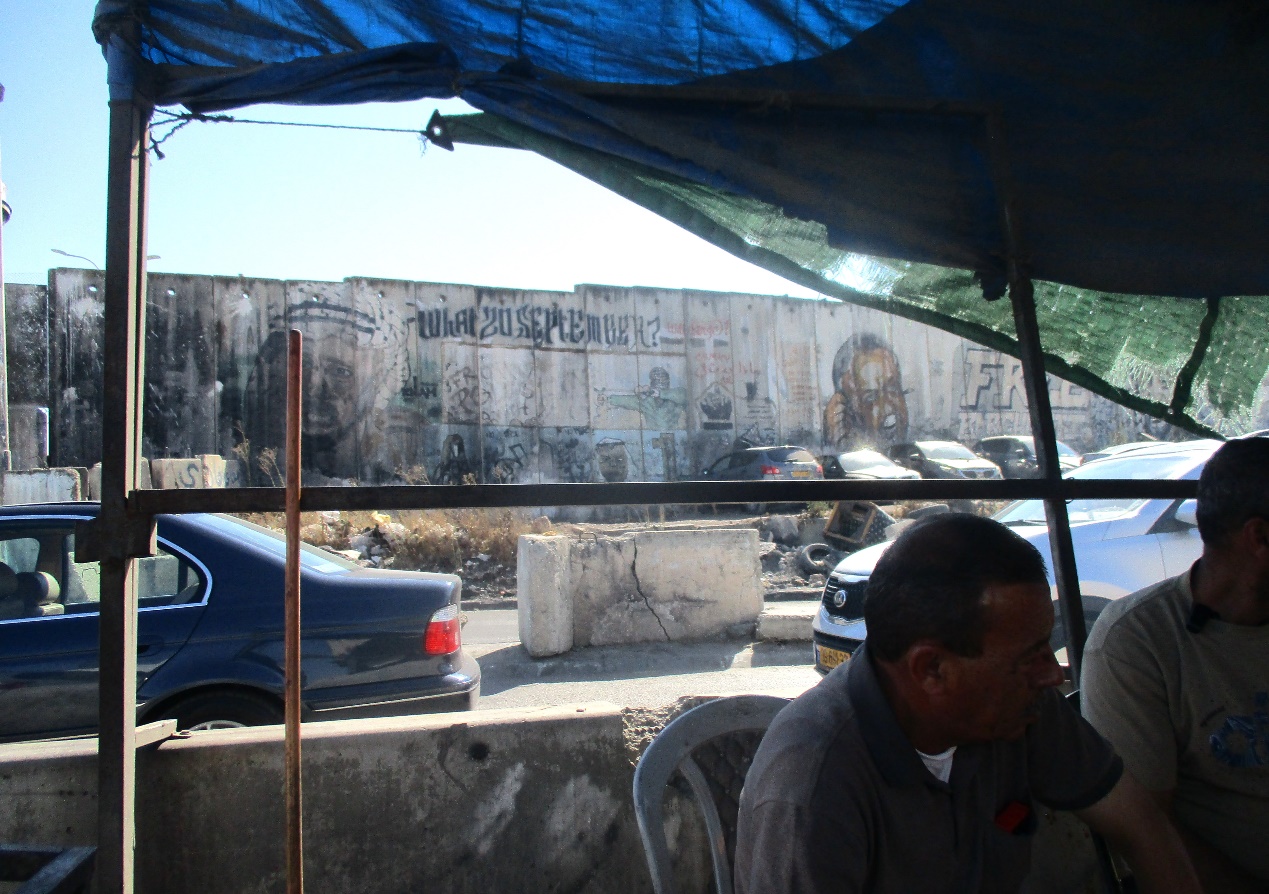 Tamar FleishmanJul-21-2026Qalandiya. Conversation in the shadow of the wall
-