
Qalandiya - no money to buy food

The Ramadan month is hardly over and already seems not to have been at all, and already the hastened building is evident, of tracks for directing humans towards the next Ramadan.
Because Corona-virus contagion rose and because Abu Mazin declared general lockdown, I haven’t been here for a while. Coming back to Qalandiya is a bit like traveling in memopry, from place to place, from person to person, from child to child.
-One man warned me not to cross the checkpoint where cars are being inspected, it’s dangerous. Walk only along the bridge.
-One man praised Netanyahu for sending him and his wife and children money. True, not enough, but he send it…
-One man said that because of Corona patients, the village of Bani Na’im was closed, but he has his family there in the village, and he himself is here, sharing a rented apartment with migrant workers like himself in a refugee camp near Ramallah, earning his living from vending things at the checkpoint. Now there are no more patients in Bani Na’im and no more lockdown.
-One man said that the general lockdown declared by Abu Mazin, as a result of which Palestinian police were posted along main roads, lasted but a few days, for the Israeli army came and chased them away. Now there is lockdown only in Ramallah, on weekends.
At the refugee camp, in a friend’s grocery store, many of the shelves are empty. Not because we didn’t receive wares, he said, it’s because we haven’t ordered them.
The greatest problem for Palestinians is not the Corona virus. It’s the fact that there’s no money for food. The friend showed me his books, people who buy “on credit” and owe him 7,000 shekels. He doesn’t have the heart to remind them, for it’s not the memory that’s lacking, it’s work. They cannot pay “so I have no money to order wares”.
It was dark inside the shop. I thought it was because of my sun glasses, but it wasn’t. The dark afflicting this shop and others nearby and in fact the entire the refugee camp, is the power cut. Power cuts around here are not a rare sight. Electricity, like water, supposedly basic commodities, are not that obvious here. For water evidently there are black tanks on roof tops. But electricity cannot be sored in a tank. Whoever can afford it, buys a generator. Whoever can’t lives without electricity.
They said it’s been like this since 11 a.m. I left at 5 p.m. I don’t know when electricity was on again, but I do know that food in refrigerators and freezes gets spoiled and thrown away.
And one mustn’t forget that electricity in the West Bank is purchased at full price – if not more – from the Israeli Electricity Company. Go figure.
On my way back, facing a new sign, a man said to me: “They know how to write English and Arabic. Hebrew, not so well…” (The word Qalandiya is spelled wrong… in Hebrew).

Qalandiya Checkpoint / Atarot Pass (Jerusalem)
See all reports for this place-
Click here to watch a video from Qalandiya checkpoint up to mid 2019 Three kilometers south of Ramallah, in the heart of Palestinian population. Integrates into "Jerusalem Envelope" as part of Wall that separates between northern suburbs that were annexed to Jerusalem in 1967: Kafr Aqab, Semiramis and Qalandiya, and the villages of Ar-Ram and Bir Nabala, also north of Jerusalem, and the city itself. Some residents of Kafr Aqab, Semiramis and Qalandiya have Jerusalem ID cards. A terminal operated by Israel Police has functioned since early 2006. As of August 2006, northbound pedestrians are not checked. Southbound Palestinians must carry Jerusalem IDs; holders of Palestinian Authority IDs cannot pass without special permits. Vehicular traffic from Ramallah to other West Bank areas runs to the north of Qalandiya. In February 2019, the new facility of the checkpoint was inaugurated aiming to make it like a "border crossing". The bars and barbed wire fences were replaced with walls of perforated metal panels. The check is now performed at multiple stations for face recognition and the transfer of an e-card. The rate of passage has improved and its density has generally decreased, but lack of manpower and malfunctions cause periods of stress. The development and paving of the roads has not yet been completed, the traffic of cars and pedestrians is dangerous, and t the entire vicinity of the checkpoint is filthy. In 2020 a huge pedestrian bridge was built over the vehicle crossing with severe mobility restrictions (steep stairs, long and winding route). The pedestrian access from public transport to the checkpoint from the north (Ramallah direction) is unclear, and there have been cases of people, especially people with disabilities, who accidentally reached the vehicle crossing and were shot by the soldiers at the checkpoint. In the summer of 2021, work began on a new, sunken entrance road from Qalandiya that will lead directly to Road 443 towards Jerusalem and Tel Aviv. At the same time, the runways of the old Atarot airport were demolished and infrastructure was prepared for a large bus terminal. (updated October 2021)
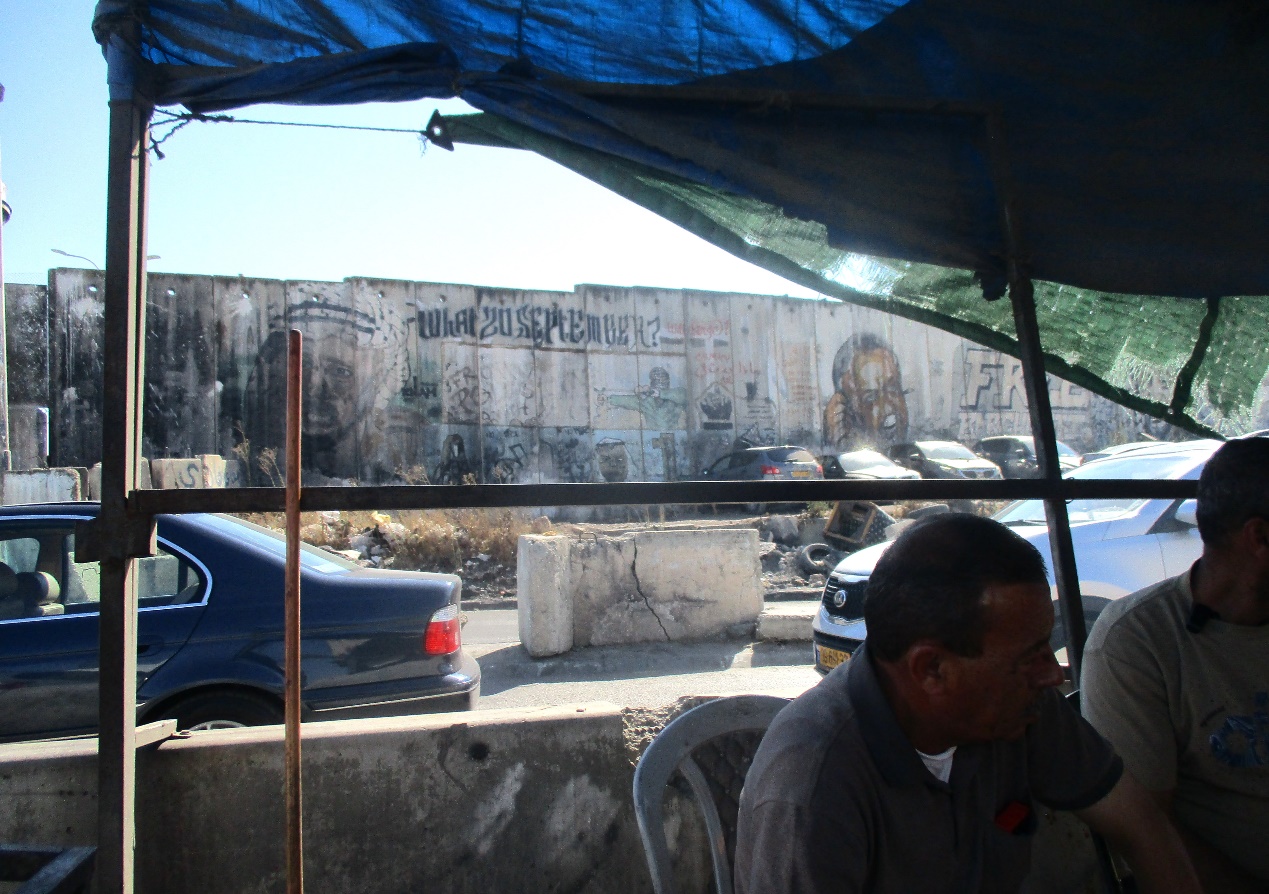 Tamar FleishmanJul-21-2026Qalandiya. Conversation in the shadow of the wall
-
