
Qalandiya - relatively short lines
A reasonable day at Qalandiya.
05.15. Outside dark and cold. Five checking stations were open and the state of the queues was reasonable.
The soldier in the aquarium was sitting with legs up on the table and his eyes glued to his smartphone. Yet we noticed that he did pay attention, and allowed many people in at each opening of the turnstiles. At 5.50 the lines were relatively short (see picture), and did not extend out of the shed.
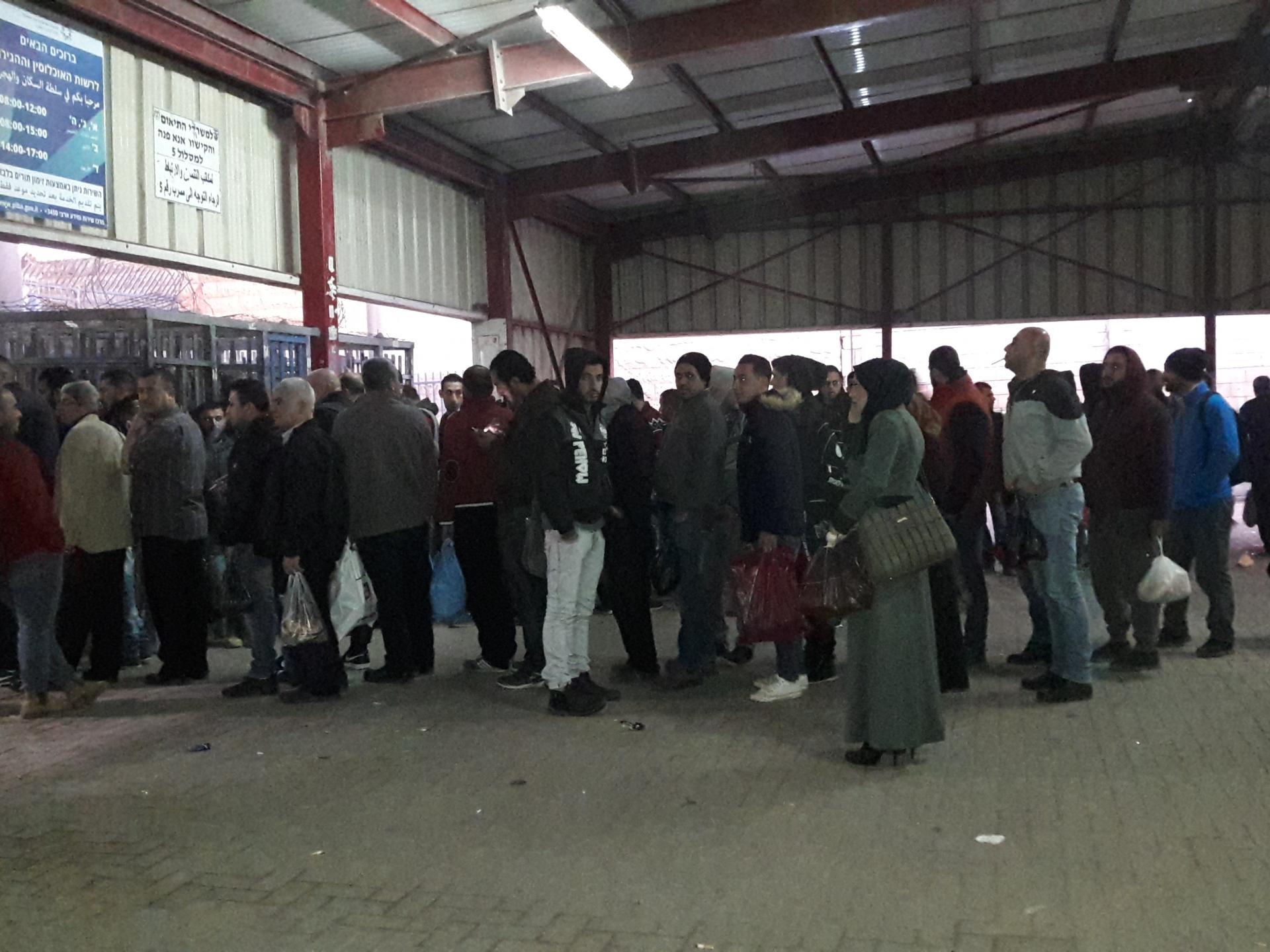
Because of this, women and older folk waited patiently in the regular lines instead of gathering at the humanitarian gate. At about 6 a.m. a policeman arrived and did not react to the small number of people who were at the gate. We hoped his arrival meant that the gate would soon open. Meanwhile the lines lengthened and shortened alternately, but there was never much pressure.
When the humanitarian gate was opened by the D.C.O. woman soldier and a guard late, as usual, at 6.30, they went to open the inner gate together with the policeman. Immediately women and other ‘entitled ones’ left the regular lines for the humanitarian gate. Once again the personnel forgot to open the passage from the gate to the checking stations, but after people drew their attention to this, a guard came to open it, while the soldier and policeman continued admitting people. In a corner opposite station no.5 stood an abandoned child stroller. Presumably someone despaired of getting through the turnstiles on the way to the check itself…
We went out to buy hot tea. Loud hooting of cars drew our attention and we went to the road. A few cars were standing without their drivers, and a crowd of people. Apparently a light accident had led to a conflict which became physical, between the drivers. We immediately heard a siren from the watchtower and saw a policeman and guard approaching. After they came, things calmed down. The drivers returned to their cars. At exactly that moment we noticed Mohammad, the patient from the Jordan Valley, coming from the direction of the road. He was not allowed today to pass in a vehicle and it turned out that he had no transport to Hadassah.
It was already 6.45, and the situation seemed very calm today. So we passed with Mohammad through the humanitarian gate, to checking station no.5. Standing there we saw a notice giving opening hours of the Post Office – Sunday to Thursday, from 8.00 to 15.00, and on Friday 8.00 to 12.00. Above it was a notice that we photographed last week, about hours of passage through the various stations to the area where the Post Office is situated.
Passage was delayed when a smartly dressed old man, resting on a cane, pushed forward in the line. Everyone honoured him and allowed him to pass. Every time he passed the turnstile it whistled, and he had to have explained to him that he must remove his coat and cane and pass them through the screening machine. When he finally crossed without whistling, it turned out that he did not have a permit and the soldier told him he would have to return at 8. The man tried to argue and meanwhile everyone in the line began to lose patience and shouted to him to return. All this created further delay, so that in the end passing took us 30 minutes to reach the car with Mohammad. The trip to Hadassah was relatively quick for a busy morning, and we could deliver him at Hadassah before 8 o’clock.
Qalandiya Checkpoint / Atarot Pass (Jerusalem)
See all reports for this place-
Click here to watch a video from Qalandiya checkpoint up to mid 2019 Three kilometers south of Ramallah, in the heart of Palestinian population. Integrates into "Jerusalem Envelope" as part of Wall that separates between northern suburbs that were annexed to Jerusalem in 1967: Kafr Aqab, Semiramis and Qalandiya, and the villages of Ar-Ram and Bir Nabala, also north of Jerusalem, and the city itself. Some residents of Kafr Aqab, Semiramis and Qalandiya have Jerusalem ID cards. A terminal operated by Israel Police has functioned since early 2006. As of August 2006, northbound pedestrians are not checked. Southbound Palestinians must carry Jerusalem IDs; holders of Palestinian Authority IDs cannot pass without special permits. Vehicular traffic from Ramallah to other West Bank areas runs to the north of Qalandiya. In February 2019, the new facility of the checkpoint was inaugurated aiming to make it like a "border crossing". The bars and barbed wire fences were replaced with walls of perforated metal panels. The check is now performed at multiple stations for face recognition and the transfer of an e-card. The rate of passage has improved and its density has generally decreased, but lack of manpower and malfunctions cause periods of stress. The development and paving of the roads has not yet been completed, the traffic of cars and pedestrians is dangerous, and t the entire vicinity of the checkpoint is filthy. In 2020 a huge pedestrian bridge was built over the vehicle crossing with severe mobility restrictions (steep stairs, long and winding route). The pedestrian access from public transport to the checkpoint from the north (Ramallah direction) is unclear, and there have been cases of people, especially people with disabilities, who accidentally reached the vehicle crossing and were shot by the soldiers at the checkpoint. In the summer of 2021, work began on a new, sunken entrance road from Qalandiya that will lead directly to Road 443 towards Jerusalem and Tel Aviv. At the same time, the runways of the old Atarot airport were demolished and infrastructure was prepared for a large bus terminal. (updated October 2021)
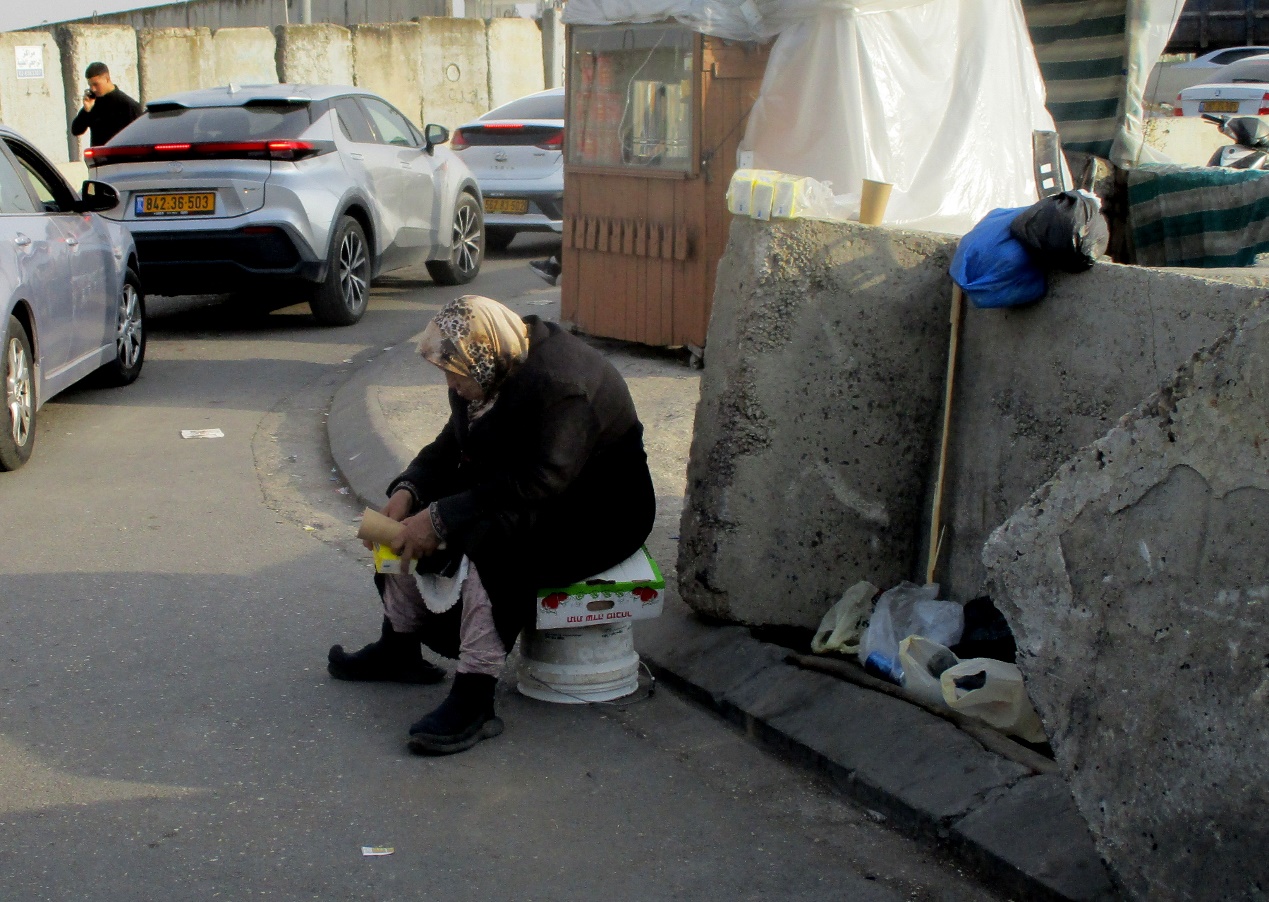 Tamar FleishmanOct-11-2026Qalandiya. Female Beggar
-
