
Qalandiya, Sat 1.5.10, Afternoon
Qalandiya dusty and dirty as ever, the vehicles kept honking, and there were lines and traffic jams.
We stood in line for 40 minutes until we got out, only one inspection post was open. Time flew for us because we weren't in a hurry to work, school or on our way to a doctor's appointment holding a baby in our arms.
The crowd and density in which people stood told us a few things regarding the occupation.
Four brothers, who were over sixty and from Canada, were waiting in line. They told us they were on a tour of the occupation which started off at the Palestinian refugee camps at Syria a year ago. They were on their way back from Nablus, after visiting Balata refugee camp. At each place they find a local Palestinian who gives them all the explanations.
Even after touring and visiting the West Bank, they asked us whether the line was so bad because it was Saturday; the crowd informed them that it relatively wasn't that bad. The brothers then said that the constructions and the inspection post in which we were standing looked like detention rooms.
It's important to sometimes hear a different perception from other new people describing the checkpoint, which is part of the daily routine life of the Palestinians.
And a seventeen year old teenager started to tell us his story, and here is his monolog which he started while we were still in line, continued when we exited the checkpoint and then at the bus from Qalandiya to Nablus Gate.
"I am 17 and I pass here every day with a permit granting me a family reunion, my mother has an ID from Jerusalem and my father was born in Gaza and has an ID from the Palestinian Authority.
Now, just before my final exams, I feel like I can't stand passing through this checkpoint every day, and I'm worried that in the upcoming years, when I might want to study at the university, I won't be able to take it.
My mother has a mental illness, and it had worsened after the announcement of regulation 1650, since my father was born in Gaza and we are very afraid. When I was born my mother was in a bad mental state and my father, who is a merchant, was on a business excursion so there was no one to arrange for me to be enlisted for a Jerusalem ID, and it became too late. The officials at the National Insurance Institute took advantage of my father's absence and interrogated my mother, who wasn't able to answer their bureaucratic inquiries. To this day some of my brothers are enlisted in my mother's ID and the others have passage permits in accordance to the family reunion documentations, and each time there is need for money and lawyers to renew and settle those documents.
I feel like we don't stand a chance. It might be that my father will be deported and it's even more likely that they will place harsher restrictions on his movement. ".
But that is nothing in comparison to the great horror in which over came my whole family after the announcement of the regulation, which enables the deportation of all infiltrators and illegal residents. After all, our father who had lived here for over 20 years was born in Gaza, and some of his relatives live in the Strip. On top of that, two years ago my father's brother died during an Israeli bombardment, four years ago his sister in law and seventeen year old niece, were killed in an Israeli bombardment. My father already has three Shahids in his family. It is still not clear what is the intent of the new lane that had been built at the checkpoint few months ago.It is also not clear what is the job of the usher in chargeof opening the chain at the bus lane ,and allowing the drivers to shorten their time in the trafic jam by just several meters;The palestinian bus company pays the the usher,but the Israeli authorizes this, and according to the kids he can keep working as long " Doudou " one of the police authoritiy that mans the Qalndiya checkpoint allows him.This is a rather curious experiment.
Qalandiya Checkpoint / Atarot Pass (Jerusalem)
See all reports for this place-
Click here to watch a video from Qalandiya checkpoint up to mid 2019 Three kilometers south of Ramallah, in the heart of Palestinian population. Integrates into "Jerusalem Envelope" as part of Wall that separates between northern suburbs that were annexed to Jerusalem in 1967: Kafr Aqab, Semiramis and Qalandiya, and the villages of Ar-Ram and Bir Nabala, also north of Jerusalem, and the city itself. Some residents of Kafr Aqab, Semiramis and Qalandiya have Jerusalem ID cards. A terminal operated by Israel Police has functioned since early 2006. As of August 2006, northbound pedestrians are not checked. Southbound Palestinians must carry Jerusalem IDs; holders of Palestinian Authority IDs cannot pass without special permits. Vehicular traffic from Ramallah to other West Bank areas runs to the north of Qalandiya. In February 2019, the new facility of the checkpoint was inaugurated aiming to make it like a "border crossing". The bars and barbed wire fences were replaced with walls of perforated metal panels. The check is now performed at multiple stations for face recognition and the transfer of an e-card. The rate of passage has improved and its density has generally decreased, but lack of manpower and malfunctions cause periods of stress. The development and paving of the roads has not yet been completed, the traffic of cars and pedestrians is dangerous, and t the entire vicinity of the checkpoint is filthy. In 2020 a huge pedestrian bridge was built over the vehicle crossing with severe mobility restrictions (steep stairs, long and winding route). The pedestrian access from public transport to the checkpoint from the north (Ramallah direction) is unclear, and there have been cases of people, especially people with disabilities, who accidentally reached the vehicle crossing and were shot by the soldiers at the checkpoint. In the summer of 2021, work began on a new, sunken entrance road from Qalandiya that will lead directly to Road 443 towards Jerusalem and Tel Aviv. At the same time, the runways of the old Atarot airport were demolished and infrastructure was prepared for a large bus terminal. (updated October 2021)
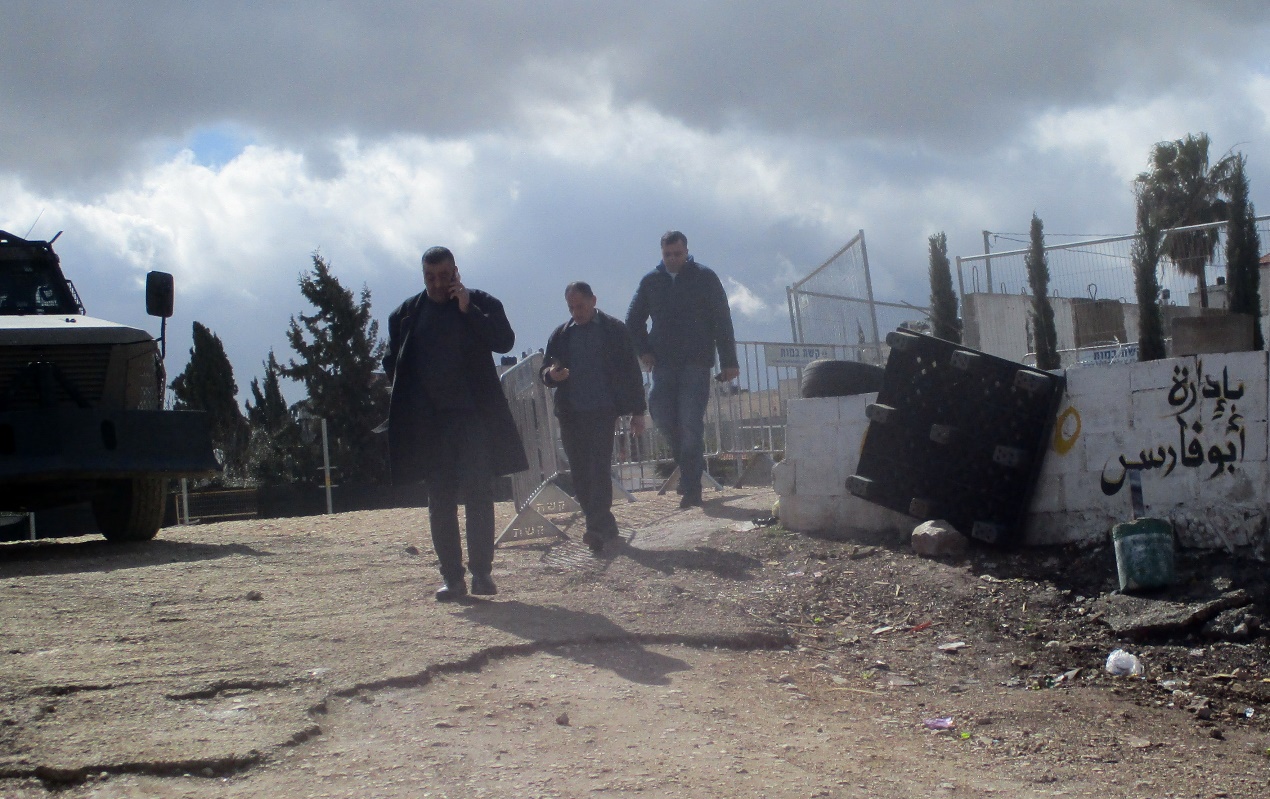 Tamar FleishmanFeb-27-2026Qalandiya: On the way to prayer
-