
Qalandiya - sick Ghazans waiting for hours to get home

Two medical patient-designated transport vehicles were waiting at the platform for their passengers to Gaza.
One of the drivers said to me:
-Do you know that there are patients who have been waiting since morning inside there, to be allowed to go home?
-Do you know what happens with those who arrive late, after you’ve left?
-Surely they are allowed to take a taxi, only it costs them more.
-Well, no.
When the signal was given and the gate opened, people exited in a crowded group, loaded with parcels, people in a slow hurry. Some of them were limping, some had a plastic cup covering one of their eyes and telling the wordless story of eye surgery.
Last out was a scrawny elderly lady whose operated eyes were no help, who hesitated at every step, afraid to trip among the puddles and stones, and glad to have my hand hold hers and lead her securely to the vehicle.
***
In the refugee camp a friend said that when the news of the disappearance of child Kaes Abu Ramila arrived, he too hurried to join the searchers. They were hundreds, perhaps thousands who came to Beit Hanina.
All of them were echoing the memory of Mohammad Abu Khdeir’s tragedy.
The human river searched every street, combed every trail. People who believed that Jews had kidnapped the child proceeded towards settler-colony Neve Yaacov to look for him there. But the junction was blocked by the police. “They thought the police knows something and is not telling, otherwise why close off only this junction and leave the Pisgat Ze’ev (another settler-colony) open?”
They searched all night. In the morning the horrific news came – the child was found dead in a hole in the ground filled with rainwater, within the Jerusalem municipal jurisdiction. A hole without any fence around it.
“What do they care, the officials in the municipality, if Arabs drown and die?” my friend half asked, half stated.

On a tin partition towering over the exit from the checkpoint a warning sign in Hebrew only has been posted. I don’t know whether it is more ridiculous or disgusting or irritating…
“Warning! No entry, construction site!
Tubul 02-5656100”
Qalandiya Checkpoint / Atarot Pass (Jerusalem)
See all reports for this place-
Click here to watch a video from Qalandiya checkpoint up to mid 2019 Three kilometers south of Ramallah, in the heart of Palestinian population. Integrates into "Jerusalem Envelope" as part of Wall that separates between northern suburbs that were annexed to Jerusalem in 1967: Kafr Aqab, Semiramis and Qalandiya, and the villages of Ar-Ram and Bir Nabala, also north of Jerusalem, and the city itself. Some residents of Kafr Aqab, Semiramis and Qalandiya have Jerusalem ID cards. A terminal operated by Israel Police has functioned since early 2006. As of August 2006, northbound pedestrians are not checked. Southbound Palestinians must carry Jerusalem IDs; holders of Palestinian Authority IDs cannot pass without special permits. Vehicular traffic from Ramallah to other West Bank areas runs to the north of Qalandiya. In February 2019, the new facility of the checkpoint was inaugurated aiming to make it like a "border crossing". The bars and barbed wire fences were replaced with walls of perforated metal panels. The check is now performed at multiple stations for face recognition and the transfer of an e-card. The rate of passage has improved and its density has generally decreased, but lack of manpower and malfunctions cause periods of stress. The development and paving of the roads has not yet been completed, the traffic of cars and pedestrians is dangerous, and t the entire vicinity of the checkpoint is filthy. In 2020 a huge pedestrian bridge was built over the vehicle crossing with severe mobility restrictions (steep stairs, long and winding route). The pedestrian access from public transport to the checkpoint from the north (Ramallah direction) is unclear, and there have been cases of people, especially people with disabilities, who accidentally reached the vehicle crossing and were shot by the soldiers at the checkpoint. In the summer of 2021, work began on a new, sunken entrance road from Qalandiya that will lead directly to Road 443 towards Jerusalem and Tel Aviv. At the same time, the runways of the old Atarot airport were demolished and infrastructure was prepared for a large bus terminal. (updated October 2021)
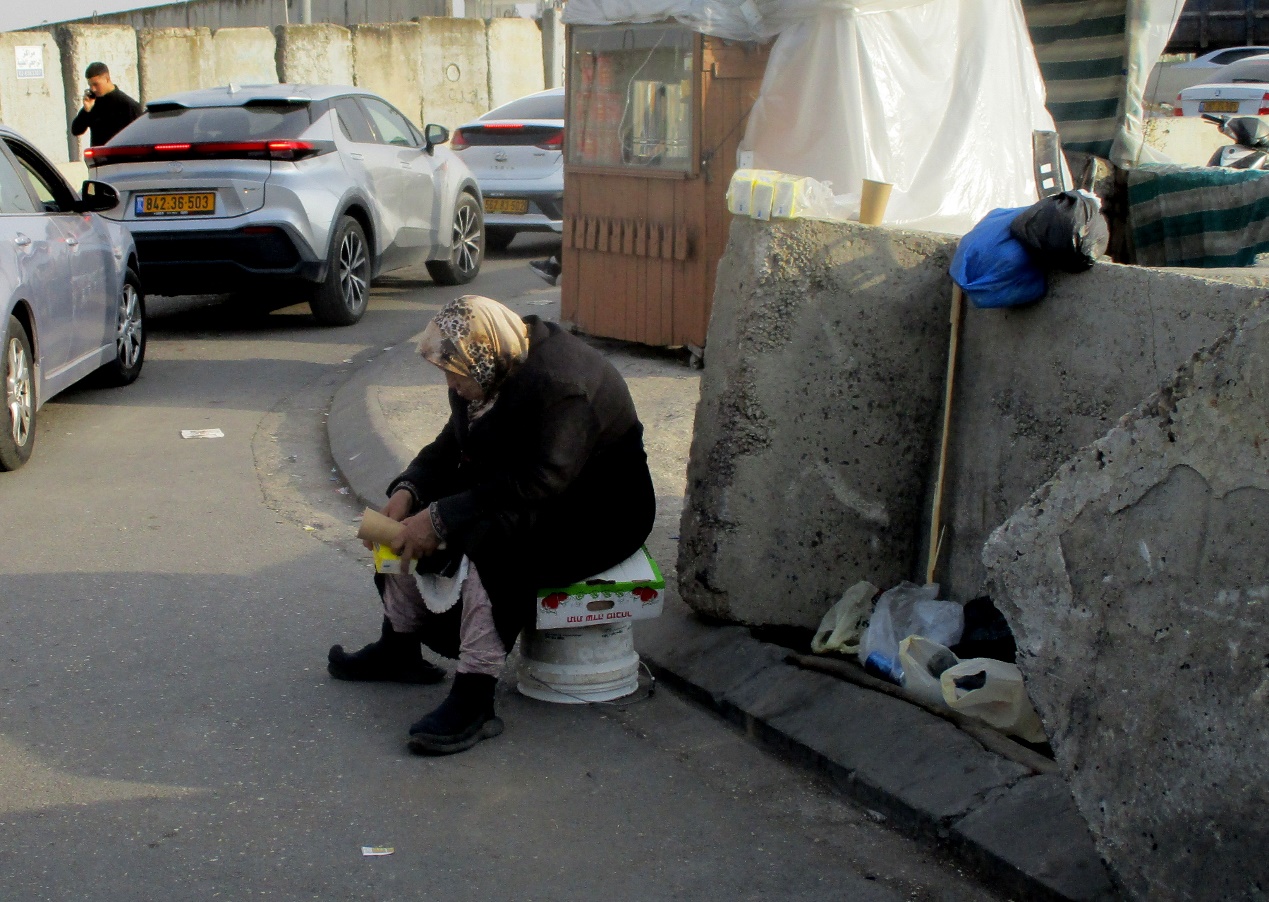 Tamar FleishmanOct-11-2026Qalandiya. Female Beggar
-
