
Qalandiya, Sun 20.12.09, Afternoon
:Two people were being transferred from one ambulance to the other at the same time
- – An elder man with a heart disease was being taken from the West Bank to Mokased hospital at East Jerusalem. He was accompanied by his wife. The an had to wait ONLY(!) 30 minutes until finally he received permission to pass to the other side of the checkpoint.
- – Medical crews were transferring a five year old child with cancer from the West Bank to East Jerusalem for treatment at Mokased hospital; he was accompanied by his mother. The co-ordinations were made before they headed on their way. Once arriving at the Qalandya checkpoint during the afternoon, those in charge of the inspections couldn't find the necessary documentations of the permits and the ambulance, along with its "passengers", was sent back.
Phone calls were made to all the hot lines. After a thorough inspection was made, the military representatives on the other end of the phone, confessed that they had lost the documents somewhere in the entangled computerized bureaucracy.
After driving to the checkpoint twice and sitting inside the ambulance for an irritating hour and a half, the child started making his way to the hospital.
The Great Hunter:
On Tuesday, the 5th of December at about noon, the authorities had a raided the peddlers' stands at the entrance to the checkpoint.
Three types of hunters surrounded their prey from three angles: municipal officials accompanied by police officers and guarded by armed civil body guards, arrived from the main gate (the western), from the exit gate of the governmental center (east) and from the vehicle checkpoint to the north.
Three people had been caught, their crooked carts and merchandise had been confiscated by the officials, under the pretext that they didn't have the required permits, and therefore they were felons:
-The first in line- the corn peddler. His boiler and gas tank were taken from him.
-Old Suliman was caught- he had sweets and cigarettes in his cart- "they took everything".
-And last- a young man which on his long cart he used to exhibit winter clothes for babies and woolen socks for all.
The lost merchandise is estimated to be worth thousands of Shekels.
On the next day these people went to the DCO offices (the local DCO) to find out what was going to happen with their stolen goods: no one knew what they were talking about. Someone called town hall on their behalf, they thought they might pay their fine and get their belongings back. But municipality wouldn't come to their rescue.
"It's all gone", said a person who had witnessed it all and told us about it.
In this kind of a place an empty spot fills up immediately: by the wall surrounding the checkpoint a stand for Kababs opened.
The owner, a young man, told us that while he was talking with us his "Israeli" wife was having their baby at Sa'ari Tzedek hospital. He, being too young and a resident of the Occupied Territories, it was prohibited from him to sit by her. "I have babies over the phone…" he said with a wink.
A book shop opened at the waiting shed- wooden boards were placed on the ground and books and work sheets for children on them.
Among the piles of trash that hasn't been clear off, two kids were throwing rotten oranges at cars that were passing by, and also at us who were observing and taking photos.
Is that how they practice towards their future in stone throwing?
Hundreds (perhaps thousands) of people were cramped up at the human-cages, in them and inside the lanes leading to the inspection post, even though both cages were open and three inspection posts were manned.
So, we stood there together with people who were heading home after a day of work, bodies all cramped together, waiting with a heart backing patience as though it was their destiny and not man's doing that they must wait for so long for the phlegmatic gaze and slow hand movement of the soldier behind the filthy glass, while she is invested in cracking up the nuts that are scattered all over the table and in which she finds more interest than in the time of those people, which is in her hands. 
While we were explaining to Cornelia that we called the entrance lane "human-cages", a man that stood next to us said that standing there made him feelt more like a mouse than a human being.
The way from the waiting shed to the inner checkpoint, which is 20 meter, took 30 minutes. It took exactly 35 minutes from there to the other side of the checkpoint- Jerusalem.
When I presented my ID to the soldier and she found out I was Jewish, she asked: "Why are you passing here?", "Because there is a passage", I answered, "She's from the Watch women", said the soldier next to her. "Oh, just a moment", the soldier muttered and started to enter my ID number into the comuter.
It was only after a thorough check up, which I couldn't understand its purpose, that she told me I could leave.
Is there a list of Kosher women which doesn't appear on the army's computer?
A story with a lesion at the end of it:
"Checkpoints are a good place to make friends", a Palestinian friend of mine once said when we were trapped together during a "Life Interruption" procedure.
While waiting to pass through the checkpoint we met Abas, a resident of El Jib, "Givon" (he said to us). He used to be the head of the village he lives in. His family has owned the lands there for generations- most of which had been confiscated by the state if Israel. He is studying for his PhD in the USA and was now on vacation. Abas told us about life during the land confiscation, he said that about a third of the young people at the village had been arrested by people from the Fatah for being supporters of the Hamas, he also told us that a couple of weeks earlier he met two of the DCO commanders: Yotam and Husam. They bragged before him about the expansions of the checkpoint and about the expected upgrading. Abas wasn't excited and said that the whole checkpoint should be taken down, in response they told him that: "We (the Israelis) spent millions trying to improve the place and you (the Palestinians) don't appreciate the effort.
In return Abas told them a story:
A couple of neighbors had a fight. One of them, the stronger one, grabbed a stick, shoved it in the mud and hit the other person with it. The one that got beaten up burst into tears from the pain. The person with the stick picked his stick up, cleaned it from the mud and hit his neighbor again. The hurt person could stop yelling.
"What kind of a person are you?", said the one who did the beating, "you are never content!"
As the Babylonian Talmod says: "VeIdach, Zil Gmora…" Sabbat, page 31a
(meaning: This is the essence- The rest you must go and study).
Qalandiya Checkpoint / Atarot Pass (Jerusalem)
See all reports for this place-
Click here to watch a video from Qalandiya checkpoint up to mid 2019 Three kilometers south of Ramallah, in the heart of Palestinian population. Integrates into "Jerusalem Envelope" as part of Wall that separates between northern suburbs that were annexed to Jerusalem in 1967: Kafr Aqab, Semiramis and Qalandiya, and the villages of Ar-Ram and Bir Nabala, also north of Jerusalem, and the city itself. Some residents of Kafr Aqab, Semiramis and Qalandiya have Jerusalem ID cards. A terminal operated by Israel Police has functioned since early 2006. As of August 2006, northbound pedestrians are not checked. Southbound Palestinians must carry Jerusalem IDs; holders of Palestinian Authority IDs cannot pass without special permits. Vehicular traffic from Ramallah to other West Bank areas runs to the north of Qalandiya. In February 2019, the new facility of the checkpoint was inaugurated aiming to make it like a "border crossing". The bars and barbed wire fences were replaced with walls of perforated metal panels. The check is now performed at multiple stations for face recognition and the transfer of an e-card. The rate of passage has improved and its density has generally decreased, but lack of manpower and malfunctions cause periods of stress. The development and paving of the roads has not yet been completed, the traffic of cars and pedestrians is dangerous, and t the entire vicinity of the checkpoint is filthy. In 2020 a huge pedestrian bridge was built over the vehicle crossing with severe mobility restrictions (steep stairs, long and winding route). The pedestrian access from public transport to the checkpoint from the north (Ramallah direction) is unclear, and there have been cases of people, especially people with disabilities, who accidentally reached the vehicle crossing and were shot by the soldiers at the checkpoint. In the summer of 2021, work began on a new, sunken entrance road from Qalandiya that will lead directly to Road 443 towards Jerusalem and Tel Aviv. At the same time, the runways of the old Atarot airport were demolished and infrastructure was prepared for a large bus terminal. (updated October 2021)
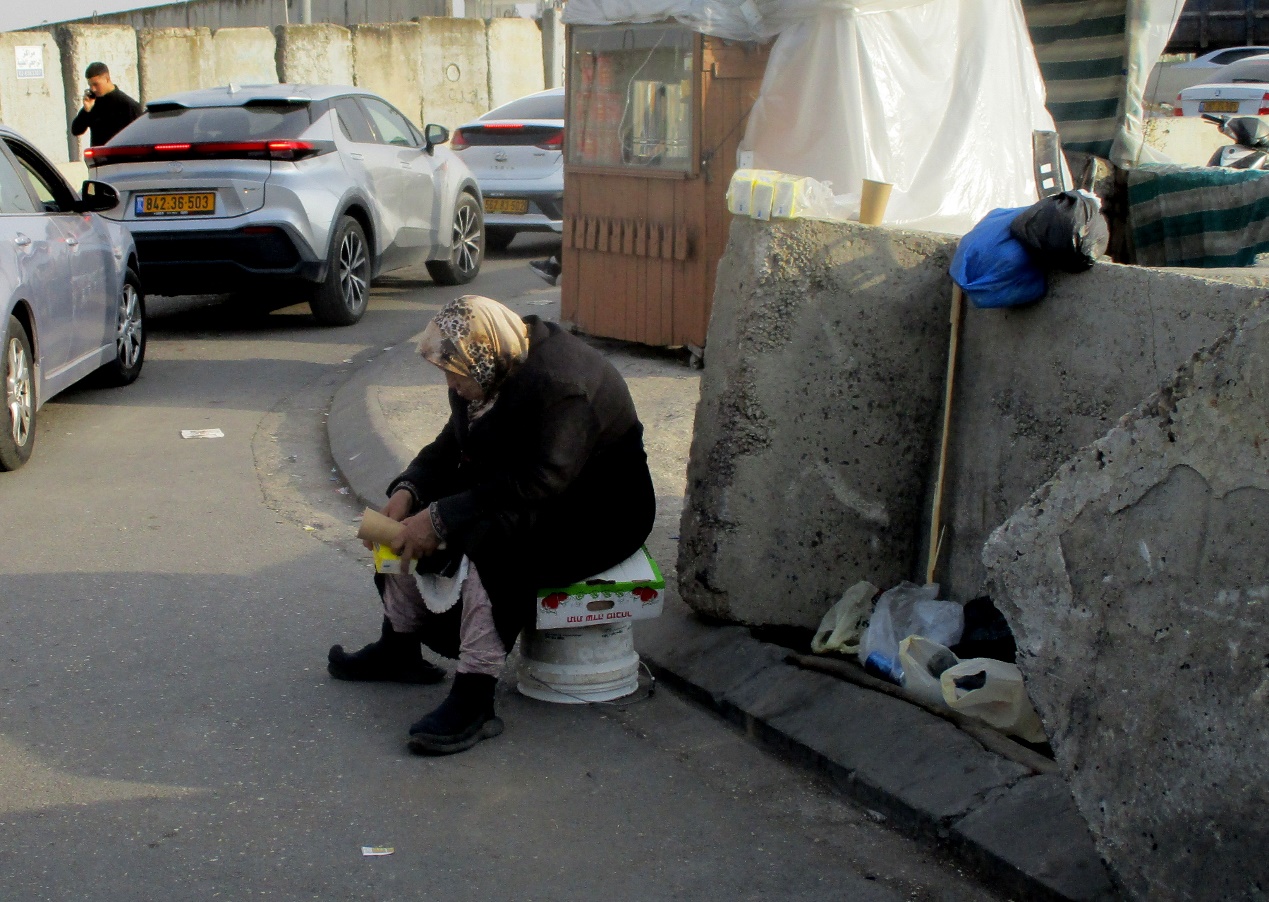 Tamar FleishmanOct-11-2026Qalandiya. Female Beggar
-
