
Qalandiya, Sun 26.7.09, Afternoon
Guest: Merian Hock (an American reporter)
Qalandiya Checkpoint 
Many signs in Hebrew (the first ones) and Arabic.Apparently, they aren't expecting any tourists at this border passage, and have also forgotten that English is one of the official languages.
A sign that says "Judea and Samaria" was directing those passing towards the occupied territories. It seems that in tune with the decision of the Minister of Transportation (Israel Katz) to Judiaz the sign on the Israeli roads, they have decided to also Judaize Palestine.
15:30- The gates leading in to the DCL were locked several minutes before the official closing time.
A person that came out of the offices with a large pile of documents in his hands and a disappointed look on his face, wanted to shake our hand as a sign of appreciation: "Even though you aren't able to improve our situation, you never stop trying. It's very important", he said.
This person lives in Ramala, he owns a company that imports computer appliances; he has 40 employees and he travels all around the world- aside for Israel, that is. He isn't allowed to enter Israel.
He wanted to try to annul the prevention, and that's why he went to the DCL. He was asked to come to the DCL for a meeting on that day. When he arrived, with all his papers, he was told to leave and come back after two weeks.
He is going to be abroad at the fixed date, he doesn't mean to continue being an instrument in the hands of the system, but plans to go on and fight for his freedom of movement and appeal to the High Court of Justice.
16:15- There were two ambulances at the lot on the inner side of the checkpoint (one came from Israel and the other from the occupied Territories), they were transferring the body of a woman who had died two days earlier. She came from the Gaza strip for an operation in her heart, but her heart failed, and her body had to be sent back to her family.
Three ambulances were going to be needed for this trip back home, each one from a different authority, and the body was going to be inspected in each stop, to see whether she was actually a bomb and not a died woman. A sign of the lack of trust on both sides.
Atara Bir Zeit: 
If it looks like a checkpoint- the chain of spikes was rolled up and placed behind the cemented post, the pillbox was standing like a phallic sentry on the highest spot, the lights were turned on even though the sun was blazing in the sky.
And if it sounds like a checkpoint- from a distance we could hear the soldiers yelling.
Even if all the media and all the newspaper say the checkpoint has been taken down- it is still a checkpoint.
- – The soldiers, some were seen standing behind the pillbox window and the others hurried to hid from us (or from our camera), who were inside the confined area yelled out to us, and then later started using the megaphone.
Selected quotes:
-"Here they are, those women from 'Peace Now' just arrive…"
– "Yalla, come on, get lost. What is there for you to take a photo of?…"
-" Yalla, go home… Yalla, go home to your kids, your grandkids… Yalla, go on…".
-" This is a military zone, you can't be here!"
-"This is a military zone, you aren't allowed to take pictures!"
And the best one:
-"Isn't it enough you made an article on us?!- You want another one?- We're not even you another one!…"
Qalandiya Checkpoint / Atarot Pass (Jerusalem)
See all reports for this place-
Click here to watch a video from Qalandiya checkpoint up to mid 2019 Three kilometers south of Ramallah, in the heart of Palestinian population. Integrates into "Jerusalem Envelope" as part of Wall that separates between northern suburbs that were annexed to Jerusalem in 1967: Kafr Aqab, Semiramis and Qalandiya, and the villages of Ar-Ram and Bir Nabala, also north of Jerusalem, and the city itself. Some residents of Kafr Aqab, Semiramis and Qalandiya have Jerusalem ID cards. A terminal operated by Israel Police has functioned since early 2006. As of August 2006, northbound pedestrians are not checked. Southbound Palestinians must carry Jerusalem IDs; holders of Palestinian Authority IDs cannot pass without special permits. Vehicular traffic from Ramallah to other West Bank areas runs to the north of Qalandiya. In February 2019, the new facility of the checkpoint was inaugurated aiming to make it like a "border crossing". The bars and barbed wire fences were replaced with walls of perforated metal panels. The check is now performed at multiple stations for face recognition and the transfer of an e-card. The rate of passage has improved and its density has generally decreased, but lack of manpower and malfunctions cause periods of stress. The development and paving of the roads has not yet been completed, the traffic of cars and pedestrians is dangerous, and t the entire vicinity of the checkpoint is filthy. In 2020 a huge pedestrian bridge was built over the vehicle crossing with severe mobility restrictions (steep stairs, long and winding route). The pedestrian access from public transport to the checkpoint from the north (Ramallah direction) is unclear, and there have been cases of people, especially people with disabilities, who accidentally reached the vehicle crossing and were shot by the soldiers at the checkpoint. In the summer of 2021, work began on a new, sunken entrance road from Qalandiya that will lead directly to Road 443 towards Jerusalem and Tel Aviv. At the same time, the runways of the old Atarot airport were demolished and infrastructure was prepared for a large bus terminal. (updated October 2021)
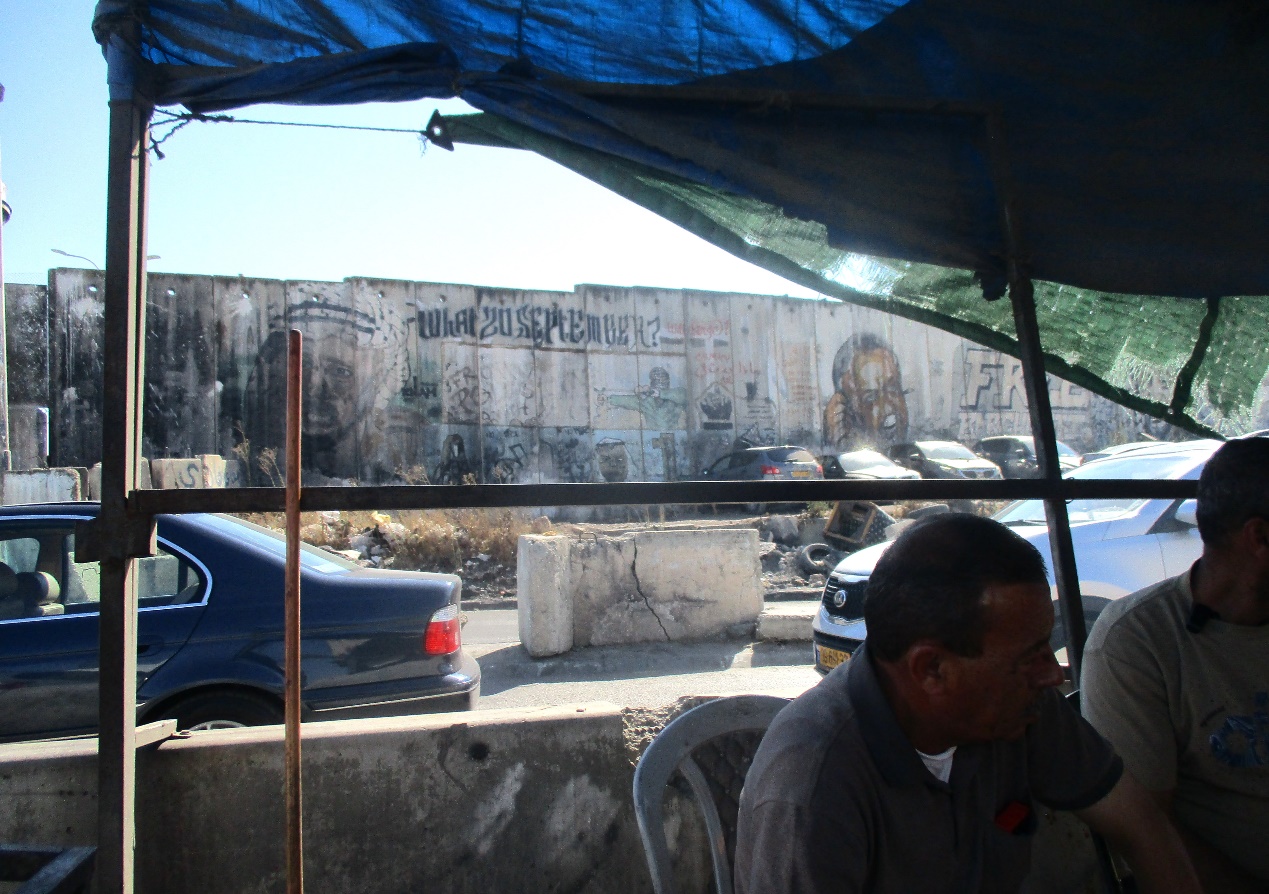 Tamar FleishmanJul-21-2026Qalandiya. Conversation in the shadow of the wall
-
