
Qalandiya, Sun 9.8.09, Afternoon
New writings on the wall: On the wall closing the parking lot in front of the checkpoint was an inscription in Arabic reading: "Return" (our translator said there was a misspelling). 

- Near the pillbox, on top of the gratifies that read: "Why" and "Hip Hop", which coved the face of Laila Haled and the inscription "I am not a terrorist", was a drawing of a tree (an olive tree perhaps) that had its roots ingrained on a tank that upon its turret was a man waving the Palestinian flag and to the write the word "Palestine".
And so: Layer upon layer upon layer… until the wall falls.
- In front of the refugee camp was a drawing of a bottle of poison and on it was written: Racism
- On the same wall was variation on Monk's "Scream".
 There is no other place more appropriate for screaming, this is where the weapon bestows the right to oppress and the wall of racism stands high and mighty.
Qalandia checkpoint
According to A's papers he lives in the Gaza Strip but actually lives in the vicinity of Qalandia checkpoint. He asked us whether he could change his residency in his ID. What he really wanted was to share with us this burden, since he already knew there was nothing that could be done.
A told us that ever since he had left the Gaza Strip (over ten years ago) he had never paid a visit there. He had once contacted the Israeli authority and requested that they change the address on his ID, and was told that he must first return to Gaza and only then would they consider his request. But A knows that if he were to return to Gaza he would be trapped there and separated from his wife and children.
A's story is another proof that we haven't really "left Gaza".
As long as Israel is still the one to run the bureaucratic system in the strip and it knows of every single person to be born or die, the disengagement was nothing more then a delusion.
Just before the lanes was a group of young people, men and women who were residents of the Gaza strip. They conference that had went to had ended and they now wanted to return home. They weren't permitted to pass. But soon enough with the good will of the commander the rules were a bit bended and they were allowed to pass. The prohibition was the result of a mistake that was printed to their permits.
The commander of the checkpoint- superintendent Abu-Hatzera, had ordered the opening of an additional lane for the group and sent Tomer (an officer) to help. Along side these people we passed to the other side in less then half an hour since we had met them. We said goodbye to these young and cheerful people with a good and optimistic feeling. When they arrived home (during the evening), one of them had sent me a text message:
"I am in Gaza and still in one piece, thank u for everything…"
When we went back to the northern side of the checkpoint, there were about a hundred people crowded in the lanes and the line wasn't moving. A phone call to Tomer was enough to get the lanes activated until the long and curving line disappeared.
Qalandiya Checkpoint / Atarot Pass (Jerusalem)
See all reports for this place-
Click here to watch a video from Qalandiya checkpoint up to mid 2019 Three kilometers south of Ramallah, in the heart of Palestinian population. Integrates into "Jerusalem Envelope" as part of Wall that separates between northern suburbs that were annexed to Jerusalem in 1967: Kafr Aqab, Semiramis and Qalandiya, and the villages of Ar-Ram and Bir Nabala, also north of Jerusalem, and the city itself. Some residents of Kafr Aqab, Semiramis and Qalandiya have Jerusalem ID cards. A terminal operated by Israel Police has functioned since early 2006. As of August 2006, northbound pedestrians are not checked. Southbound Palestinians must carry Jerusalem IDs; holders of Palestinian Authority IDs cannot pass without special permits. Vehicular traffic from Ramallah to other West Bank areas runs to the north of Qalandiya. In February 2019, the new facility of the checkpoint was inaugurated aiming to make it like a "border crossing". The bars and barbed wire fences were replaced with walls of perforated metal panels. The check is now performed at multiple stations for face recognition and the transfer of an e-card. The rate of passage has improved and its density has generally decreased, but lack of manpower and malfunctions cause periods of stress. The development and paving of the roads has not yet been completed, the traffic of cars and pedestrians is dangerous, and t the entire vicinity of the checkpoint is filthy. In 2020 a huge pedestrian bridge was built over the vehicle crossing with severe mobility restrictions (steep stairs, long and winding route). The pedestrian access from public transport to the checkpoint from the north (Ramallah direction) is unclear, and there have been cases of people, especially people with disabilities, who accidentally reached the vehicle crossing and were shot by the soldiers at the checkpoint. In the summer of 2021, work began on a new, sunken entrance road from Qalandiya that will lead directly to Road 443 towards Jerusalem and Tel Aviv. At the same time, the runways of the old Atarot airport were demolished and infrastructure was prepared for a large bus terminal. (updated October 2021)
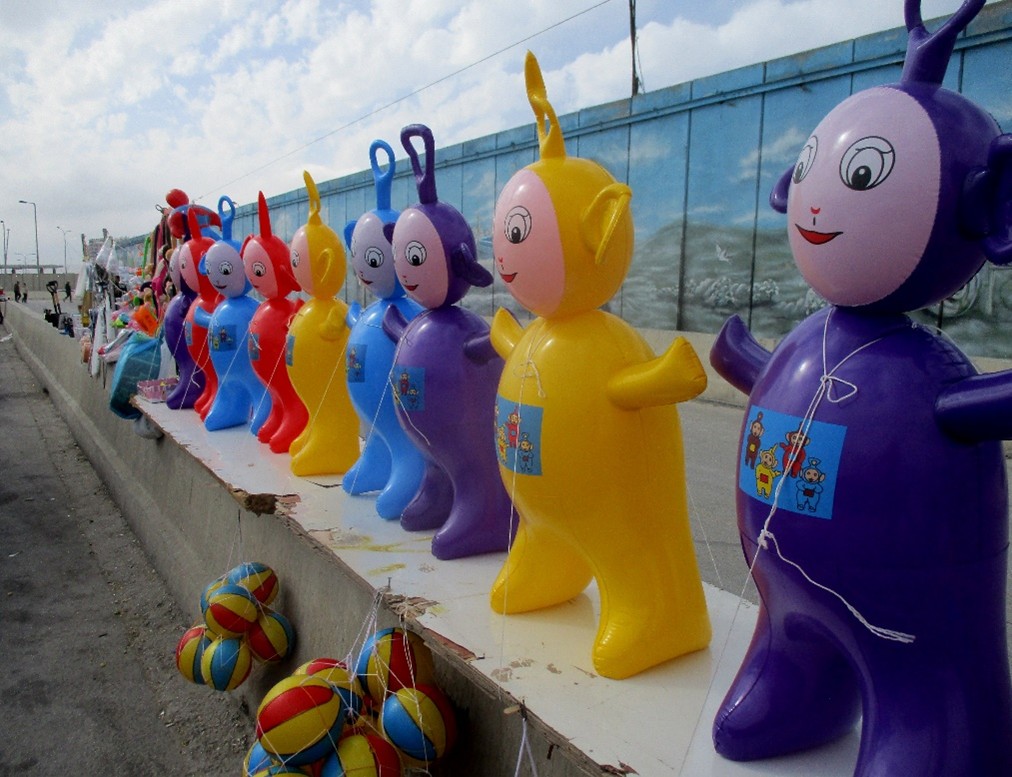 Tamar FleishmanApr-26-2026Qalandiya. Things you see on the way
-