
Qalandiya: the gate aimed for prams is locked and remains locked
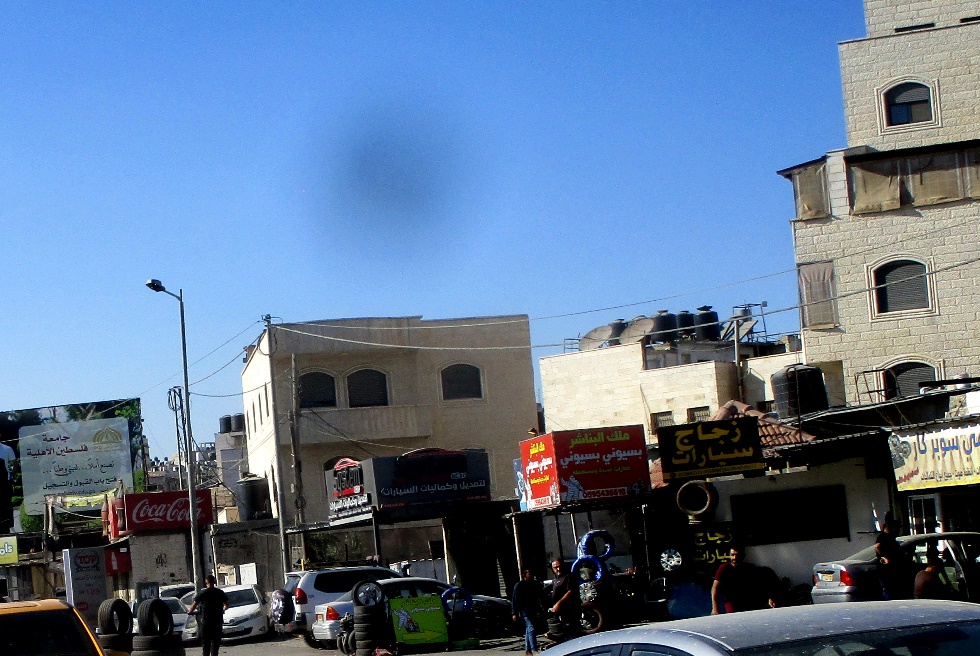
I was waiting for Abed at Ameer’s quebab stand to return his things left at the Ramla police station where he had been detained for three days after being caught looking for work without having a permit. Suddenly, from nowhere, an explosion hit the air and made one’s heart tremble.
What began as a single explosion and a black cloud hovering over the refugee camp roof tops became sounds of shot volleys and more explosions a few minutes later.
“It’s the army” people said, telling me that 5 hours earlier soldiers had already raided Qalandiya refugee camp and this was what they do, fire their guns and explode stuff that turns into fire over roof tops.
When the shooting sounds got louder and scarier, I was east of there, standing amidst children. Fear took over and we scattered in all directions.
On my way back, in the labyrinth leading to the checkpoint, I joined a young woman with a baby.
When we arrived at the entrance to the checkpoint the mother took part the pram, held the carrying basket with the baby while carried the metal basis of the pram.
Passage was difficult. I managed eventually only by twisting and pushing to cross the metal turnstile with the basis of the pram.
True, there is a gate aimed for prams but it was locked. I tried to attract the attention of the soldier sitting in the air-conditioned space to push the button and open the gate, but he only shrugged and nodded with the familiar gesture meaning ‘go on’. We did. I placed the folded basis in the magnetometer while the mother took out the infant from its basket, placed it in my arms and passed the seat under the metal detector. They were both ‘kosher’ and posed no threat to state security. Still, we had two more turnstiles to cross. Again the crowding, the acrobatics of passing, the soldiers’ opaque eyes behind their secured windows, seeing and not pushing the button that would open the gate meant especially for prams.
The question that didn’t let go then and continues to harass me is why they exist at all, if in real time they remain locked?
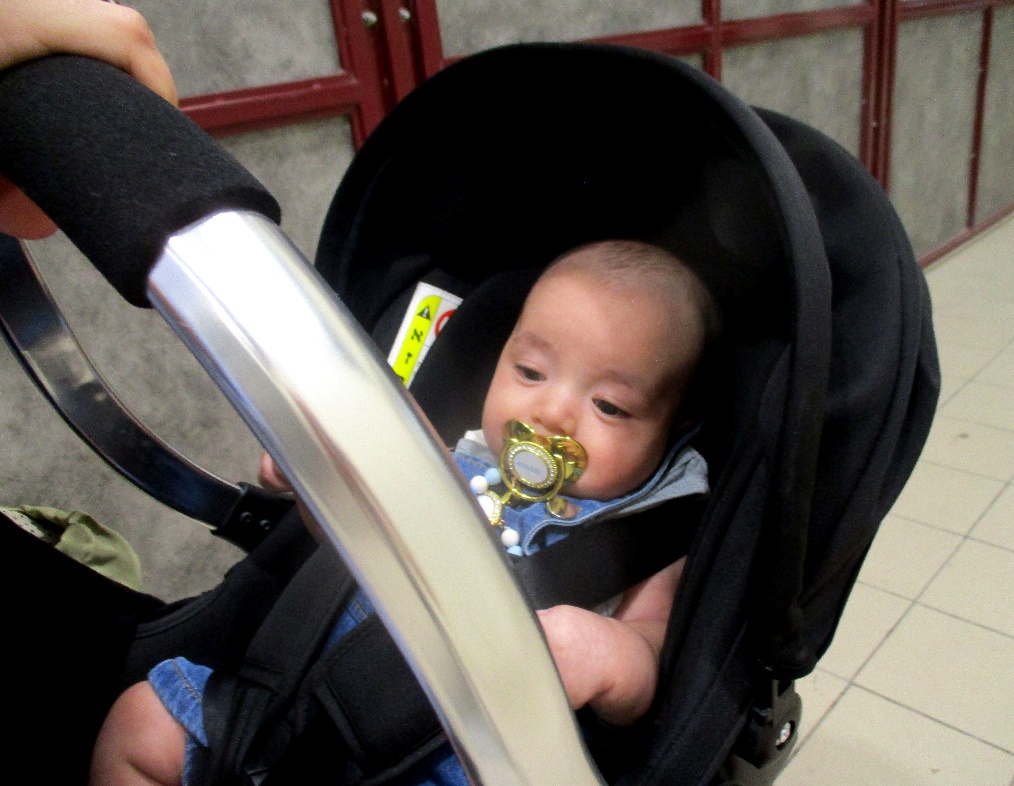
When we took our leave and Tamara (the mother) and her baby continued on their way and I went on to my car, I remembered that two hours earlier, in front of the refugee camp, an acquaintance asked me if I see the pictures of dying babies in Gaza, and I could not help thinking about the baby I had just now held in my arms, healthy and well-groomed, a baby who is not yet aware of the fact that he, like his parents and the rest of his family are devoid of any rights or freedom.
Location Description
Qalandiya Camp
See all reports for this place-
Qalandiya Camp The camp was founded east of the village of Qalandiya in 1949 and became inhabited by Palestinian refugees from Jerusalem and the surrounding villages whose homes had remained on the Israeli side of the armistice lines. The camp was included in Jerusalem’s municipal jurisdiction after 1967, and since the erection of the Separation Wall has been disconnected from the city and become no-man’s-land between Jerusalem and Ramallah. It numbers about 10,000 inhabitants and many of them hold a Jerusalem ID. It is considered one of the most difficult camps both from a criminal and a ‘security’ standpoint, and also one of the most neglected and impoverished. It suffers from poverty, neglect, crime, illegal construction, and the lack of proper municipal services. Terrorist attackers have come from there, and it often seems ‘security’ incidents, numerous incursions, and arrests, including the killing of youths following stone-throwing.
-
Qalandiya Checkpoint / Atarot Pass (Jerusalem)
See all reports for this place-
Click here to watch a video from Qalandiya checkpoint up to mid 2019 Three kilometers south of Ramallah, in the heart of Palestinian population. Integrates into "Jerusalem Envelope" as part of Wall that separates between northern suburbs that were annexed to Jerusalem in 1967: Kafr Aqab, Semiramis and Qalandiya, and the villages of Ar-Ram and Bir Nabala, also north of Jerusalem, and the city itself. Some residents of Kafr Aqab, Semiramis and Qalandiya have Jerusalem ID cards. A terminal operated by Israel Police has functioned since early 2006. As of August 2006, northbound pedestrians are not checked. Southbound Palestinians must carry Jerusalem IDs; holders of Palestinian Authority IDs cannot pass without special permits. Vehicular traffic from Ramallah to other West Bank areas runs to the north of Qalandiya. In February 2019, the new facility of the checkpoint was inaugurated aiming to make it like a "border crossing". The bars and barbed wire fences were replaced with walls of perforated metal panels. The check is now performed at multiple stations for face recognition and the transfer of an e-card. The rate of passage has improved and its density has generally decreased, but lack of manpower and malfunctions cause periods of stress. The development and paving of the roads has not yet been completed, the traffic of cars and pedestrians is dangerous, and t the entire vicinity of the checkpoint is filthy. In 2020 a huge pedestrian bridge was built over the vehicle crossing with severe mobility restrictions (steep stairs, long and winding route). The pedestrian access from public transport to the checkpoint from the north (Ramallah direction) is unclear, and there have been cases of people, especially people with disabilities, who accidentally reached the vehicle crossing and were shot by the soldiers at the checkpoint. In the summer of 2021, work began on a new, sunken entrance road from Qalandiya that will lead directly to Road 443 towards Jerusalem and Tel Aviv. At the same time, the runways of the old Atarot airport were demolished and infrastructure was prepared for a large bus terminal. (updated October 2021)
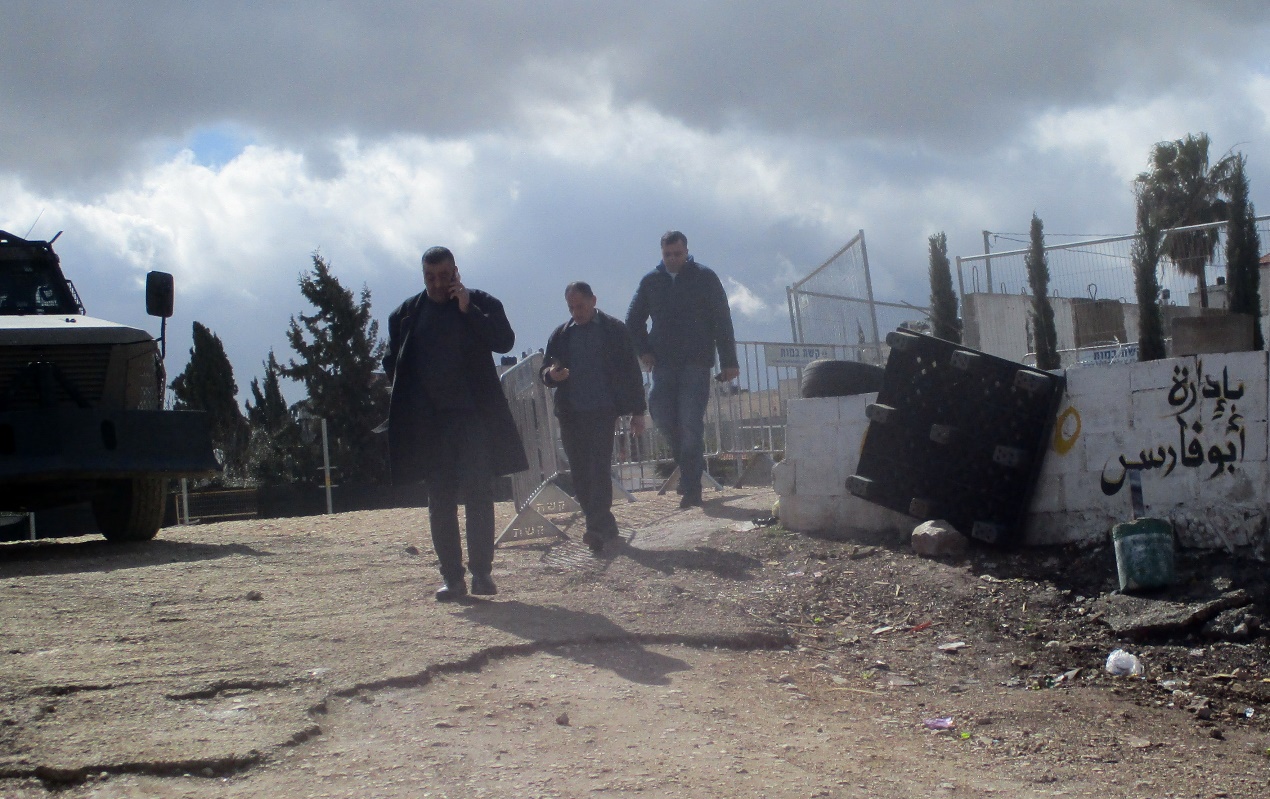 Tamar FleishmanFeb-27-2026Qalandiya: On the way to prayer
-