
Qalandiya: Third Friday of the Ramdan month
On the way there, with a fog wrapping up the world, I thought that perhaps they – who know most chances are they would not be allowed to cross, they who know they will be “greeted” with contempt and even violence, they who see the cold and wet weather – might not even come to the place where they meet armed men, guns and restrictions.
But as I parked in the Atarot Industrial Zone and took off on my long hike, coping with the wind and rainy spray on the road leading up to the checkpoint, I realized that this was it, that I and especially they would come.


Indeed, in spite of the limitations and weather and knowledge of the violent and humiliating treatment they would get, they came. There were not thousands of people as in former years, but there was a presence of elderly persons filled with hope. Most of those arriving were sent back down the hill.


The many idle armed persons improvised hunting actions on the sidelines, not visible in either the former two weeks or previous years:
Three of them, two guys and a girl, went down with their protective and assault gear from the hilltop and stopped to thoroughly inspect youngsters on their way who didn’t even consider getting to the checkpoint.
First they got their hands on a young man who came out of his father’s car in order to take a tik-tok.
One of the armed men took away his phone and entered it to check its content (an act forbidden by Israeli law, but what has that to do with the conduct of the occupation?), while the two others stood facing the young man with pointed guns.

The guy’s mother hurried to join, tried to protect her son and immediately got yelled at to get back to the car. When she wasn’t answered and the weapon was pointed at her, I went to her, hugged her shoulders and whispered in her ear, begging her to come with me. Thus, the two that were as one body backed off all the way to the car where her husband was sitting, as his disability prevented him from coming out.
When the guy was checked and no incriminating evidence was found, the family was released, the son and his parents drove to her home in the Old City and the soldiers – turned to their next victim, having him go through everything his predecessor did plus taking a photo of his face.

Driving back from Palestine to Jerusalem, next to the first checkpoint, I met a man on his way in the opposite direction, from the checkpoint to Palestine. We stopped side by side for a chat.
The man who lives in Nablus said he took the trouble to get all the necessary documents, and wanting to pray in Al Aqsa he exited his home at dawn, and drove the way, lasting three and a half hours, to Qalandiya Checkpoint. He crossed the first two inspection posts, but arriving at the post inside the checkpoint itself, he was stopped.
Why? He is blacklisted.
The man said he was clean, never had any problems. “I never threw even a single stone” he said in his defense, but they held his body tight and pushed him out of the compound.
Coming out of the inferno, Primo Levy wrote the following:
“Every time we were forced to witness an injustice or lower our heads at it – this was the shame that Germans never knew, which the just man feels facing sin that another has committed, and his conscience torments him because this sin exists and has entered the world of existing things without being obliterated, and because his goodwill is nill or extremely reduced and he could not protect anyone”.
I quote Primo Levy who is my guide.
I am not a just woman but I do not cooperate with the state’s crimes and feel a great shame.
Shame about what is being done in my name as well in Gaza and in the West Bank in these dark times, days in which a shining black flag waves above a political survival war, over the normalization of evil and injustices that keep crossing more and more red lines every day, and that the media activates the kind of selection about what it might tell and show in order not to irritate the powers that be.
Location Description
Qalandiya Checkpoint / Atarot Pass (Jerusalem)
See all reports for this place-
Click here to watch a video from Qalandiya checkpoint up to mid 2019 Three kilometers south of Ramallah, in the heart of Palestinian population. Integrates into "Jerusalem Envelope" as part of Wall that separates between northern suburbs that were annexed to Jerusalem in 1967: Kafr Aqab, Semiramis and Qalandiya, and the villages of Ar-Ram and Bir Nabala, also north of Jerusalem, and the city itself. Some residents of Kafr Aqab, Semiramis and Qalandiya have Jerusalem ID cards. A terminal operated by Israel Police has functioned since early 2006. As of August 2006, northbound pedestrians are not checked. Southbound Palestinians must carry Jerusalem IDs; holders of Palestinian Authority IDs cannot pass without special permits. Vehicular traffic from Ramallah to other West Bank areas runs to the north of Qalandiya. In February 2019, the new facility of the checkpoint was inaugurated aiming to make it like a "border crossing". The bars and barbed wire fences were replaced with walls of perforated metal panels. The check is now performed at multiple stations for face recognition and the transfer of an e-card. The rate of passage has improved and its density has generally decreased, but lack of manpower and malfunctions cause periods of stress. The development and paving of the roads has not yet been completed, the traffic of cars and pedestrians is dangerous, and t the entire vicinity of the checkpoint is filthy. In 2020 a huge pedestrian bridge was built over the vehicle crossing with severe mobility restrictions (steep stairs, long and winding route). The pedestrian access from public transport to the checkpoint from the north (Ramallah direction) is unclear, and there have been cases of people, especially people with disabilities, who accidentally reached the vehicle crossing and were shot by the soldiers at the checkpoint. In the summer of 2021, work began on a new, sunken entrance road from Qalandiya that will lead directly to Road 443 towards Jerusalem and Tel Aviv. At the same time, the runways of the old Atarot airport were demolished and infrastructure was prepared for a large bus terminal. (updated October 2021)
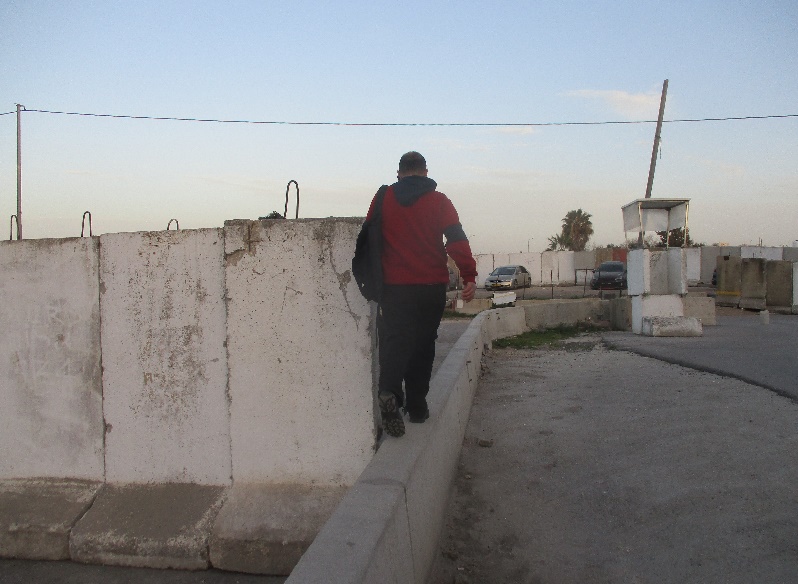 Tamar FleishmanFeb-16-2026Qalandiya CP: shortcut
-