
Qalandiya, Tue 1.11.11, Morning
For the past several years, our team has been going to Wadi Naar every Tuesday afternoon. Since our shifts there have been so uneventful (with few exceptions) and since there was no shift assigned to Qalandia, we decided to go to Qalandiya and see what was happening there.
We arrived at about 2:00 P.M and there was already great congestion at the traffic circle. All kinds of vehicles of all sizes converged on the narrow area of the traffic circle, trying to make their way to Ramallah.
We crossed over to the Palestinian side, chatted with some of the drivers, and walked around. At 2:45, we headed toward the cages containing those heading back toward Jerusalem. Most of the people in the area were returning from the Israel side. Very few people were joining the 2 lines going in the other direction, but those lines were scarcely budging. When we first got there, it took a full five minutes before anyone could get through. When the turnstile moved, several people pushed through. Only the first one was allowed into the next room. The others were forced back into the turnstile and had to wait. We kept hearing yells of “Wahad, Wahad”. In the middle of this confused mess, one man took charge and made everyone allow a woman carrying a child go through. He later did the same for an elderly woman with a cane
It took Chana another 15 minutes until she was pushed through together with another woman. As she entered the hall, a woman soldier (who obviously replaced the one there previously) screamed “Wahad. Wahad “ to Chana and made her go back into the other room. She then screamed in Hebrew “What’s so hard for you to understand?” When Chana came to the window, the soldier started screaming at her and she became totally perplexed. She didn’t know what was expected of her, took her i.d. and when she tried to exit, found the turnstile locked. She went back to the window and asked to be let out. The woman soldier screamed at her for not putting her purse through the conveyor belt. Chana put the purse through the conveyor belt and returned to the window. Now, adding insult to injury, she started laughing at Chana. The whole thing was obviously a big joke to her. She then asked Chana where she lived and Chana replied “in an Old Age Home” and then gave her the address. That brought on some more laughs. As Chana was finally allowed to leave, the soldier yelled out to her, “Did you ever hear of Gilad Shalit?” Chana did not tell her, but it should be noted that Chana, who is Sabbath observant, walked almost every Shabbat, in all kinds of weather, from her home in Baqaa to the Shalit tent in Rehavia in order to be with the Shalit family for Shabbat.
When she finally emerged from her ordeal, Chana was shaking. The ugliness of it all, the gratuitous humiliation, the mocking of an elderly woman, these are all the dividends of the occupation and what it entails.
Unlike the Palestinians who stoically endure this kind of treatment on a daily basis, we at least have the opportunity to write about it and hope that someone, someplace will give those soldiers managing the checkpoints a crash course in menschlichkeit
.
Qalandiya Checkpoint / Atarot Pass (Jerusalem)
See all reports for this place-
Click here to watch a video from Qalandiya checkpoint up to mid 2019 Three kilometers south of Ramallah, in the heart of Palestinian population. Integrates into "Jerusalem Envelope" as part of Wall that separates between northern suburbs that were annexed to Jerusalem in 1967: Kafr Aqab, Semiramis and Qalandiya, and the villages of Ar-Ram and Bir Nabala, also north of Jerusalem, and the city itself. Some residents of Kafr Aqab, Semiramis and Qalandiya have Jerusalem ID cards. A terminal operated by Israel Police has functioned since early 2006. As of August 2006, northbound pedestrians are not checked. Southbound Palestinians must carry Jerusalem IDs; holders of Palestinian Authority IDs cannot pass without special permits. Vehicular traffic from Ramallah to other West Bank areas runs to the north of Qalandiya. In February 2019, the new facility of the checkpoint was inaugurated aiming to make it like a "border crossing". The bars and barbed wire fences were replaced with walls of perforated metal panels. The check is now performed at multiple stations for face recognition and the transfer of an e-card. The rate of passage has improved and its density has generally decreased, but lack of manpower and malfunctions cause periods of stress. The development and paving of the roads has not yet been completed, the traffic of cars and pedestrians is dangerous, and t the entire vicinity of the checkpoint is filthy. In 2020 a huge pedestrian bridge was built over the vehicle crossing with severe mobility restrictions (steep stairs, long and winding route). The pedestrian access from public transport to the checkpoint from the north (Ramallah direction) is unclear, and there have been cases of people, especially people with disabilities, who accidentally reached the vehicle crossing and were shot by the soldiers at the checkpoint. In the summer of 2021, work began on a new, sunken entrance road from Qalandiya that will lead directly to Road 443 towards Jerusalem and Tel Aviv. At the same time, the runways of the old Atarot airport were demolished and infrastructure was prepared for a large bus terminal. (updated October 2021)
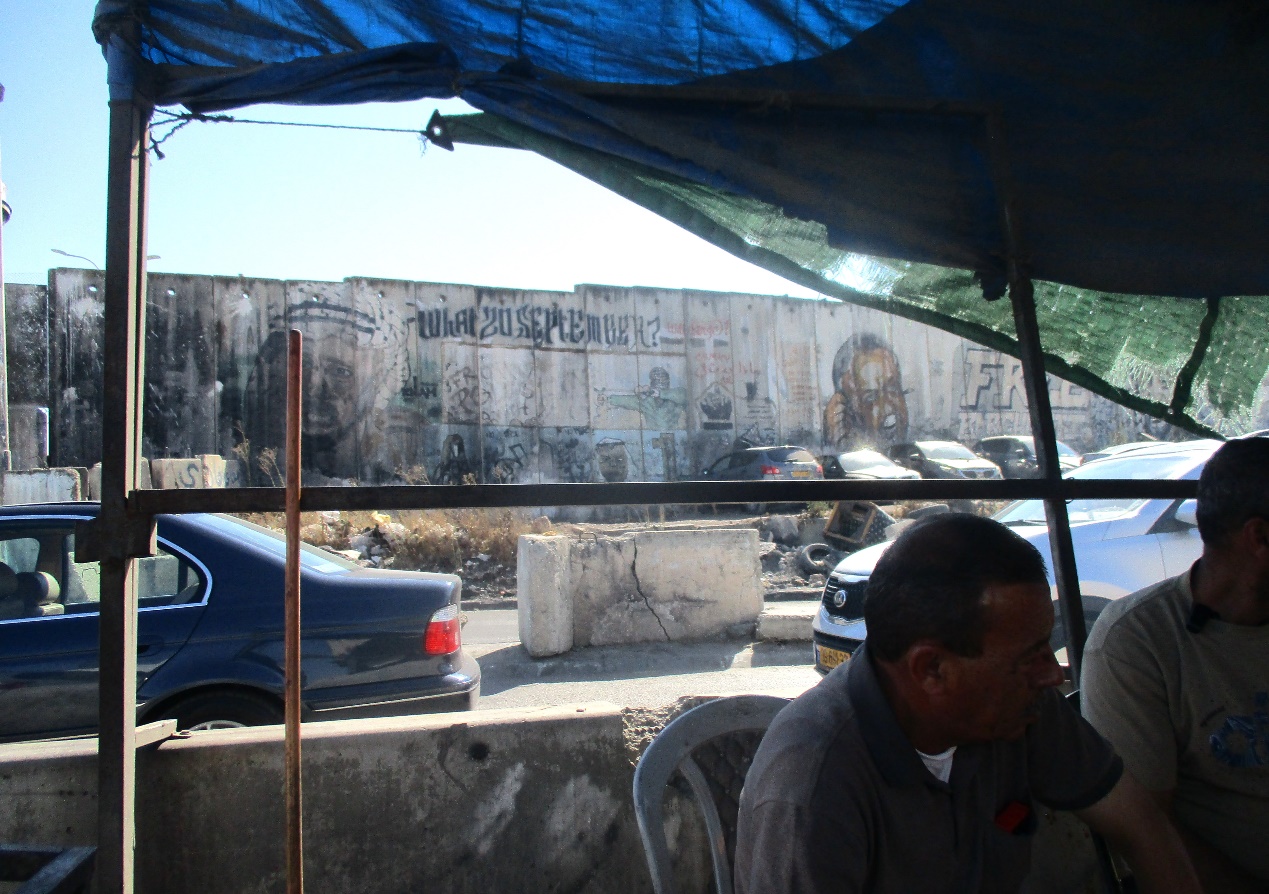 Tamar FleishmanJul-21-2026Qalandiya. Conversation in the shadow of the wall
-
