
Qalandiya, Wed 16.6.10, Afternoon
Summary
What has a British comic opera, got to do with Qalandiya? Not much, although, at one level, British politics and institutions are satirized in "The Mikado" in a way that might be helpful in this part of the world. Today, at Qalandiya, no satire, but a cruel and harsh reality for "three little maids from school." There, three Palestinian sisters could not be "filled to the brim with girlish glee," since they live under the cruelty of Occupation: nothing can be a "source of fun," and life is certainly not the "joke that's just begun" as it is for the threesome in The Mikado. Other than that, yes, there were three little maids today at Qalandia, ranging in age from ten to fourteen, and they could not go to see their father….
Route 443
At the end of 2009, the Supreme Court revoked the ban on Palestinians traveling or walking on Route 443, ruling it was unauthorized and disproportional. Yet the facts on the ground are very different. Our shift today found thorough security checks before being allowed to access the highway, a multitude of new fencing, barbed wire and all manner of obstacles, such as gates and concrete blocks, as well as new checkpoints and hills bristling with communication antennae. Moreover, the permission granted by the IDF for Palestinians from villages alongside 443, which cuts through Palestinian territory, a fact oblivious to the thousands of Israelis motorists whizzing along, unaware of what's new, is for driving an extremely limited stretch of the roadway — not more than 3 kms. if that, to a new checkpoint. Just before this checkpoint is a side road which indicates a way to Ramallah as well as a sign in Hebrew only, directed at Israelis: "if you get up to here, you've made a mistake!" In any case, no Palestinian can use Route 443 to access Jerusalem or Ramallah. So much for the Supreme Court's success.
Qalandiya
13:10 — only two booths are open. And there's a long line of people who've been waiting, as they tell us, for a long, long time. Inside the bulletproof "cage" which houses two soldiers working the first of the several turnstiles that need to be negotiated at this infamous terminal, we see a male and a female solider joking with each other but certainly doing nothing to relieve the line which lengthens by the minute. Men, women, and children are quiet but frustrated.
13:30 — twenty minutes after our arrival and midst a series of phone calls that we make, K. the DCO representative arrives; one of the two soldiers presses a button and the line begins to move. K.'s response to our complaints of the line not moving: "The soldiers were eating… they, too, are human." Yet he goes on to show his own complete lack of humanity insofar as the "three little maids" are concerned. We hadn't noticed them go through the first turnstile, but meet them, with their relative, as they return through the lane next to the outgoing one. Three well-dressed girls, eyes downcast, brimming with tears. They have no papers, so no way can they leave Qalandia to go to Beit Hanina to meet their father. K. announces that nobody can get into America without a passport (so, he seems to suggest,  there's an analogy in going through Qalandia, on Palestinian soil, to going to Beit Hanina, also on Palestinian soil). No amount of persuasion about the role of a DCO means anything to him. No phone calls help, and the sad little trio, depart after our efforts, half an hour or so of trying, trying, and trying yet again, fail.
Inside the bulletproof cage, the woman soldier pulls faces at the small boy trying to sell chewing gum. and later, K., joshes with this same kid, making a show of "fraternal" behavior.
13: 40 — outside, one can see how Qalandiya is growing apace, the new checking station for vehicles and pedestrians nearing completion. A long line of vehicles attempts to make its way out of Rammalah, is stopped by the checking process, aided and abetted by the shouting belching out from the tall military lookout tower above. Vendors stand in the midst of the forlorn looking roundabout, selling blankets (and it's 30 C) and a very military looking orange and khaki kite — a plane!
13:50 — the situation is as before. The two soldiers inside their bulletproof bubble do nothing. A Palestinian man comes out of the ever increasing line and gives them the finger and is hastily pulled away by a fellow Palestinian.
Another officer arrives, argues with us that things are not bad considering it's between one and two o'clock in the afternoon, when, according to us, lines should be flowing smoothly. But with only two checking lanes open?
14:00 — as the two soldiers inside the bulletproof bubble leave, they are replaced by just one woman soldier who works on her own. As her comrade leaves, like her fellow soldier in the military tower outside, she's shouting, this time, not at the Palestinians but at us.
More than half an hour after our first sighting of the "three little maids", the DCO officer returns, saying nothing can be done. Intransigence. Exactly what a District Coordinating Officer, we've been led to believe and, indeed, seen over the years, is not meant to display.
Qalandiya Checkpoint / Atarot Pass (Jerusalem)
See all reports for this place-
Click here to watch a video from Qalandiya checkpoint up to mid 2019 Three kilometers south of Ramallah, in the heart of Palestinian population. Integrates into "Jerusalem Envelope" as part of Wall that separates between northern suburbs that were annexed to Jerusalem in 1967: Kafr Aqab, Semiramis and Qalandiya, and the villages of Ar-Ram and Bir Nabala, also north of Jerusalem, and the city itself. Some residents of Kafr Aqab, Semiramis and Qalandiya have Jerusalem ID cards. A terminal operated by Israel Police has functioned since early 2006. As of August 2006, northbound pedestrians are not checked. Southbound Palestinians must carry Jerusalem IDs; holders of Palestinian Authority IDs cannot pass without special permits. Vehicular traffic from Ramallah to other West Bank areas runs to the north of Qalandiya. In February 2019, the new facility of the checkpoint was inaugurated aiming to make it like a "border crossing". The bars and barbed wire fences were replaced with walls of perforated metal panels. The check is now performed at multiple stations for face recognition and the transfer of an e-card. The rate of passage has improved and its density has generally decreased, but lack of manpower and malfunctions cause periods of stress. The development and paving of the roads has not yet been completed, the traffic of cars and pedestrians is dangerous, and t the entire vicinity of the checkpoint is filthy. In 2020 a huge pedestrian bridge was built over the vehicle crossing with severe mobility restrictions (steep stairs, long and winding route). The pedestrian access from public transport to the checkpoint from the north (Ramallah direction) is unclear, and there have been cases of people, especially people with disabilities, who accidentally reached the vehicle crossing and were shot by the soldiers at the checkpoint. In the summer of 2021, work began on a new, sunken entrance road from Qalandiya that will lead directly to Road 443 towards Jerusalem and Tel Aviv. At the same time, the runways of the old Atarot airport were demolished and infrastructure was prepared for a large bus terminal. (updated October 2021)
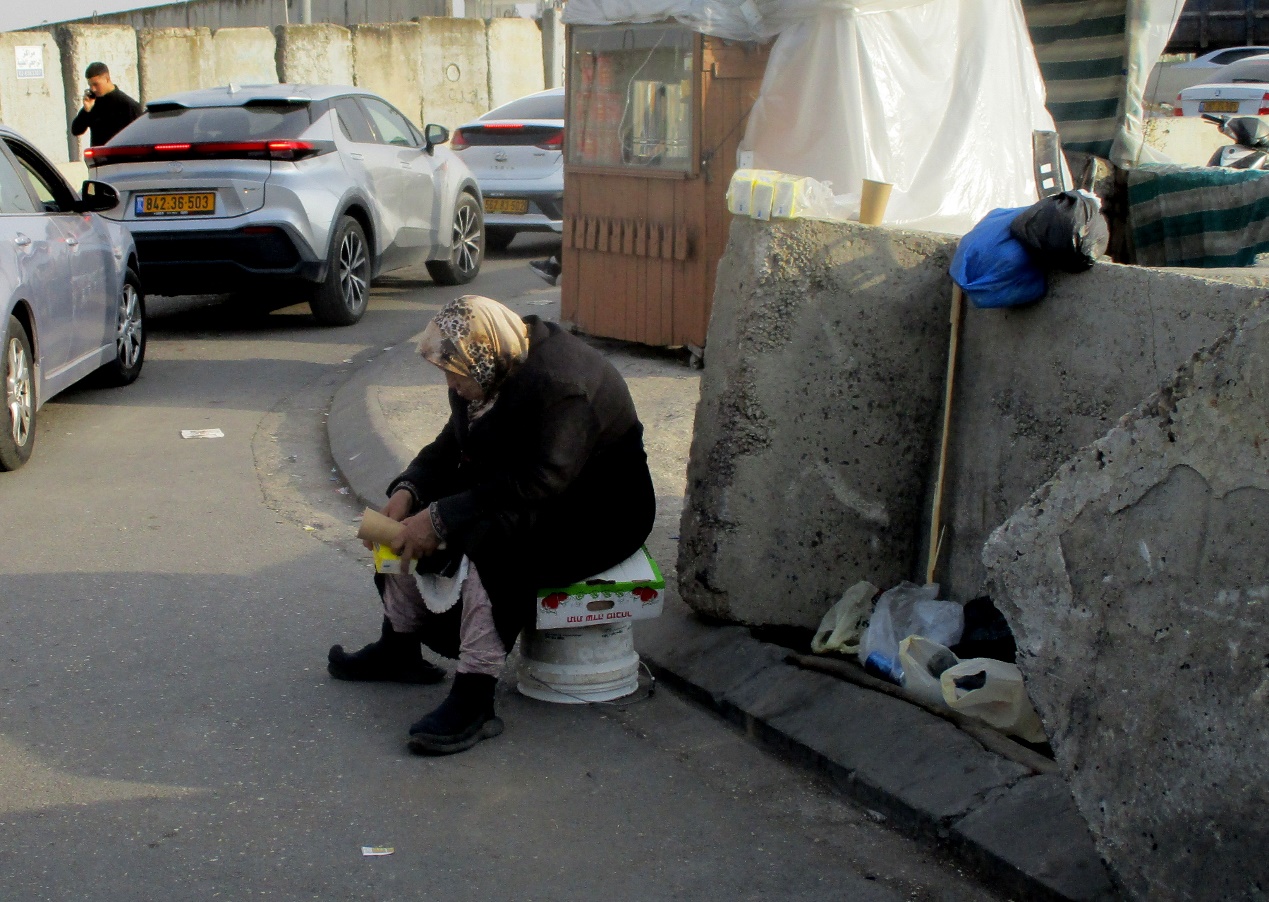 Tamar FleishmanOct-11-2026Qalandiya. Female Beggar
-
