
Qalandiya, Wed 18.1.12, Afternoon
Translator: Charles K.
The scene – a jubilant flock of starlings chirps innocently in the sky above the fence.
The gate leading to A-Ram at the southern plaza opened and closed repeatedly during our entire shift, the cars sent there by police officers. Sometimes all the cars were sent to A-Ram, sometimes drivers were able to choose between entering via the Qalandiya checkpoint or directly to A-Ram. When we asked one of the police officers for an explanation, he replied that “he’s not the Israeli Police spokesman.” Apparently it’s to control the amount of traffic at the northern plaza.
A man waiting for someone at the southern plaza is arguing with police officers next to the gate to a-Ram. They wanted him to move away. He was very upset and yelled at the police officers and guards. We were surprised how aggressive he was, unusual for someone confronting an armed guard or a police officer. “I’m from Abu Ghosh,” he said, “not one of these Indians!” (referring to the Palestinians). Two guards also arrived, more forgiving. At one point another Palestinian showed up, saying to the police officers, “He’s with me,” which ended the argument. Apparently they had a special “status.”
At 16:10, a Red Crescent ambulance from the Red Crescent station on the Mount of Olives arrived at the minibus parking lot south of the checkpoint. The station has only five ambulances with yellow license plates.
We then see an ambulance from Jenin arriving and being inspected. The southern ambulance is waiting for a 22-day-old newborn in critical condition, intubated, in an incubator, who’ll be accompanied by a doctor and perhaps by a family member as well.
Inspecting the ambulance from Jenin took seven minutes. “You should be here every day,” the driver said to us jokingly.
The incubator with the infant is transferred on a stretcher, “back to back;” the ambulance leaves for the Maqasid Hospital, siren wailing.
The ambulance from Jenin moves to the parking lot at the northern plaza. Its crew waits for the Jerusalem ambulance to return from Maqasid with the accompanying doctor and the incubator, both of which will return to Jenin.
A driver at the checkpoint leading to Ramallah says, “I don’t believe I’ve waited here half an hour every day for five years and haven’t gotten mad! Ten years ago I wouldn’t have believed things would be like this, and that I’d get used to it!”
The drivers of the minibuses going to Jerusalem, waiting at the checkpoint intended solely for residents of Jerusalem, explained how things work, as of today: “Everyone, except for someone who’s handicapped and must be carried, everyone has to get off the minibus, walk through the checkpoint and be inspected, and is then allowed to return to the minibus.” “Everyone,” including the elderly, infants and even those with handicap certificates (Remember: it’s terribly cold at Qalandiya in the winter).
Qalandiya Checkpoint / Atarot Pass (Jerusalem)
See all reports for this place-
Click here to watch a video from Qalandiya checkpoint up to mid 2019 Three kilometers south of Ramallah, in the heart of Palestinian population. Integrates into "Jerusalem Envelope" as part of Wall that separates between northern suburbs that were annexed to Jerusalem in 1967: Kafr Aqab, Semiramis and Qalandiya, and the villages of Ar-Ram and Bir Nabala, also north of Jerusalem, and the city itself. Some residents of Kafr Aqab, Semiramis and Qalandiya have Jerusalem ID cards. A terminal operated by Israel Police has functioned since early 2006. As of August 2006, northbound pedestrians are not checked. Southbound Palestinians must carry Jerusalem IDs; holders of Palestinian Authority IDs cannot pass without special permits. Vehicular traffic from Ramallah to other West Bank areas runs to the north of Qalandiya. In February 2019, the new facility of the checkpoint was inaugurated aiming to make it like a "border crossing". The bars and barbed wire fences were replaced with walls of perforated metal panels. The check is now performed at multiple stations for face recognition and the transfer of an e-card. The rate of passage has improved and its density has generally decreased, but lack of manpower and malfunctions cause periods of stress. The development and paving of the roads has not yet been completed, the traffic of cars and pedestrians is dangerous, and t the entire vicinity of the checkpoint is filthy. In 2020 a huge pedestrian bridge was built over the vehicle crossing with severe mobility restrictions (steep stairs, long and winding route). The pedestrian access from public transport to the checkpoint from the north (Ramallah direction) is unclear, and there have been cases of people, especially people with disabilities, who accidentally reached the vehicle crossing and were shot by the soldiers at the checkpoint. In the summer of 2021, work began on a new, sunken entrance road from Qalandiya that will lead directly to Road 443 towards Jerusalem and Tel Aviv. At the same time, the runways of the old Atarot airport were demolished and infrastructure was prepared for a large bus terminal. (updated October 2021)
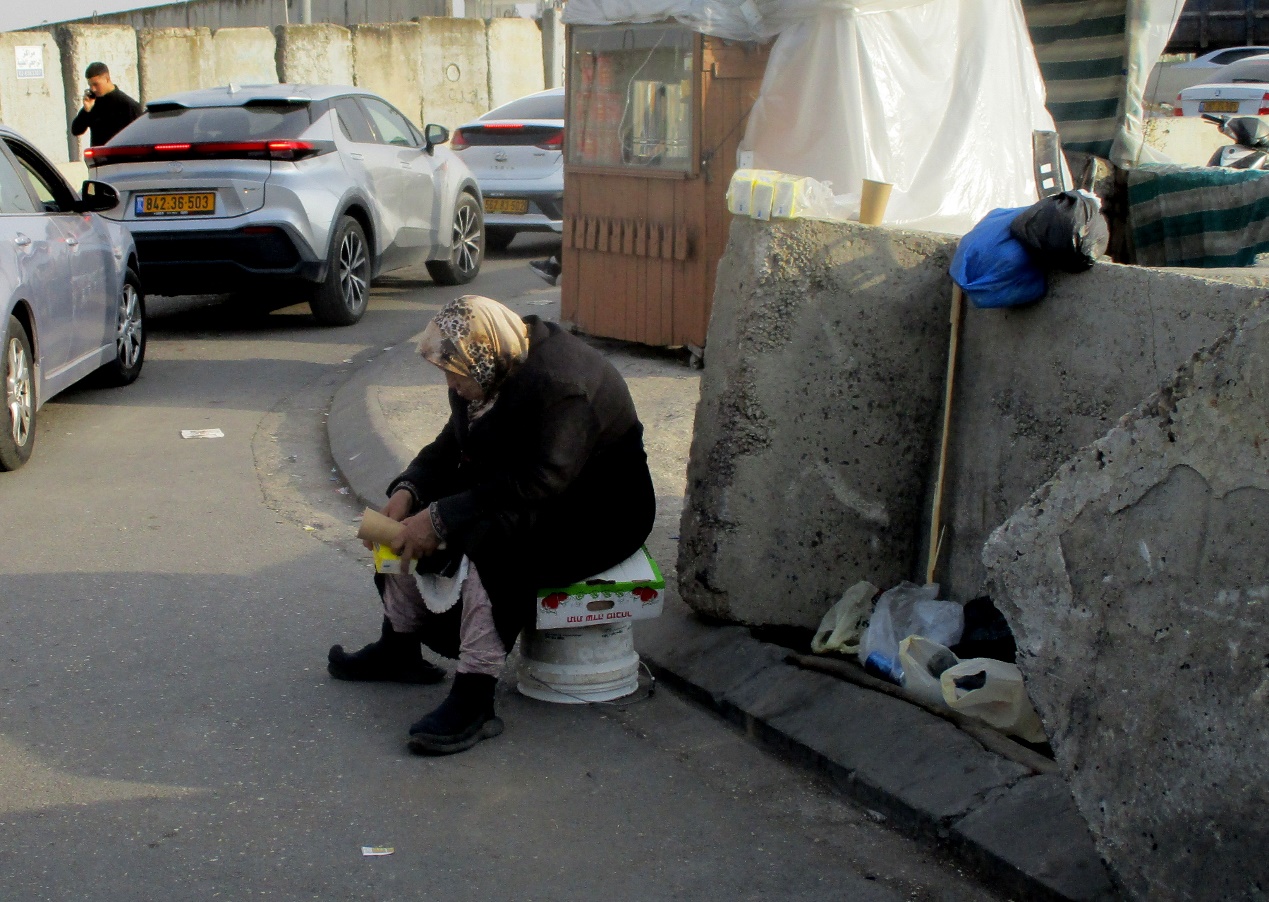 Tamar FleishmanOct-11-2026Qalandiya. Female Beggar
-
