Qussra, Talfit

10:00 Qussra
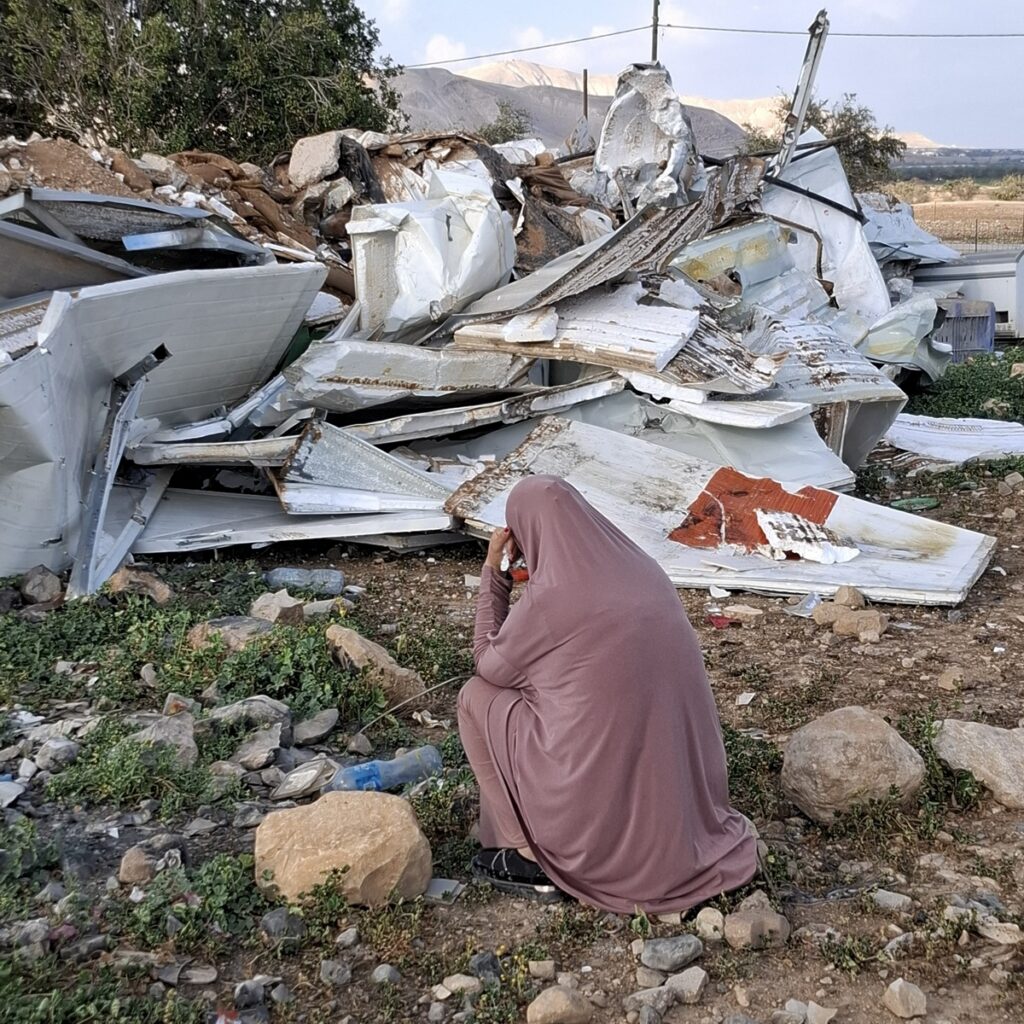
On our previous visit to the village, exactly two months ago, the head of the council and his staff, whom we met at the council house, were very tense. Many inhabitants had received from the messengers of the civil administration injunctions of demolition, cessation of work, and confiscation of working tools. The head of the council transferred the handling of the injunctions to the office of the El Kuds Center in East Jerusalem. As happens in other villages we visit, it can be assumed that at Kussara too, transfer of these matters to legal authorities will result in the postponement of the injunctions for some time.
However, while the problem of the injunctions has been removed from the immediate agenda, the occupation army creates new limitations for them, this time involving infringement on their right of freedom of movement.
The relatively new invention, as we realized also at our visits to other villages in the region, is that of flying checkpoints. H., who hosts us at the council building, reports on flying checkpoints about 10 times in the last month near the entrance to the Migdalim settlement. Last week, spikes were dispersed on the road between Jurish and Kussara and two people (not inhabitants of Kussara) were detained. Furthermore, the army built a new post on the internal road leading to Jalud and Krayot. The soldiers who man it block the way of the farmers who arrive at their fields, and often detain them for several hours.
H. gives us a letter from the head of the council (dated April 17) in which he reports on this new development. He expects the Palestinian DCO to approach the Israeli DCO and demand evacuation of the post. No answer has been received so far.
A donation from some European countries (Holland, France) enabled the farmers to build small storerooms on their plots of lands, all in Area B, to store their tools. The donors put up signposts to mark their donation, as is customary. Soldiers who serve in the area reacted by scrawling graffiti on the signs. One of them said: “You have no right to be here. A day will come on which we shall banish you.” “This is our land” and added a curse concerning Islam. “All this is based on the testimony of the farmers and some of the council members, they can come and testify,” says H.
H. comes with us to see the storerooms from close up. On the way, we get a chance to become acquainted with new initiatives of the villagers, which are being carried out thanks to donations from several European countries: A big industrial building for the storage of potatoes, the initiators of which are now being organized to produce French-fries for marketing. There is an events hall in the process of being built, and next to it there is a small playground for children. Also a large hen house.
11:15 Talfit
At the council house, we meet our friend A., the deputy head of the council, an eloquent man with broad knowledge, not only about what is going on in his village.
Talfit is one of the villages that suffer most from the occupation, as it is surrounded by two especially aggressive settlements – Ali and Shilo. And in spite of this it was never accorded any help from the various human rights organizations. When we arrived at the village and learned of the difficult problems, we enlisted to help. During the olive harvest this year the inhabitants will be accorded help for the first time and owing to this, hopefully, the setllers will not plunder a large portion of their crop.
The phenomenon of the flying checkpoints has arrived here too. One of those was set up last week between Talfit and Yatma, with the purpose of preventing the inhabitants from reaching road 60. In contrast to the situation in other villages in the neighborhood, the settlers of Ali and Shilo commit ongoing provocations – felling trees and attacking farmers even in Area B, but refrain from entering the villages. Thus for instance, A. tells us about a settler from Ali who, riding on his horse, repeatedly enters fields where farmers are working and tries to drive them away. The farmers, fearing a confrontation with him, try to shy away from him.
The army on the other hand, does appear in the village, but lately has refrained from ambushing the schoolchildren and spraying tear gas in their direction.
Talfit has two problems that gravely harm the villagers’ human rights and quality of life:
1. Sewage that flows from Ali and Shilo into Talfit. We reported on this nuisance, which gravely impairs the health and the quality of life of the inhabitants, to a member who maintains a relationship with the Eco Peace organization. Its representatives will activate the branch Eco Palestine to solve the problem.
2. A severe water shortage. Talfit does indeed receive water from Rujib, but it doesn’t suffice even for the animals, let alone for agriculture.
The villagers built small reservoirs which are filled with rainwater, but toward the summer these reservoirs dry out.
A. tells us of an even more acute problem of water shortage, at Khirbet el Marajim, where we visited during one of our former shifts following information about the destruction of several buildings there (the reason being “they were built in Area C”…). To this place, whose land belongs to Talfit, water is brought in tankers only, which very much increases the price. A. has plans for a project to transport water through a pipe from Akraba to El Marajim. The army refuses.
A. has 500 dunams in El Marajim and he cannot access them. He also has sheep. “If I want to crossroad 458 (which leads to the Tapuah Junction) with my sheep, the soldiers will stop me and confiscate the sheep,” he says.
He tells us of a severe event: a boy of 14 crossed over to the other side of the road. Soldiers stopped him and he was led in handcuffs to Ma’ale Ephraim. After hours of investigations, at 10 o’clock at night, he was released and ordered to walk on foot about 20 kilometers (according to A.’s estimate) in the dark, alone, on an unknown road, to his house.
Talfit, with about 3,800 inhabitants, has a diaspora of about 3,000-4,000 in countries like Jordan, Yemen, Lebanon, Kuwait, Saudi Arabia and even Syria. A. says they are refugees who left their homes because of the occupation.
12:30 Tapuah Junction. No soldiers are around. The flying CP from this morning has been dismantled. The traffic from road 60 flows northward. Building material is strewn everywhere.
Qabalan
See all reports for this place-
Qabalan is a small Palestinian town (Nablus governorate) Area B.
According to the mair, the population consists of 8000 inhabitants (2012).
Water: The inhabitants suffer from a severe water shortage at least since 2002. The minimum quota according to international standards is 100 liters per capita per day - the supply is not close to this amount.
The inhabitans make a living from orchards: Olives and some fruit trees, Also. permit holders can work in Israel after passing through the Eyal checkpoint.Not far from the agricultural areas of the Qabalan inhabitans, situated the settlements: Tapuach and Rehelim.
-
Qusra
See all reports for this place-
Qusra
This village is located in the Nablus district, about 28 kilometers south-east of the city. Its population numbers 4,310 as of 2007 (according to the Palestinian census). After the Oslo Accords, 50% - most of the village’s built-up area – was categorized Area B, and about 70 homes as well as the rest of its land are inside Area C.
In 1983, 177 dunams of the village lands were confiscated by Israel to build a ‘Nahal’ stronghold, turned civilian in 1985 and named Migdalim settler-colony, east of the village itself. To the north-east is a gas station and a leather plant, as well as a studio producing wood ware, all of which are a branch of the settler-colony. Dozens of additional farmland were confiscated from Qussra and Jaloud in order to erect the settler-colonies Esh Qodesh and Ahiya.
“The villagers point to the settler-colonists of Esh Qodesh as the source of their problem. Qussra villagers were forbidden to tend their lands located a kilometer away from the Esh Qodesh fence, and about 20 meters from the area declared military zone. What about the ‘legitimate’ plots? Their crops are regularly destroyed by the settler-colonists. Fires break out in wheat fields, olive trees are cut down, wells are destroyed – these have all become routine events. In spite of all of this, the head of the local council sees the Israeli army as the main source. He says that the settler-colonists could not have harassed the villagers without the army backing them up…”
(From a MW report, August 3, 2015)
In 2001, the Israeli army evacuated its intelligence base “Kida”. In 2003, the settler outpost Kida was established, a quick attempt was made to evict the newcomers, but they were eventually allowed to remain.
For further information: http://vprofile.arij.org/nablus/pdfs/vprofile/Qusra_vp_en.pdf
-