
Rafaiya - house demoliltion


Our main object was to to visit Rafaiya, o see the demolitions and to ask how the people are. The demolitions took place two weeks ago.
On the way, we saw army jeeps encircling the fields and at the Dura-El Fawwar on every side possible, preparing for something. Then on Route 317 near Zif Junction.
We then went to see what is happening at Mitzpe Ziv, where there are signs of something happening.
Then a ruin with a broken sign in memory of someone whose blood will be avenged and also a Price Tag graffiti on the ruin. They call it a sukkah. A spectacular view of the Judean Desert and Nahal hHever and the heart aches in memory of the aircraft of the late Assaf Ramon.
Then we drove to the tiny Rafaiya between Dirat and the Zif Junction. The destruction of what was home once to parents and their six children is appalling. An attempt to rebuild from the rubble of 4 years ago was once again crushed and sealed by the Civil Administration and the army.
Why? Why?
Illegal construction we are told.
What is there that so bothers you? Nothing. Poor dwelling houses. The grandfather turns around in grief and does not stop muttering again and again:
“They came in at 7.30 in the morning, didn’t even tell us in advance, they didn’t let us take our clothes, no foods, no utensils , everything belonging to the children was detraoyed”.
Everything is ruined, a beautiful door, floor tiles, clothing, small bikes and two trees, an Olive crushed under rubble.
The trees of the field are human?
Now they have been given a tent and built it on the roof of a house on the Wadi slope so that one can see them from the road. The mother came with a 3-month-old baby wrapped in blankets, tiny., What do we say except to say that our hearts are with them and how we can help.
So I have towels and blankets to give them, but I think they still need warm clothes and more blankets.
Dura Al-Fawwar Junction
See all reports for this place-
Junction on Route 60: west - the town of El Dura, east - the Al Fawwar refugee camp. There is a manned pillbox at the junction. From time to time the army sets up flying checkpoints at the entrance to El Fawwar and Al Dura. Al-Fawwar is a large refugee camp (7,000 inhabitants in 2007) established in 1949 to accommodate Palestinian refugees from Be'er Sheva and Beit Jubrin and environs. There are many incidents of stone-throwing. In the vicinity of the pillbox there are excellent agricultural areas, Farmers set up stalls adjacent to the plots close to the road. In recent months the civil administration has set up dirt embankments thereby blocking access to the stalls, and making it impossible for the farmers to sell their vegetables. Updated April 2021, Michal T.
-
South Hebron Hills
See all reports for this place-
South Hebron Hills
South Hebron Hills is a large area in the West Bank's southern part.
Yatta is a major city in this area: right in the border zone between the fertile region of Hebron and its surroundings and the desert of the Hebron Hills. Yatta has about 64,000 inhabitants.
The surrounding villages are called Masafer Yatta (Yatta's daughter villages). Their inhabitants subsist on livestock and agriculture. Agriculture is possible only in small plots, especially near streams. Most of the area consists of rocky terraces.Since the beginning of the 1980s, many settlements have been established on the agricultural land cultivated by the Palestinians in the South Hebron Hills region: Carmel, Maon, Susia, Masadot Yehuda, Othniel, and more. Since the settlements were established and Palestinians cultivation areas have been reduced; the residents of the South Hebron Hills have been suffering from harassment by the settlers. Attempts to evict and demolish houses have continued, along with withholding water and electricity. The military and police usually refrain from intervening in violent incidents between settlers and Palestinians do not enforce the law when it comes to the investigation of extensive violent Jewish settlers. The harassment in the South Hebron Hills includes attacking and attempting to burn residential tents, harassing dogs, harming herds, and preventing access to pastures.
There are several checkpoints in the South Hebron Hills, on Routes 317 and 60. In most of them, no military presence is apparent, but rather an array of pillboxes monitor the villages. Roadblocks are frequently set up according to the settlers and the army's needs. These are located at the Zif Junction, the Dura-al Fawwar crossing, and the Sheep Junction at the southern entrance to Hebron.
Updated April 2022
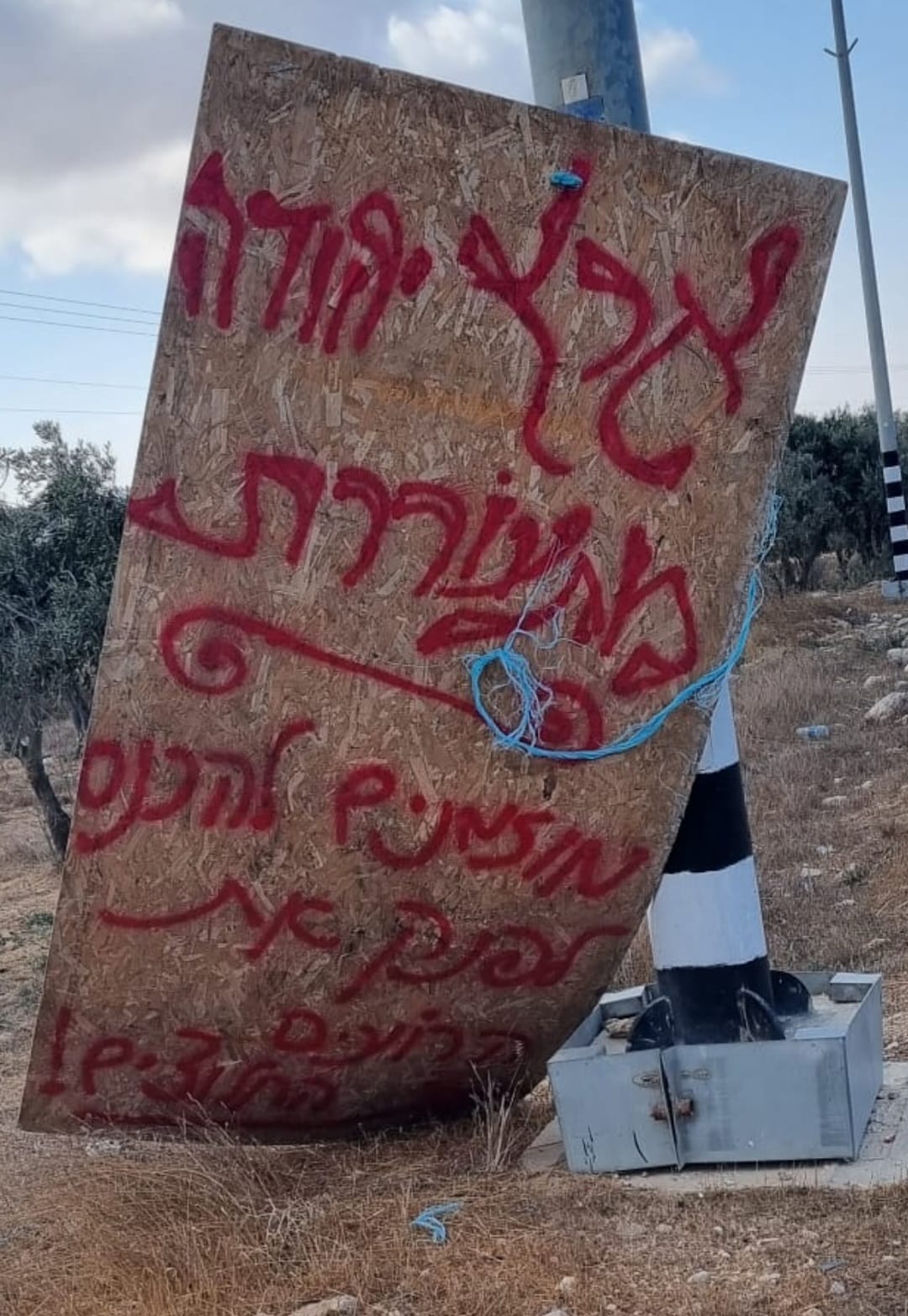 Smadar BeckerOct-17-2026A sign placed by those who call themselves the Pioneer Shepherds, at the outpost adjacent to Qawawis
-
Zif Junction
See all reports for this place-
Zif Junction located on the crossroads that directs towards Road 356 to Yata. Yata is the district city of the southern Hebron Mountains. Usually, this junction is open to traffic. The nearby pillbox is unmanned. But the army and police are present occasionally, sometimes setting up a checkpoint and sometimes detaining residents from the big city. Often, the Israeli policemen inspect vehicles and distribute driving reports to Palestinian vehicles. s
-
