
Ras el Ayn: the Army and Police Abuse Field Activists and the Settlers Terrorize Palestinians without Hindrance
We do protective presence shifts (round the clock presence) among different Palestinian communities in order to prevent settlers from attacking them. They get backing and support from the army and police.
Today at 7:30, we took over from the shift at Ras el Ayn in the area of Auja. The local residents have provided a hut for Looking the Occupation in the Eye on a hill overlooking the village, where around 100 families live, so they can stay there and even sleep over. The hut has a cooler, which doesn’t really cool in this heat, but rather blows scorching air in our direction, as well as a fridge, gas, beds and of course a table and chairs. Apart from the insane heat, the place is very comfortable.
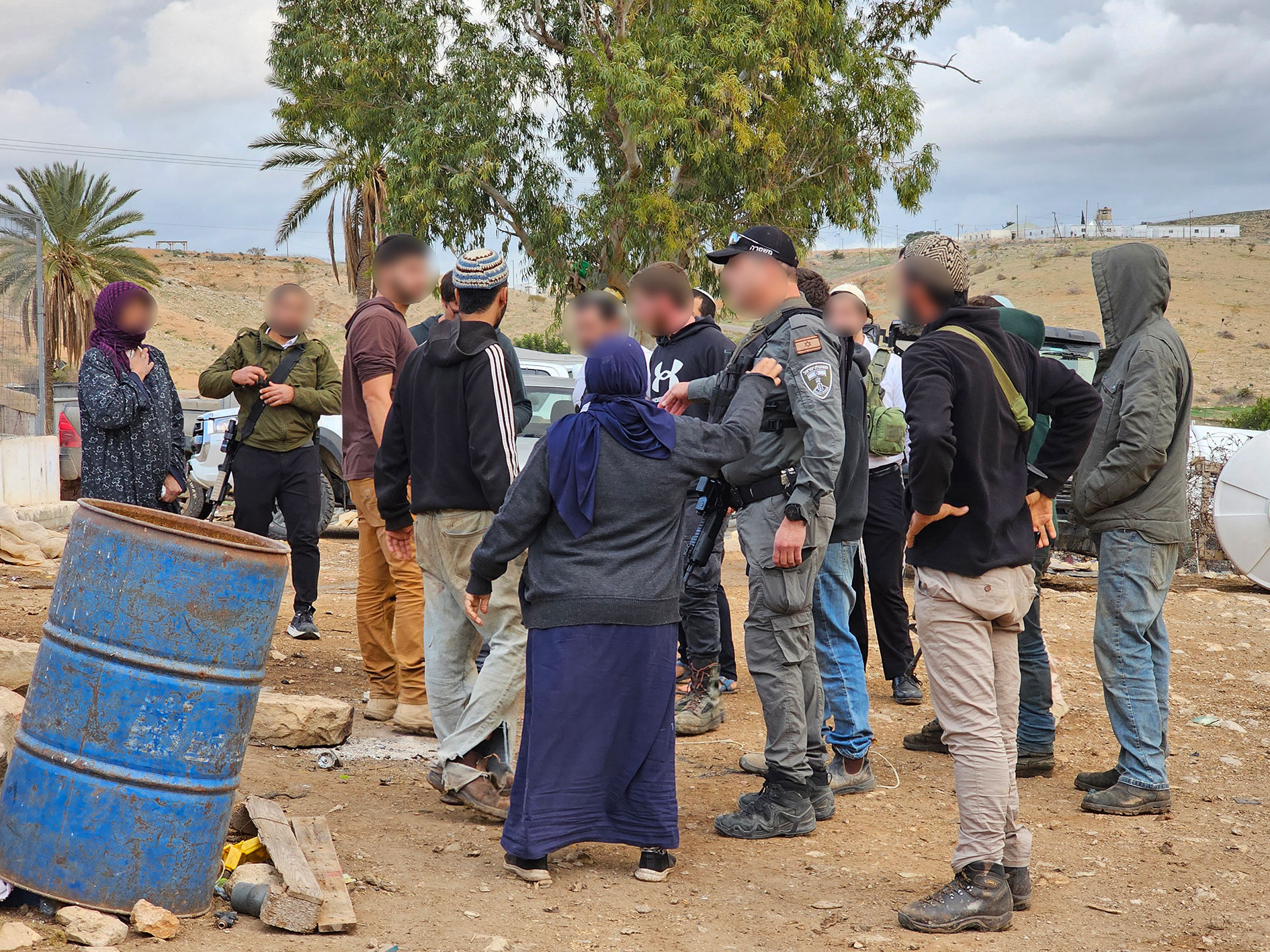
Around 3:30 p.m., we saw two flocks of sheep coming down from the violent outpost towards the western houses of the village of Salame (named for one of the village’s families). When we arrived, we found a young settler (a minor called Dvir) marching his flock towards the Palestinians’ homes and guiding them by throwing stones. Ben, Nava, and I stood between them and the Palestinian homes, waving our arms for them to stop, while running from side to side in that dreadful heat. At a certain point, I also threw a stone, of course without causing harm. The settler immediately took a picture and called the army and the police (did he tell them that he’d thrown no end of stones at them for half an hour or more?).
At first, four female soldiers arrived and tried to send us away and justified the threatening presence of the settler. Then the battalion commander, Sadi, appeared, and made up a story as if Ben Zion had demolished the homes of Ma’arjat, a village of 150 families, that the security coordinator from Mevo’ot Yericho along with some settlers and together with the army had evicted a week earlier. A loud argument developed between Ben Zion and the battalion commander and then the police arrived under the command of Ofir Aharonovitch (I don’t know his rank exactly). As soon as he got out of his car, he demanded our identity papers so he could arrest us. The crime – “animal abuse and disturbing public order” (after all, public order, in his opinion, is that the settler and his flock should go into the homes of the terrified Palestinians hiding inside).
During the argument, the settler again threw stones at the flock, and when we pointed this out, the policeman denied it. Ben Zion refused to be arrested, since it was clear that the purpose of the arrest was to remove us from the site to give the settlers a free hand in terrorizing the Palestinians. Ofir called to another policeman and soldier who had come with him and they handcuffed him and dragged him to the van (not an easy task because Ben is big). He took our phones (claiming they contained evidence) and left Nava alone in the field, in the heart of a population that in his opinion is hostile and even dangerous. They didn’t even let me get water.
When we drove to the police station at Geva Binyamin, we drove past the deserted village of Ma’arjat in the last light, and the sight of the homes with no doors and windows and above all none of the dear people who lived there until a week ago, was heartbreaking.
At the police station, all my things were taken from me, even my watch, and at Ofir’s command, a female officer conducted a body search, including my private parts. It was very embarrassing for her. Interestingly, he didn’t demand a body search on Ben. Maybe because the aim was to humiliate me, as a woman. The whole time, my phone was ringing nonstop. It was my husband’s birthday and we had arranged to meet after the shift. It was getting late (I was detained until 10 p.m.) and there was no way they would let me answer just to reassure him. The interrogation was to the point and, in the end, they let me go at 10, after taking fingerprints, DNA, etc., and they gave me back my phone. I demanded they give me Nava’s phone, since there was no justification for taking it, but there was a problem. How could I call her to tell her to come and get it. I made a few calls to activists whose numbers I had and reached Doron Meinert who was on the night shift at Ras el-Ayn.
Nava was afraid to go to the police at Binyamin alone, because she didn’t know the dark and winding road, and Doron volunteered to drive her safely to the police station. We waited for Ben Zion and took him with us to Tel Aviv. We got home at midnight. My husband’s birthday was ruined but this was nothing compared to a first-hand experience of the police working for the settlers and not hesitating to break the law and make false arrests in order to keep activists away and give the settlers a free reign to steal, break in, and terrorize the Palestinians.
Location Description
Jordan Valley
See all reports for this place-
Jordan Valley The Jordan Valley is the eastern strip of the West Bank. Its area consists of almost a third of the West Bank area. About 10,000 settlers live there, about 65,000 Palestinian residents in the villages and towns. In addition, about 15,000 are scattered in small shepherd communities. These communities are living in severe distress because of two types of harassment: the military declaring some of their living areas, as fire zones, evicting them for long hours from their residence to the scorching heat of the summer and the bitter cold of the winter. The other type is abuse by rioters who cling to the grazing areas of the shepherd communities, and the declared fire areas (without being deported). The many groundwaters in the Jordan Valley belong to Mekorot and are not available to Palestinians living in the Jordan Valley. The Palestinians bring water to their needs in high-cost followers.
 Sarah PostecDec-27-2026Hammam al-Malih: Border Guard and settlers in the compound
-