
Sansana (Meitar Crossing), South Hebron Hills
Meitar crossing
We wanted mainly to see what was the situation with the sellers’ stands that were demolished about a month earlier. An entire fabric of life had sprung up. Food and drink stands for those leaving in the morning, vegetables, fruit and groceries people were happy to purchase on their way home. Since the disorder continued to grow and the access road was blocked and mounds of refuse grew despite attempts to organize the site, a large military and police force arrived one morning and simply demolished everything and cleaned up in a way that left mounds of trash by the roadside that are still there. But life is more powerful than anything else and a decree that is impossible to obey is void. And so we came and saw again food stands and products to cook at home. The pita seller told us that now they’re putting things on the roadside, not on the road. No one has come to demolish the stands for now. I wonder how long it will take until the next invasion.
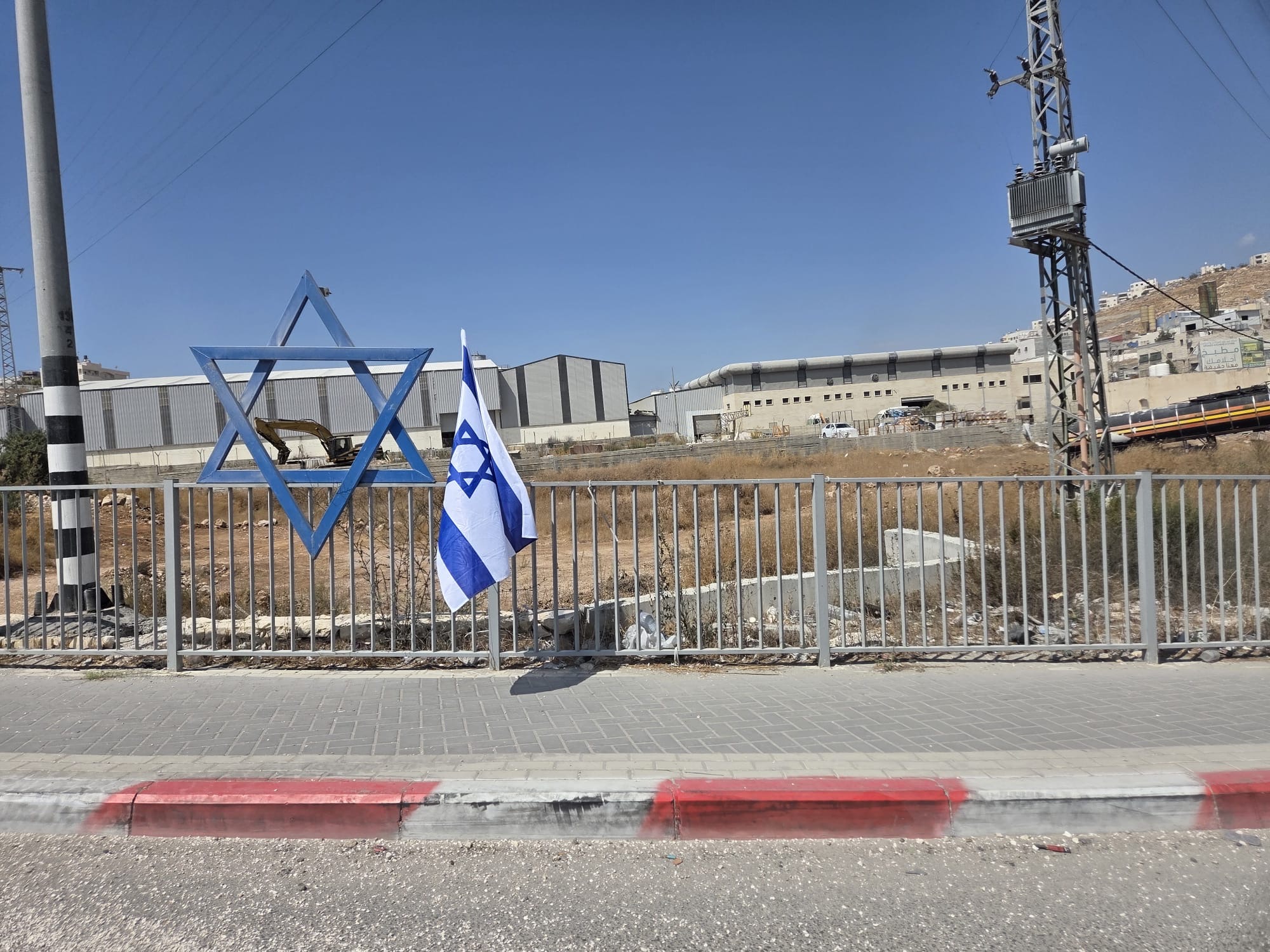
You can see the piles of rubbish and the ugly fences and checkpoint. An “international transit point,” they call it.
Hebron
We drove to Hebron, to visit Imad Abu Shamsiyya, who is subjected to constant acts of retribution because he’s the photographer who immortalized Aloar Azariya’s deed. After a preliminary discussion with Mufid and Zidan Shaharbati we were invited to meet him and them in Hana Abu Heikhal’s olive grove, atop Tel Rumeida. So we drove there first. It was a real festival.
Students from the Open University of Hebron came en masse to help the family harvest. They’d received two days to pick. The army is providing security.
The photos show some of the congregating around these ancient trees, and the cooperative picking.
Another photo shows Imad holding the sign described the joint harvest effort.
Imad invited us home to hear what happened Saturday night from his wife as well. On the way to his home a paratrooper wants to know who we are. We’re news to him. He’s not familiar with Machsom Watch. So we explained, and also wanted to hear the army’s version of this serious incident, why they broke into the home and why they arrested the youth, his mother and another relative.
The soldiers says it all began when 30 Palestinians dared come up from the town along a path between buildings that they’re forbidden to use, and got on the road up to Tel Rumeida.
The IDF came fully alert, observed and got the impression that “they had their eye on three settlers and intended to attack them so they came to block and arrest them.” But, I say, why did they break into the Abu Shamsiyya’s family home? The soldier insists that the arrests were to prevent the planned attack they feared.
People visited the youth who returned from surgery at the hospital, we say.
Conflicting versions.
We listened. It’s hard to be told by the soldier how sure he is that the army’s response was justified, especially when he says, “I wasn’t there. I was on guard duty somewhere else. I only heard from my friends”…
We went to find out how Abu Shamsiyya’s wife is feeling, and how they see what occurred. She’s hoarse, has difficulty speaking after defending her 16-year-old son and screaming at the soldiers to get out of her house. She said some friends came to ask how the son is, after he returned from the hospital and the soldiers began interrogating the people in the house. They were angry at the invasion of their privacy and said they don’t have to report to the army what happens in their home. The soldiers claimed they were interfering with the soldiers’ ability to do their job and arrested her and the son and another relative, Abu Ayyash. Also, a soldier outside fired a shot. In the air, fortunately for them. They spent 9 PM to 1 AM at the police station being interrogated about why they interfered with the army, and then they telephoned Imad to come take them home on condition he pay NIS 500 for their release.
Abu Ayyash was kept there and brought to court Tuesday. An attorney from Gabi Laski’s office is following the case.
The wife was given a court date. We’ll be in touch with her. Meanwhile the parents sent their three children away from Hebron, afraid of what might happen to them.
Imad isn’t allowed to fence off and erect an entry gate to his home.
It’s obvious to everyone there, and to us as well, that Imad is being persecuted and is suffering retribution because he photographed the Elor Azariya incident.
Meitar checkpoint / Sansana
See all reports for this place-
Meitar Checkpoint / Sansana The checkpoint is located on the Green Line and serves as a border crossing between Israel and the West Bank. It is managed by the Border Crossing Authority of the Defense Ministry. It is comprised of sections for the transfer of goods as well as a vehicle checkpoint (intended for holders of blue identity cards, foreign nationals or diplomats and international organizations). Passing of Palestinians is prohibited, except for those with entry permits to Israel. Palestinians are permitted to cross on foot only. The crossing has a DCO / DCL / DCL / DCL (District Coordination Office), a customs unit, supervision, and a police unit. In the last year, a breach has been opened in the fence, not far from the crossing. This breach is known to all, including the army. There does not appear to be any interest in blocking it, probably as it permits needed Palestinian workers without the bureaucratic permits to get to work in Israel. Food stalls and a parking area economy have been created, but incidents of violent abuse by border police have also been recorded. Updated April 2022
-
South Hebron Hills
See all reports for this place-
South Hebron Hills
South Hebron Hills is a large area in the West Bank's southern part.
Yatta is a major city in this area: right in the border zone between the fertile region of Hebron and its surroundings and the desert of the Hebron Hills. Yatta has about 64,000 inhabitants.
The surrounding villages are called Masafer Yatta (Yatta's daughter villages). Their inhabitants subsist on livestock and agriculture. Agriculture is possible only in small plots, especially near streams. Most of the area consists of rocky terraces.Since the beginning of the 1980s, many settlements have been established on the agricultural land cultivated by the Palestinians in the South Hebron Hills region: Carmel, Maon, Susia, Masadot Yehuda, Othniel, and more. Since the settlements were established and Palestinians cultivation areas have been reduced; the residents of the South Hebron Hills have been suffering from harassment by the settlers. Attempts to evict and demolish houses have continued, along with withholding water and electricity. The military and police usually refrain from intervening in violent incidents between settlers and Palestinians do not enforce the law when it comes to the investigation of extensive violent Jewish settlers. The harassment in the South Hebron Hills includes attacking and attempting to burn residential tents, harassing dogs, harming herds, and preventing access to pastures.
There are several checkpoints in the South Hebron Hills, on Routes 317 and 60. In most of them, no military presence is apparent, but rather an array of pillboxes monitor the villages. Roadblocks are frequently set up according to the settlers and the army's needs. These are located at the Zif Junction, the Dura-al Fawwar crossing, and the Sheep Junction at the southern entrance to Hebron.
Updated April 2022
 Timna OrevSep-24-2026Replacing flags on Highway 6
-
