
Sansana (Meitar Crossing), South Hebron Hills

The Meitar checkpoint had a high presence of police and border guards.
In the morning Muhammad received a phone call that the army and the Civil Administration had arrived at Amer’s family from Maktal Umm Salem. The translation of the name of the place is “Kill Salem” but probably the more correct is “They have killed the peace “. I wrote about the place a few months ago. It is on Road 317 between the settlements Shima and Asael. Two families of shepherds live in this place.
In the month of Ramadan Amer received a paper with the title “the holder” without mentioning his name. So much so that the people here are transparent, without a name, without a title and without a place. The details of the goods stated: 3 units of iron constructions. The truth is that these were the tents of the family, their home and that too was taken from them. Adam, a boy about two years old, has already experienced the demolition of his house. I understand that Adam has never experienced a wall of a house from the inside. The only houses he has probably seen are the houses of the settlement Shima, which stand at the top of the hill in front of his tent.
From there we continued to Abu Safi in Wadi Radim. Our friend Paula, who was very impressed by the paintings of Rania, Abu Safi’s daughter, and even purchased some of her works that are displayed in the living room of her home, told me that her friend Nitza saw the paintings and bought her paints and blocks for painting. Of course I went to Paula to pick up the equipment and so we returned to his house – Abu Safi’s cave.
The road to it is spectacular in its beauty, only the access to it requires SUVs and for those who do not one, then a donkey or a tractor will also do the job. The smile that lit up in Rania’s face when she saw the things Paula sent was amazing, and I thought to myself about the equal opportunities for other young people which Rania does not have and probably many more talented young people like her. Meanwhile, Rania’s sister has returned from grazing. Abu Safi told me that everyone who is big enough works because otherwise there will be nothing to eat.
When we got there were problems. One of Abu Safi’s cows gave birth to twins and there was a complication in the calving. A veterinarian arrived who performed emergency surgery in very difficult conditions. Hope the cow and calves will survive.
As I have not seen horses and donkeys at Abu Safi, I realise the tractor is the only vehicle that Abu Safi has to travel. In the yard he has spare parts. If I were to see these scraps elsewhere, like a kibbutz for example, I would say I am in the kibbutz’s tractor museum. But no, I’m seeing of Abu Safi’s and his friends’ real life.
Meitar checkpoint / Sansana
See all reports for this place-
Meitar Checkpoint / Sansana The checkpoint is located on the Green Line and serves as a border crossing between Israel and the West Bank. It is managed by the Border Crossing Authority of the Defense Ministry. It is comprised of sections for the transfer of goods as well as a vehicle checkpoint (intended for holders of blue identity cards, foreign nationals or diplomats and international organizations). Passing of Palestinians is prohibited, except for those with entry permits to Israel. Palestinians are permitted to cross on foot only. The crossing has a DCO / DCL / DCL / DCL (District Coordination Office), a customs unit, supervision, and a police unit. In the last year, a breach has been opened in the fence, not far from the crossing. This breach is known to all, including the army. There does not appear to be any interest in blocking it, probably as it permits needed Palestinian workers without the bureaucratic permits to get to work in Israel. Food stalls and a parking area economy have been created, but incidents of violent abuse by border police have also been recorded. Updated April 2022
-
South Hebron Hills
See all reports for this place-
South Hebron Hills
South Hebron Hills is a large area in the West Bank's southern part.
Yatta is a major city in this area: right in the border zone between the fertile region of Hebron and its surroundings and the desert of the Hebron Hills. Yatta has about 64,000 inhabitants.
The surrounding villages are called Masafer Yatta (Yatta's daughter villages). Their inhabitants subsist on livestock and agriculture. Agriculture is possible only in small plots, especially near streams. Most of the area consists of rocky terraces.Since the beginning of the 1980s, many settlements have been established on the agricultural land cultivated by the Palestinians in the South Hebron Hills region: Carmel, Maon, Susia, Masadot Yehuda, Othniel, and more. Since the settlements were established and Palestinians cultivation areas have been reduced; the residents of the South Hebron Hills have been suffering from harassment by the settlers. Attempts to evict and demolish houses have continued, along with withholding water and electricity. The military and police usually refrain from intervening in violent incidents between settlers and Palestinians do not enforce the law when it comes to the investigation of extensive violent Jewish settlers. The harassment in the South Hebron Hills includes attacking and attempting to burn residential tents, harassing dogs, harming herds, and preventing access to pastures.
There are several checkpoints in the South Hebron Hills, on Routes 317 and 60. In most of them, no military presence is apparent, but rather an array of pillboxes monitor the villages. Roadblocks are frequently set up according to the settlers and the army's needs. These are located at the Zif Junction, the Dura-al Fawwar crossing, and the Sheep Junction at the southern entrance to Hebron.
Updated April 2022
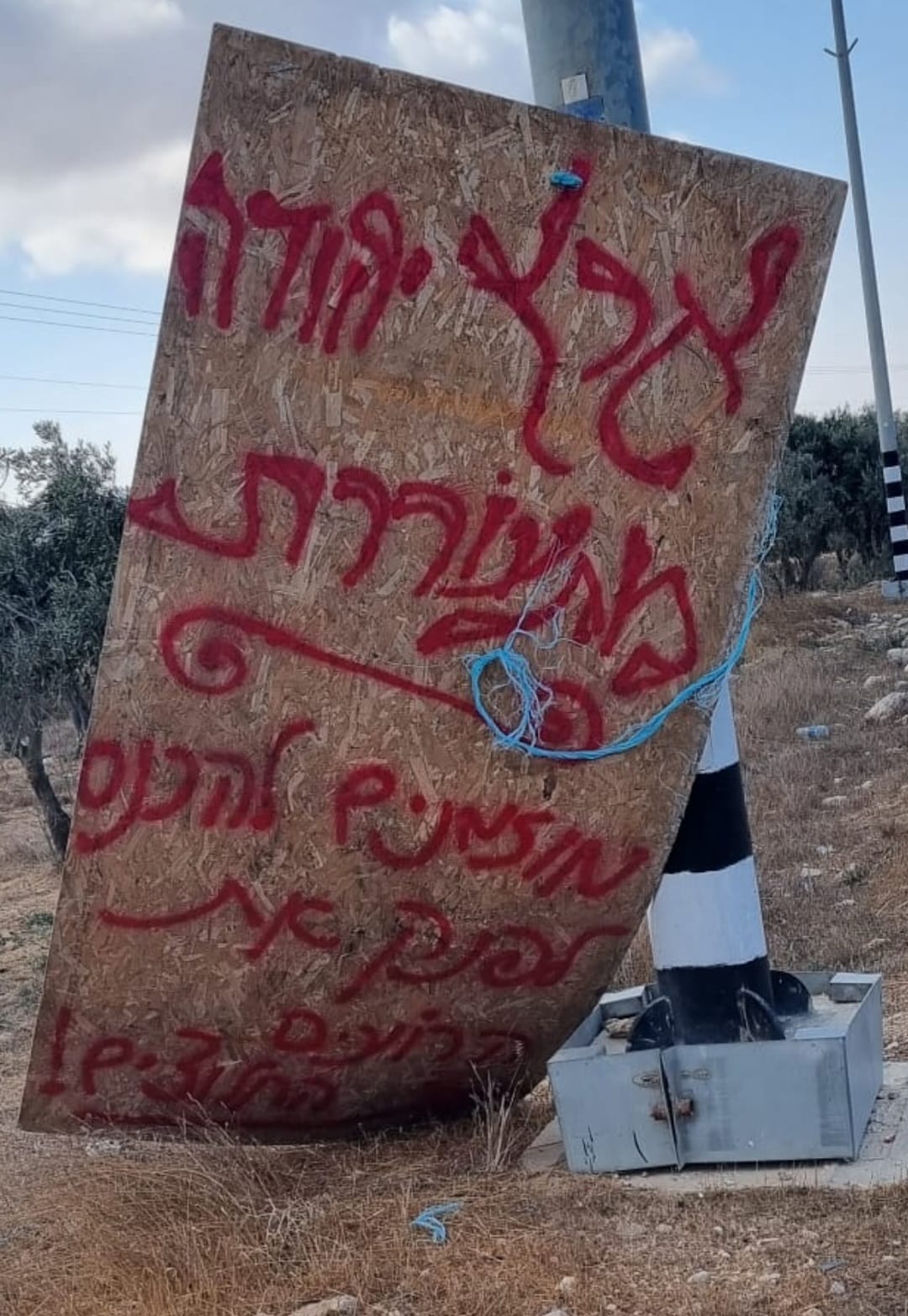 Smadar BeckerOct-17-2026A sign placed by those who call themselves the Pioneer Shepherds, at the outpost adjacent to Qawawis
-
