
Sansana (Meitar Crossing), South Hebron Hills, Mon 4.6.12, Morning
Translator: Charles K.
Meitar crossing is open again, with no accompanying stench. It’s not clear how that happened; they’re taking care of it but we weren’t able to get any answers.
Southern Hebron Hills
Highway 60 is quiet, no army traffic, no flying checkpoints anywhere.
A new pillbox has been erected on the hill overlooking the road to Negohot, after many months of work.
The guard at the entrance to Kiryat Arba tells us the road is closed because of construction.
It’s possible to enter the city, and continue to Hebron, only through the southern entrance – which is usually closed and guarded – through the industrial zone.
We decided not to enter Hebron today.
We drove to Beit Anun. The roadblocks at the exit from the village to Highway 60 were removed three weeks ago. We’ll wait and see when they’ll open the road to Hebron on the other side of the highway.
Tarqumiyya
Since we haven’t “enjoyed” the Tarqumiyya checkpoint for a while, we decided to take Highway 35 and go through. And in fact the workers at the checkpoint, managed by Zion, continue to be unpleasant to everyone who isn’t Jewish or who belongs to Machsom Watch.
M., our driver and friend, told us to be prepared for a search by a dog, a scanner and other such “pleasures.”
M. isn’t Motkeh from the Palmach or from the reconnaissance unit, or even Miki from Kiryat Gat, so he’s often experienced racist behavior at first-hand. And this time also.
The guards didn’t content themselves with asking unnecessary questions, like where’d you come from, etc., or with checking our ID’s. The woman at the gate began a series of phone calls to “big brother” (Quote: “The Israel-haters are here”), and we were then invited to the area where additional inspections are conducted. Why? Because.
“Do settlers crossing here also have to be inspected?”, we ask. “I’m the last, tiny link in the chain, I just follow orders, I don’t know, ask my superiors.”
“Zion?”, we ask. “Yes,” I see you know.
“We get it; Zion decided to treat us the same way he treats everyone who isn’t Jewish, even if they’re loyal, law-abiding Israeli citizens.”
We joined the line M. was asked to use. We’re like him. So, the first thing they did was to empty the car, items the driver always takes with him.
Today, dear God, we also had vegetables we’d bought on the way. All of us went with our belongings to the scanner.
Hostile elements like us must be inspected again and again.
“Check the watermelon also,” one of our stalwarts says to his colleague, in all seriousness.
“Watermelon?” I ask. What crime did the watermelon commit? The energetic employees look at us silently. They’re earning their salary today, no question about it.
All the vegetables were scanned and approved to cross. Meanwhile, the guy with the dog keeps going over the car.
The dog looks as if it wants to leave right away; he’s smarter than the human watchdog. He quickly understood that there’s no treat in it for him today. But the guy makes him continue sniffing. Finally he had to agree with the dog. Both left.
I’m sure the dog was aware of all I thought about him, but he didn’t look at me.
The inspections ended – wait – something about the vehicle’s documents. M. is getting annoyed, he begins telling them what he thinks about them and their behavior. We know that if things get out of hand he’ll pay the price – who does he think he is, after all?
So we calmed both sides down. “Tell the truth,” we ask the “last link in the chain” – which is how the one following orders had described himself earlier – “if we’d come through here with our families, you wouldn’t treat us like this, right?” The last link in the chain is silent, looks down and smiles.
Silence as an admission of guilt. Of course not.
Thanks, Zion. Once again you gave us the opportunity to experience a tiny bit of what everyone you identify as … whatever you decide…gets to experience.
Meitar checkpoint / Sansana
See all reports for this place-
Meitar Checkpoint / Sansana The checkpoint is located on the Green Line and serves as a border crossing between Israel and the West Bank. It is managed by the Border Crossing Authority of the Defense Ministry. It is comprised of sections for the transfer of goods as well as a vehicle checkpoint (intended for holders of blue identity cards, foreign nationals or diplomats and international organizations). Passing of Palestinians is prohibited, except for those with entry permits to Israel. Palestinians are permitted to cross on foot only. The crossing has a DCO / DCL / DCL / DCL (District Coordination Office), a customs unit, supervision, and a police unit. In the last year, a breach has been opened in the fence, not far from the crossing. This breach is known to all, including the army. There does not appear to be any interest in blocking it, probably as it permits needed Palestinian workers without the bureaucratic permits to get to work in Israel. Food stalls and a parking area economy have been created, but incidents of violent abuse by border police have also been recorded. Updated April 2022
-
South Hebron Hills
See all reports for this place-
South Hebron Hills
South Hebron Hills is a large area in the West Bank's southern part.
Yatta is a major city in this area: right in the border zone between the fertile region of Hebron and its surroundings and the desert of the Hebron Hills. Yatta has about 64,000 inhabitants.
The surrounding villages are called Masafer Yatta (Yatta's daughter villages). Their inhabitants subsist on livestock and agriculture. Agriculture is possible only in small plots, especially near streams. Most of the area consists of rocky terraces.Since the beginning of the 1980s, many settlements have been established on the agricultural land cultivated by the Palestinians in the South Hebron Hills region: Carmel, Maon, Susia, Masadot Yehuda, Othniel, and more. Since the settlements were established and Palestinians cultivation areas have been reduced; the residents of the South Hebron Hills have been suffering from harassment by the settlers. Attempts to evict and demolish houses have continued, along with withholding water and electricity. The military and police usually refrain from intervening in violent incidents between settlers and Palestinians do not enforce the law when it comes to the investigation of extensive violent Jewish settlers. The harassment in the South Hebron Hills includes attacking and attempting to burn residential tents, harassing dogs, harming herds, and preventing access to pastures.
There are several checkpoints in the South Hebron Hills, on Routes 317 and 60. In most of them, no military presence is apparent, but rather an array of pillboxes monitor the villages. Roadblocks are frequently set up according to the settlers and the army's needs. These are located at the Zif Junction, the Dura-al Fawwar crossing, and the Sheep Junction at the southern entrance to Hebron.
Updated April 2022
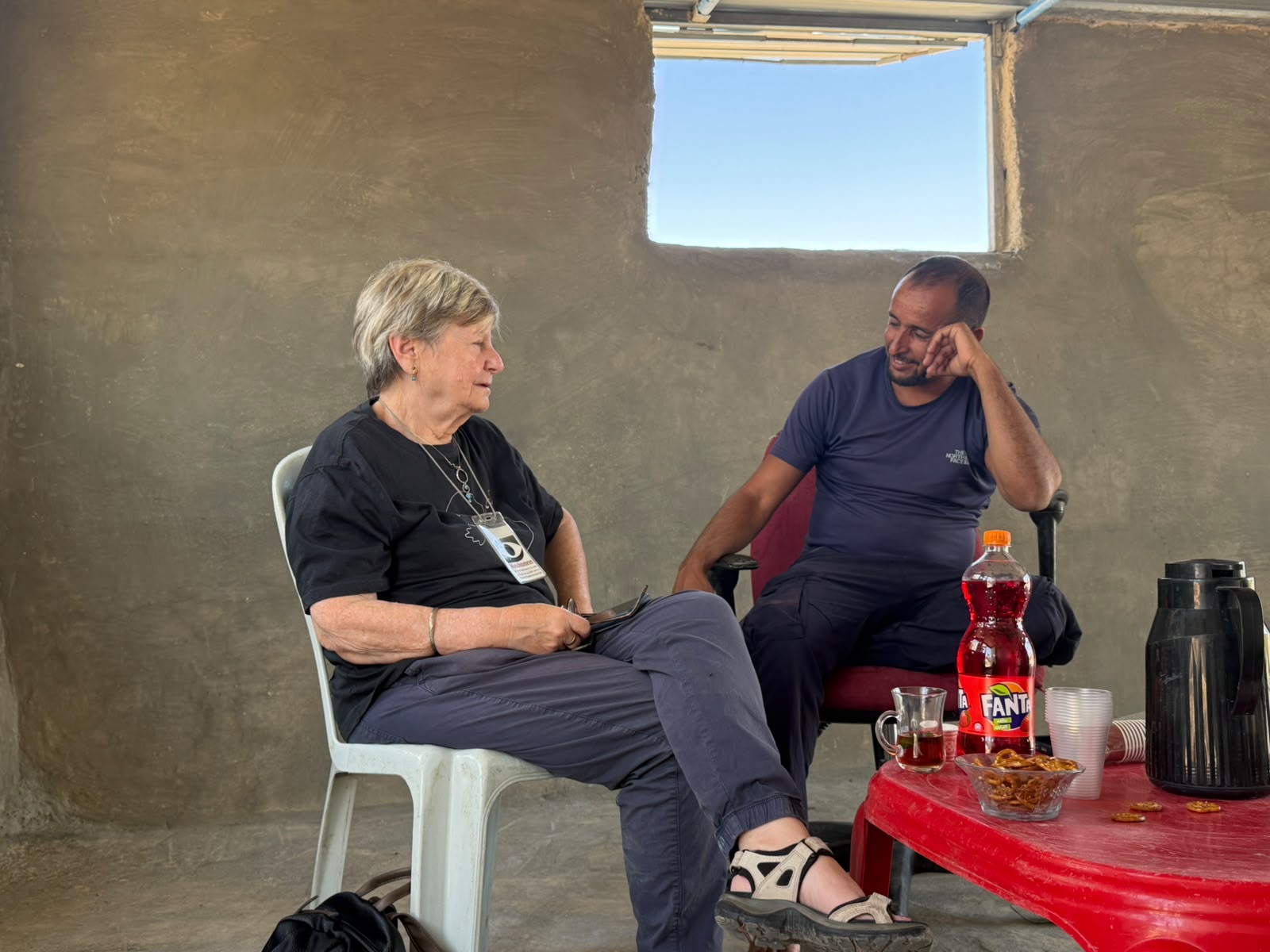 Muhammad D.Oct-10-2026Smadar with Najeh in Umm Qusa
-
