
Sansana (Meitar Crossing), South Hebron Hills, Tue 16.7.13, Morning
Translator: Charles K.
Everything’s sleepy and quiet all along the way during these late morning hours.
When we reached the entrance to Kiryat Arba, Netanya told us about unusual activity she saw before the entrance, on her way from Jerusalem. And in fact, a few hundred meters from the turn from Highway 60 to Kiryat Arba, going toward Jerusalem, we see many vehicles belonging to the police, the Civil Administration and settlement security coordinators parked on the right side of the road. So we stopped and got out to see what was going on. They said they were all gathered by the roadside because they discovered pipes laid by water thieves that greatly reduced the water pressure in Kiryat Arba, which barely had water last week.
The settlers signal our arrival to the police; the officer, their obedient soldier, rushes toward us and hurriedly asks M., our driver, for license and registration. He claims he’s forbidden to park that way, and will get a ticket.
Our argument that many civilian vehicles were parked there, and that we’ll move the car, didn’t help. “All the vehicles,” he says, “have been specially permitted to park by the police.” Our driver gets annoyed, says he saw the settlers instructing the police how to treat us because they saw where we were from and that he was Arab; it’s simply racism. The police officer explains to me that there was a violation and he has to issue a ticket. All my efforts to get him to let us off were fruitless. “I would have let you off,” he said, “if the driver hadn’t been insubordinate.” And anyway, “3000 tickets a year are issued here, half to Jews, so how can you say we discriminate. They have it very good here; they should see what’s happening in Arab countries.” “OK,” I said, “why don’t you masquerade as an Arab and travel around like that for a month, then come back and tell us there’s no racism and how good it is to be an Arab here.” He grins shamefacedly and says he can’t cancel the ticket because his colleague already sent the information by computer.
Our driver wants to go to court, not pay the ticket, and risk getting a large number of points that will endanger his livelihood. We’ll testify, of course, and hope things end well.
The lords of the land are also the lords of the army and the police.
In Hebron the apartheid continues as usual and everything is quiet.
When we returned through the Meitar checkpoint a new, young, energetic female employee asks us to go to the security inspection area. “Ma’am, whatever you want to ask, do it there,” she says when I express my surprise.
So we went to the inspection area and I protest again and call Motti, the checkpoint manager. He didn’t answer, but that must have done the job. The embarrassed affable shift manager arrived, explained that he knows us, and that you just have to talk to me and everything will be ok. He goes to get our ID cards from the “diligent” gatekeeper, and releases us. Our driver says he saw him reprimand the employee who suddenly decided to detain us.
Let’s hope this was a one-time incident and not a sign of new directives.
Meitar checkpoint / Sansana
See all reports for this place-
Meitar Checkpoint / Sansana The checkpoint is located on the Green Line and serves as a border crossing between Israel and the West Bank. It is managed by the Border Crossing Authority of the Defense Ministry. It is comprised of sections for the transfer of goods as well as a vehicle checkpoint (intended for holders of blue identity cards, foreign nationals or diplomats and international organizations). Passing of Palestinians is prohibited, except for those with entry permits to Israel. Palestinians are permitted to cross on foot only. The crossing has a DCO / DCL / DCL / DCL (District Coordination Office), a customs unit, supervision, and a police unit. In the last year, a breach has been opened in the fence, not far from the crossing. This breach is known to all, including the army. There does not appear to be any interest in blocking it, probably as it permits needed Palestinian workers without the bureaucratic permits to get to work in Israel. Food stalls and a parking area economy have been created, but incidents of violent abuse by border police have also been recorded. Updated April 2022
-
South Hebron Hills
See all reports for this place-
South Hebron Hills
South Hebron Hills is a large area in the West Bank's southern part.
Yatta is a major city in this area: right in the border zone between the fertile region of Hebron and its surroundings and the desert of the Hebron Hills. Yatta has about 64,000 inhabitants.
The surrounding villages are called Masafer Yatta (Yatta's daughter villages). Their inhabitants subsist on livestock and agriculture. Agriculture is possible only in small plots, especially near streams. Most of the area consists of rocky terraces.Since the beginning of the 1980s, many settlements have been established on the agricultural land cultivated by the Palestinians in the South Hebron Hills region: Carmel, Maon, Susia, Masadot Yehuda, Othniel, and more. Since the settlements were established and Palestinians cultivation areas have been reduced; the residents of the South Hebron Hills have been suffering from harassment by the settlers. Attempts to evict and demolish houses have continued, along with withholding water and electricity. The military and police usually refrain from intervening in violent incidents between settlers and Palestinians do not enforce the law when it comes to the investigation of extensive violent Jewish settlers. The harassment in the South Hebron Hills includes attacking and attempting to burn residential tents, harassing dogs, harming herds, and preventing access to pastures.
There are several checkpoints in the South Hebron Hills, on Routes 317 and 60. In most of them, no military presence is apparent, but rather an array of pillboxes monitor the villages. Roadblocks are frequently set up according to the settlers and the army's needs. These are located at the Zif Junction, the Dura-al Fawwar crossing, and the Sheep Junction at the southern entrance to Hebron.
Updated April 2022
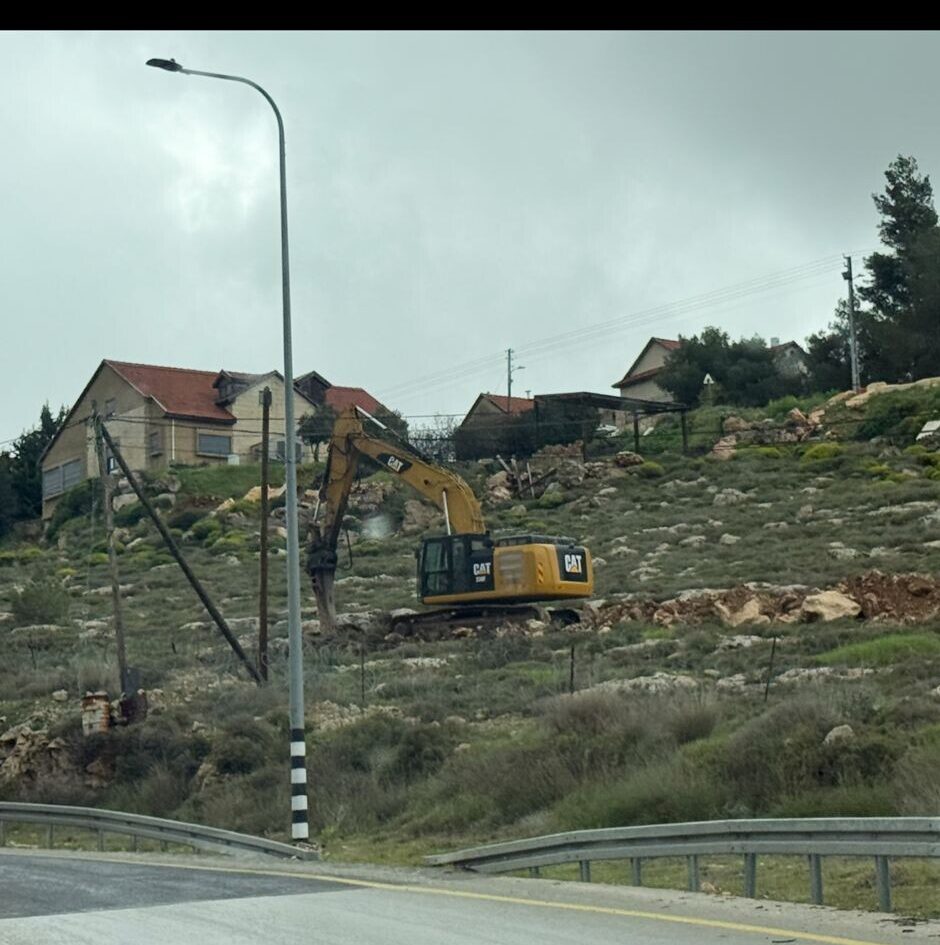 MuhammadFeb-24-2026South Hebron Hill, Beit Hagai: Paving an internal security road
-