
Sansana, South Hebron Hills, Fri 3.4.09, Morning
7:30 – 18:00
We left Beit Shemesh in the morning. The weather is foggy and we are accompanied by several shepherds in Sussia who want to get to their fields far away from their village close to a settlement and are afraid to go alone.
Sansana – Maitar Checkpoint
Light pedestrian traffic. A few transits and several people are waiting in the parking lot on the Israeli side. There is no one in the checkpoint. There are several cars waiting in the vehicle inspection area.
Road 60
It is relatively early. There is thick fog and almost no traffic. The hills have become green after the recent rains, but there has not been enough. We continue to be optimistic and hope that this area will get a little more rain.
Sussia: the usual morning routine. The shepherds have not yet come out of their tents. We sit in Nasser’s tent chatting, drinking a lot of tea and trying to think together about what can be done about the new construction that has begun recently on the hill distant from the settlement.
Around 9:00 we go on a hike through the south Hebron hills with the shepherds. The sky begins to clear and the sun comes out. We reach the hill behind the archeological site with the shepherds. Nasser tells me that a plow exhibited in the museum there was left behind by the Palestinian residents of Sussia when they fled when the settlement was evacuated in the 1980s. He says that there is a sign hanging on the plow that says it is from the Biblical period. We laugh at the Jews’ ability to make a valuable heritage out of everything – even if it is not ours. Near the fence at the site the Jews plowed the sections in a haphazard manner and planted wheat. Now, when the flocks have arrived, they can say that it is their wheat and their land. We deliberately go farther up with the herds into the fields. The sheep are very pleased because the grass is good there. The atmosphere is pastoral and calm. About two hours later, three settlers arrive. Two remain far away, while one breaks into a run towards the fence, shouting and making a lot of noise, to frighten the sheep and scatter them (as was done last week). When he sees the cameras aimed at him he retreats. Several minutes later we see three adults – two men and a woman – and two small children walking about the site. One of the men who is holding a baby girl and leading a small boy by the hand descends towards us. The other young man, who can now be identified as the one who attempted to frighten the sheep away, remained behind with the woman. The father, a religious man from Arad, comes towards us. “He has to know what brings us here.” There is pleasant conversation for a few minutes. There are, of course, differences of opinion that cannot be bridged but people are listening to each other. We reach an impasse when he declares that he believes in violence, is prepared to sacrifice his children for the land on which we are standing, and anyone who believes that the conflict can be solved in any other way is naïve and gullible. I can only feel sorry for him. He turns to leaves, going back to his wife. At this point the young man — who I now identify as a known troublemaker whom I have seen before on several occasions – begins to descend towards the sheep. I take out my camera and photograph him. He stops and sits down. The other young man attempts to blame me and claims that I am taking pictures in order to be disruptive. What would you say to this? We are then joined by two more. We sit down next to a nearby well, light a fire, prepare tea and eat pita bread with organic preserves made from fruit grown in Sussia. It’s the best preserves I’ve ever eaten. We sit there, a group of young people, drinking tea and talking. The hills are green and the sun caresses our backs. The sheep have stopped grazing and have been watered and rest nearby.This is how the south Hebron hills will look when peace comes. Amen.
Meitar checkpoint / Sansana
See all reports for this place-
Meitar Checkpoint / Sansana The checkpoint is located on the Green Line and serves as a border crossing between Israel and the West Bank. It is managed by the Border Crossing Authority of the Defense Ministry. It is comprised of sections for the transfer of goods as well as a vehicle checkpoint (intended for holders of blue identity cards, foreign nationals or diplomats and international organizations). Passing of Palestinians is prohibited, except for those with entry permits to Israel. Palestinians are permitted to cross on foot only. The crossing has a DCO / DCL / DCL / DCL (District Coordination Office), a customs unit, supervision, and a police unit. In the last year, a breach has been opened in the fence, not far from the crossing. This breach is known to all, including the army. There does not appear to be any interest in blocking it, probably as it permits needed Palestinian workers without the bureaucratic permits to get to work in Israel. Food stalls and a parking area economy have been created, but incidents of violent abuse by border police have also been recorded. Updated April 2022
-
South Hebron Hills
See all reports for this place-
South Hebron Hills
South Hebron Hills is a large area in the West Bank's southern part.
Yatta is a major city in this area: right in the border zone between the fertile region of Hebron and its surroundings and the desert of the Hebron Hills. Yatta has about 64,000 inhabitants.
The surrounding villages are called Masafer Yatta (Yatta's daughter villages). Their inhabitants subsist on livestock and agriculture. Agriculture is possible only in small plots, especially near streams. Most of the area consists of rocky terraces.Since the beginning of the 1980s, many settlements have been established on the agricultural land cultivated by the Palestinians in the South Hebron Hills region: Carmel, Maon, Susia, Masadot Yehuda, Othniel, and more. Since the settlements were established and Palestinians cultivation areas have been reduced; the residents of the South Hebron Hills have been suffering from harassment by the settlers. Attempts to evict and demolish houses have continued, along with withholding water and electricity. The military and police usually refrain from intervening in violent incidents between settlers and Palestinians do not enforce the law when it comes to the investigation of extensive violent Jewish settlers. The harassment in the South Hebron Hills includes attacking and attempting to burn residential tents, harassing dogs, harming herds, and preventing access to pastures.
There are several checkpoints in the South Hebron Hills, on Routes 317 and 60. In most of them, no military presence is apparent, but rather an array of pillboxes monitor the villages. Roadblocks are frequently set up according to the settlers and the army's needs. These are located at the Zif Junction, the Dura-al Fawwar crossing, and the Sheep Junction at the southern entrance to Hebron.
Updated April 2022
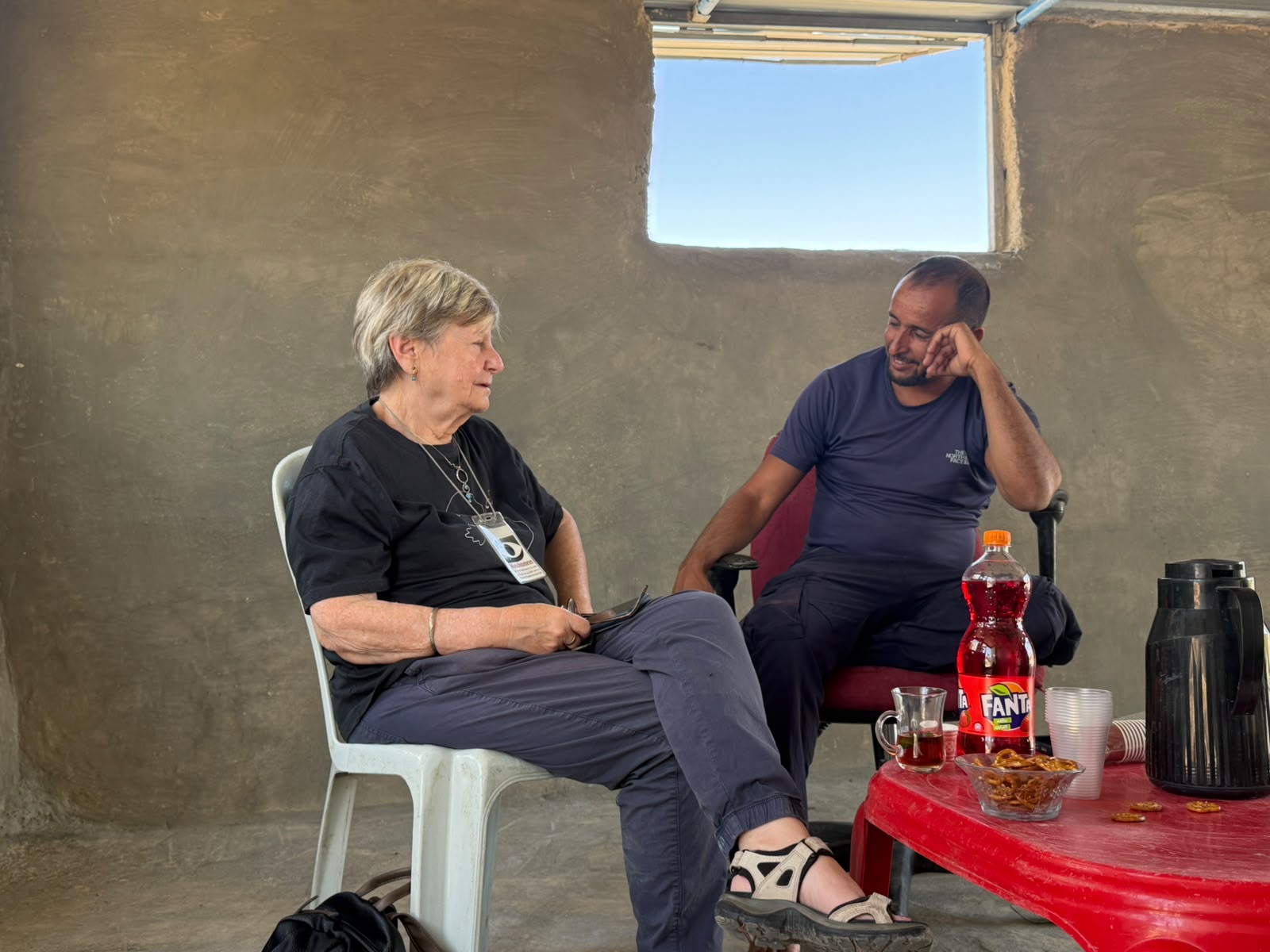 Muhammad D.Oct-10-2026Smadar with Najeh in Umm Qusa
-
