
Sansana, South Hebron Hills, Sun 10.2.08, Morning
7:00- 10:30
Meitar (Sansana) CP
7:00AM. About 200 people waiting at the roadblock. There doesn't seem to be any movement. In response to our inquiry, some of the people say they've been waiting for 20 minutes and some say an hour and a half.
7:03AM, miraculously the queue begins to move; people enter in large groups of about 30 people each time. Within 25 minutes, the roadblock is clear.
The workers complain that they cannot pass work tools through the roadblock. Later, Leah asks the roadblock commander, and he says that according to their rules, the workers were supposed to pass the tools during the first month of the civil operation of the roadblock and leave them in Israel – i.e. to rely on the employer. It's a problematic arrangement.
One person is required to leave behind a plastic bottle with olive oil. We calculated that if the guy is an unskilled worker, he gets less than 10NIS an hour – The cost of taking a ride down to the roadblock + the cost of the oil he left behind, makes his work day unprofitable up to finishing at a loss.
Two other people are turned around because they don't have a permit.
The voice of the security inspector inside the facility can be heard all over the area – unpleasant and degrading.
7:35AM – Soldiers open the side gate beside the revolving gate to go buy Falafel. As a result, the first revolving gate stops working and one worker stays trapped inside – waiting. Leah shouts –" The employer will leave the worker behind! Let him pass! He will lose a day of work because of your Falafel!"
Without a word, the soldiers get out of the passage and close the gate. The revolving gate is released and the worker passes through.
Two other people tell us that their licenses have been taken without any explanation, and that they've been ordered to go to the GSS (General Security Services) to retrieve their licenses. One of them has been at the GSS offices 3 times already and has yet to get his license back. We promised to check it out.
The workers tell us that the bypass road to Ramadin was closed about a week ago, and that taxis are prohibited from getting near. They get to the roadblock by foot through the mountains. We drive down there to see, and it is indeed so – huge dirt and stone bodies are blocking a wide road.
Route 60
Sheep Junction – We stop to talk to taxi drivers. They tell us that IDF soldiers break the windows of their vehicles if they dare get too close to the barricade (which is made of dirt and stone and is impossible to pass through by taxi). Another original form of punishment is to sit the drivers down in the mud with their eyes covered.
The drivers withdraw about 20 meters from the barricade.
We also met the head of the village Khalit Al Dav Aria. The village has a population of 5,000 people, and has 3 schools. He tells us about a graffiti in Arabic that was sprayed on an electric utility box which read: "Mohammad is an offspring of a pig". One of the drivers shows us a picture he took of the graffiti on his mobile phone. To be absolutely clear – the word pig was misspelled in English "big". They think soldiers wrote it. Someone from the DCO erased it.
Another person, a member of "Fatah", tells us that he was beaten up by soldiers a couple of weeks ago, and that they wrote on his membership card that he must come down to the DCO on January 3rd. He was afraid to go and asked us to check how he can file a complaint against the soldiers.
Exhausted and disturbed, we decided to skip Hebron and go home.
Meitar checkpoint / Sansana
See all reports for this place-
Meitar Checkpoint / Sansana The checkpoint is located on the Green Line and serves as a border crossing between Israel and the West Bank. It is managed by the Border Crossing Authority of the Defense Ministry. It is comprised of sections for the transfer of goods as well as a vehicle checkpoint (intended for holders of blue identity cards, foreign nationals or diplomats and international organizations). Passing of Palestinians is prohibited, except for those with entry permits to Israel. Palestinians are permitted to cross on foot only. The crossing has a DCO / DCL / DCL / DCL (District Coordination Office), a customs unit, supervision, and a police unit. In the last year, a breach has been opened in the fence, not far from the crossing. This breach is known to all, including the army. There does not appear to be any interest in blocking it, probably as it permits needed Palestinian workers without the bureaucratic permits to get to work in Israel. Food stalls and a parking area economy have been created, but incidents of violent abuse by border police have also been recorded. Updated April 2022
-
South Hebron Hills
See all reports for this place-
South Hebron Hills
South Hebron Hills is a large area in the West Bank's southern part.
Yatta is a major city in this area: right in the border zone between the fertile region of Hebron and its surroundings and the desert of the Hebron Hills. Yatta has about 64,000 inhabitants.
The surrounding villages are called Masafer Yatta (Yatta's daughter villages). Their inhabitants subsist on livestock and agriculture. Agriculture is possible only in small plots, especially near streams. Most of the area consists of rocky terraces.Since the beginning of the 1980s, many settlements have been established on the agricultural land cultivated by the Palestinians in the South Hebron Hills region: Carmel, Maon, Susia, Masadot Yehuda, Othniel, and more. Since the settlements were established and Palestinians cultivation areas have been reduced; the residents of the South Hebron Hills have been suffering from harassment by the settlers. Attempts to evict and demolish houses have continued, along with withholding water and electricity. The military and police usually refrain from intervening in violent incidents between settlers and Palestinians do not enforce the law when it comes to the investigation of extensive violent Jewish settlers. The harassment in the South Hebron Hills includes attacking and attempting to burn residential tents, harassing dogs, harming herds, and preventing access to pastures.
There are several checkpoints in the South Hebron Hills, on Routes 317 and 60. In most of them, no military presence is apparent, but rather an array of pillboxes monitor the villages. Roadblocks are frequently set up according to the settlers and the army's needs. These are located at the Zif Junction, the Dura-al Fawwar crossing, and the Sheep Junction at the southern entrance to Hebron.
Updated April 2022
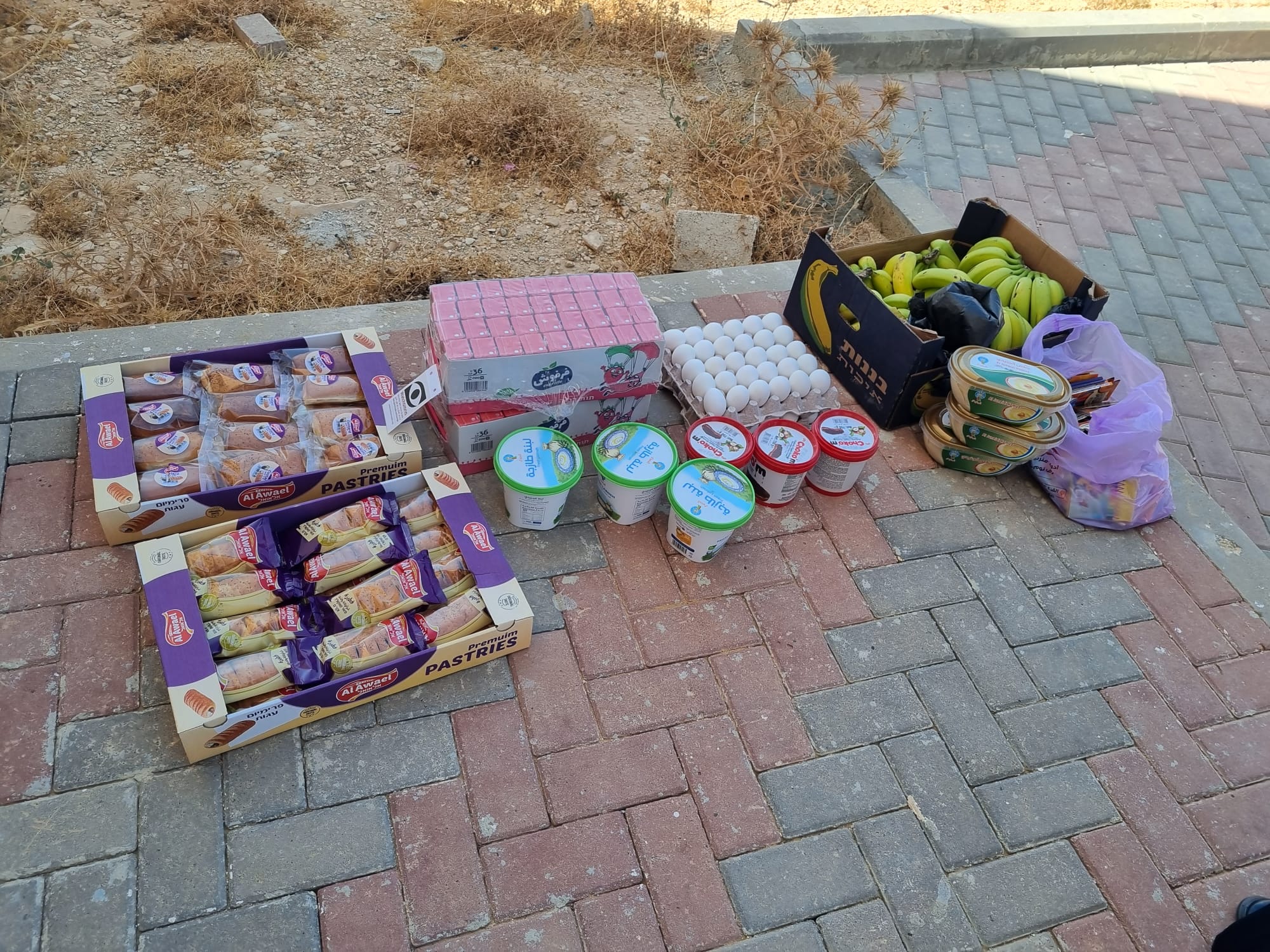 Muhammad D.Sep-27-2026Food items we brought to Huda's kindergarten in Khashem a-Daraj
-
