
Sarra, Beit Iba, Jit
SARRA, BEIT IBA, JIT JUNCTION, Saturday 11 December 2004 AMObservers: Miri Z., Solly F., Hava H. (reporting)colour=red>Following up a conversation between a Sarra villager and one of our observers last week – we went to the Sarra checkpoint which we had not visited for some time.There were no turnstiles and no concrete “sleeves” leading to the checking stations here: it was just a large outpost on the hill and a small position in the middle of nowhere, manned by two soldiers. The people passing through came from four villages – Iraq Burin, Madama, Tell and Sarra. Pickup trucks brought them to the checkpoint where they got out, were checked and got into the vehicles again, to be taken on to ….the Beit Iba checkpoint. There they were checked again and finally went through to Nablus.We asked first if the soldiers had received instructions regarding the elections to the Palestinian Authority. It transpired that as far as they were concerned (and the same sense was conveyed at all the other checkpoints we visited today) these elections might just as well be taking place on the moon. They knew nothing about them and had been given no instructions. We chatted with the soldier on duty about the occupation and its implications.We left Sarra at 09:00 and drove to Beit Iba. At the Jit junction where vehicles from Qalqiliya, Tulkarm and all the villages around go through to Nablus, there was an unannounced checkpoint – with several vehicles waiting to go through on either side. The passengers were not told to get out and all the vehicles were released to go on their way almost as soon as we arrived. There too we talked to the soldiers who told us about the leaflets which the Blue and White [Likud-sponsored women’s] organization handed out to them telling them to beware of Machsomwatch.At Beit Iba we discovered that the age restriction at the checkpoint had changed: it was now the 14 to 25-year-olds who had difficulties in passing through [it used to be 16 to 30 or 35-year-olds. All others went through without checking. There were seven detainees who were released after 15 minutes.[Detainees are, typically, men aged from 16 to 30 or 35 who have no passage permits; recently, young women, too, have been detained. The detainees’ ID details are phoned through to the General Security Services (GSS, also known as the Shabak or the Shin Bet, the Hebrew acronym for the GSS) for checking against a central list of security suspects and the answers are then relayed back to the checkpoints. This cumbersome process can take considerable time, and that can be prolonged even more if the soldiers wait to accumulate a batch of ID cards before passing them on to the GSS , or if they behave in a similarly tardy manner at the end of the process, waiting until they have a batch of GSS clearances before they release individual detainees. Meanwhile, the detainees are virtually prisoners at the checkpoint where the soldiers retain the ID cards until the entire process is completed]. While we were talking to the soldiers about Qusin village, which lies above the checkpoint, one of them told us that they had lived there for a month. Thus we discovered that the house which the army had requisitioned and whose occupants it had driven out a year ago was still being used by the army.By the time we were on our way back, the unannounced checkpoint at Jit junction had disappeared, but several new ones were dispersed along the road as far as Huwwara.
Beit Iba
See all reports for this place-
A perimeter checkpoint west of the city of Nablus. Operated from 2001 to 2009 as one of the four permanent checkpoints closing on Nablus: Beit Furik and Awarta to the east and Hawara to the south. A pedestrian-only checkpoint, where MachsomWatch volunteers were present daily for several hours in the morning and afternoon to document the thousands of Palestinians waiting for hours in long queues with no shelter in the heat or rain, to leave the district city for anywhere else in the West Bank. From March 2009, as part of the easing of the Palestinian movement in the West Bank, it was abolished, without a trace, and without any adverse change in the security situation.
 Jun-4-2014Beit-Iba checkpoint 22.04.04
-
Jit Junction
See all reports for this place-
The checkpoint is located on Route 60 near at the junction with Route 55, near the village of Jit. There was a checkpoint for vehicles passing between the north and south of the West Bank, which was abolished towards 2010. Since then, surprise checkpoints have been set up there from time to time with a police or Border Police vehicle, and vehicles and their passengers are inspected.
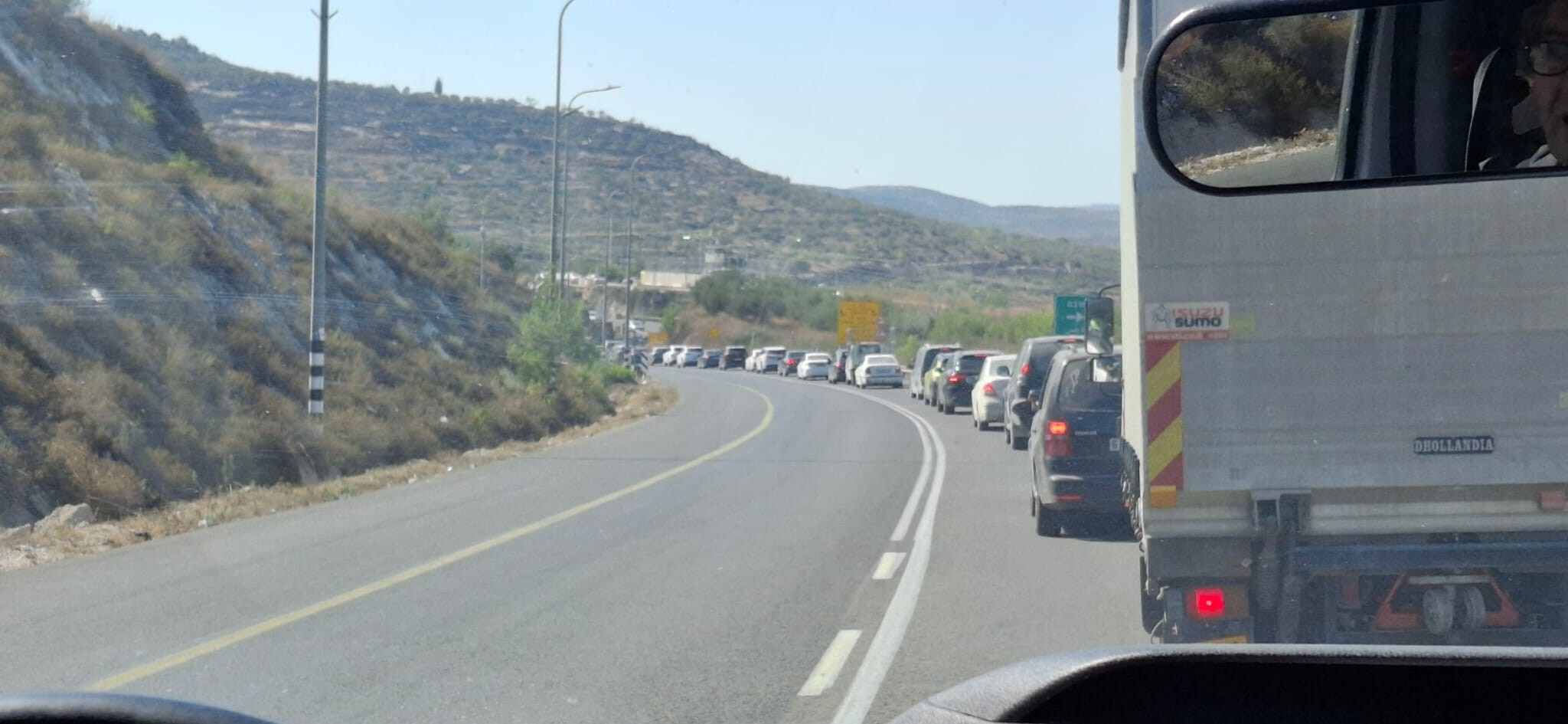 Anat PolakJul-17-2025Yitzhar Road, Jit Junction: traffic jam
-
Madama
See all reports for this place-
Madama
This village is situated in the Nablus district, about 5 kilometers south of the city of Nablus, at an altitude of 517 meters above sea level. Madama was founded 400 years ago and its villagers originate from the Arabian Peninsula. It numbered 1,728 inhabitants in 2007. 62% of the village area is categorized as Area B, and 38% as Area C.
Over the years, hundreds of dunams have been robbed of the village for the purpose of building settler-colonies, army bases, and paving roads:139 dunams were sequestered to found settler-colony Yitzhar south of the village, and the land was also confiscated for paving road 60. The road and its buffer zone (75 meters on each side) lined by barbed wire fences separate the village’s farmlands to the north and the village farmers are denied access to tend them. The road also separates Madama and Burin, two villages with close neighborly ties, and now not able to access the road directly.
The settler-colony Yitzhar has become a daily threat to the village. The settler-colonists planted trees in fenced-in groves, steal crops, burn, uproot and vandalize Palestinians’ trees, and harm both holy sites and property. They also attack the Palestinian landowners in order to terrorize them and prevent them from accessing their lands.
For further information: http://vprofile.arij.org/nablus/pdfs/vprofile/Madama_vp_en.pdf
-
Sarra
See all reports for this place-
Sarra
The checkpoint is installed between the Palestinian village of Sera and the district city of Nablus,
Since 2011, internal barriers Located among the West Bank Israeli settlements have somehow allowed, Palestinian residents to travel and move and reach various Palestinian cities.
After the terrible massacre by the Hammas on October 7 upon Israelis in the communities around Gaza, internal checkpoints manned by the army were installed to prevent free passage for Palestinians.
Many restrictions were imposed on the Palestinians in the West Bank. The prevention of movement shuttered the possibility of making a living in Israel. The number of Palestinian attacks by Israeli extremist settlelers increased along with the radicalization of the army against the Palestinians.
The conduct at the Sera checkpoint is one of the manifestations of the restrictions on all aspects of the Palestinians' lives.
-
