
Shuafat Camp: It is unclear how many students are still not registered in schools
7:30 at the Zeitim Checkpoint:
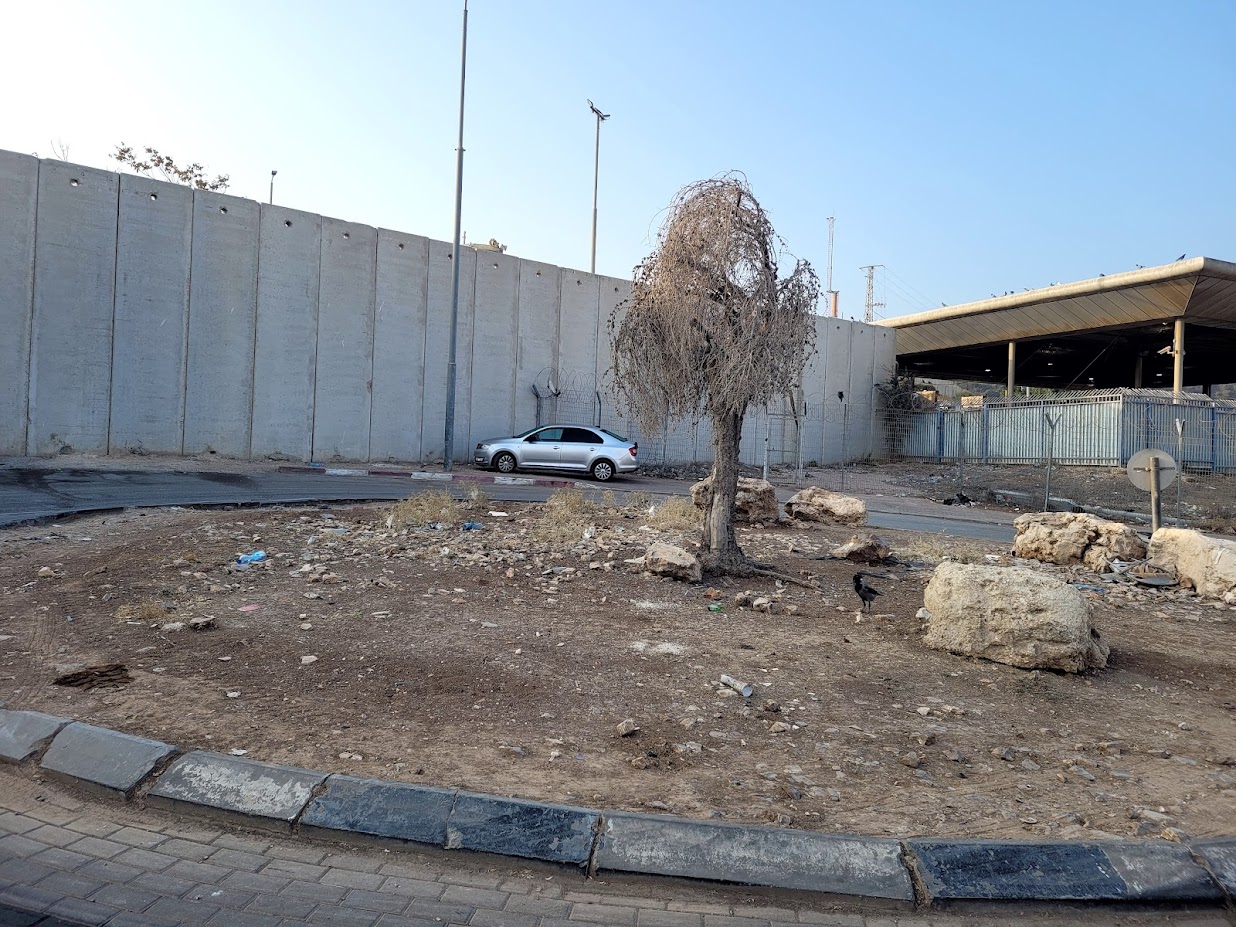
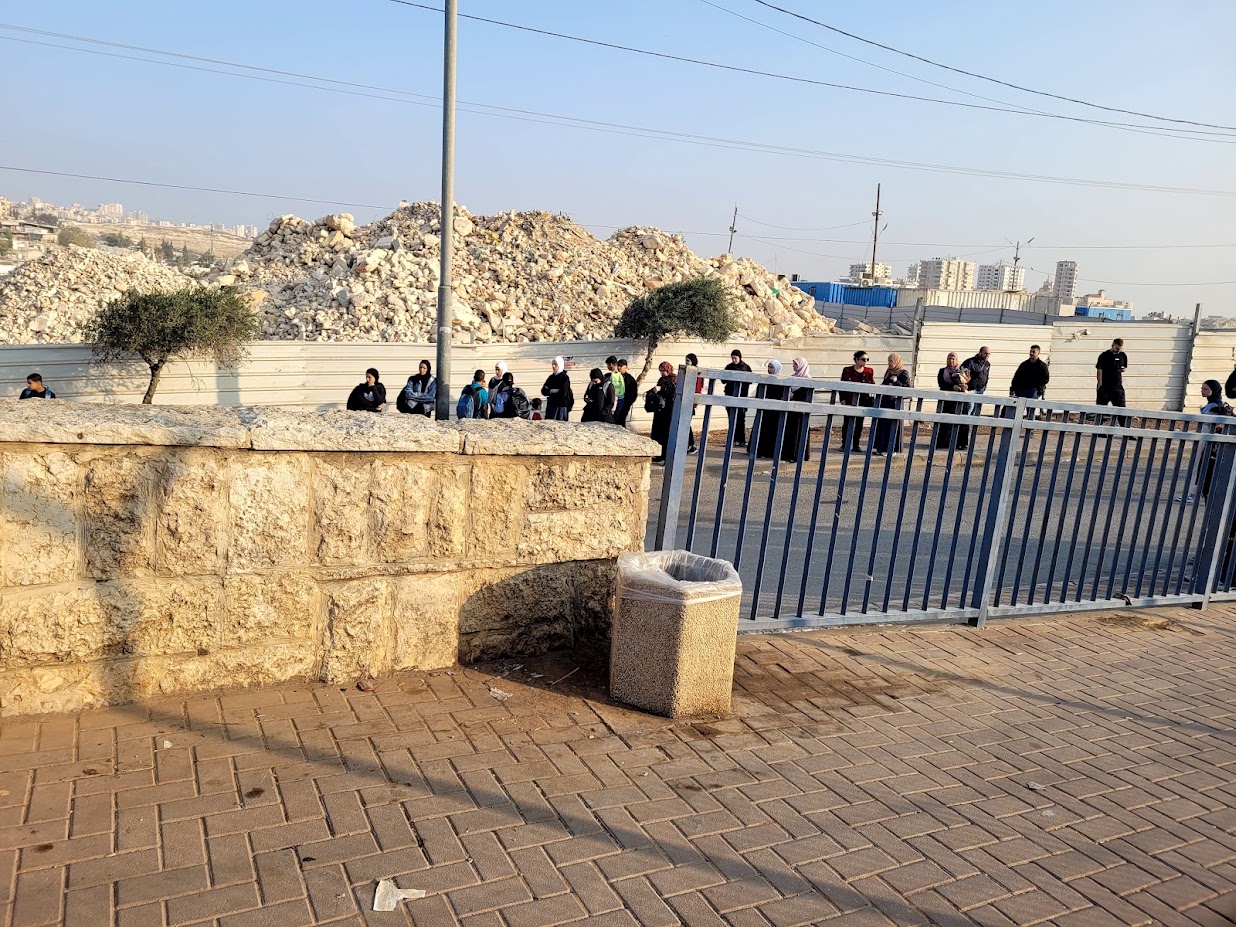
This is rush hour at the checkpoint through which permit-holders from the southern Jerusalem neighborhoods beyond the wall go into the city for school and work. Today we see one or two buses arriving, but the traffic is light and the passage through the checkpoint is smooth. On the Palestinian side in Azzariya, shuttle drivers make the most of the two hours during which the checkpoint is open toward Jerusalem to earn their daily wage.
A young woman from the Shuafat Camp has arrived here via a long detour, because the checkpoint of the camp that’s near her home is open only to blue-ID holders.
When we approach the inspection post, we find that the soldiers and the supervising policeman just want us to get the hell out of there. They don’t even check our IDs. Our conversation with them takes place through shouting behind the sealed glass window, because none of the speakers connecting those crossing and those inspecting at the checkpoint are working. A deliberate policy—the ruling side may speak and give instructions; the ruled side is better left unheard.
8:30 Shuafat Refugee Camp:
We’d visited the camp before the summer, and after Israel shut down the three UNRWA schools operating there since before 1967. About 800 students of all ages were displaced from school, including about 650 blue-ID–holding students from the Shuafat Refugee Camp.
We tried then to find out where these children would study, but the director of the UNRWA compound was afraid to speak with us. The long summer vacation was approaching, and by the time the school year began, we read in Noa Limone’s Haaretz article and in an Ir Amim report on education in East Jerusalem: no alternative schools were established. The intention was to have students enroll only in schools that teach the Israeli curriculum, and about 600 students still could not find any school at all. According to information from the Association for Civil Rights in Israel, the municipality shut down additional schools in the camp that did not meet its requirements, worsening the situation.
From what we checked, two elementary schools currently operate in the camp that meet Jerusalem Municipality standards:
Al-Furqan, an elementary school (grades 1–6) located in what was once the meat market, and Al-Razi, a private elementary/secondary school supervised by the municipality.
What is happening now? We were still unable to find out. We decided to visit with Kamal, our driver, who lives in the camp and holds a blue ID. Kamal told us that education is of the utmost importance to Palestinians, and in his view all parents send their children to study—either in the camp or outside it.
- We first visited at Al-Furqan Elementary School which operates under full municipal supervision. We visited it in the past and were impressed by its sloped, unique structure—the old market stalls turned into small classrooms, with a concrete courtyard where assemblies and recess activities take place.
We were pleased to see that the school appears more invested in and well-organized than before. They were hesitant to speak with us, but the vice principal told us that they absorbed 150 students from the closed schools and received special budgets from the Jerusalem Municipality for teachers and equipment. The city intends to expand the school into the lot behind it and enlarge the special-education classrooms. Over the summer, educational workshops were held to prepare the students.
We were only able to peek into the small classrooms; despite the crowding, everything ran smoothly. We also saw a student wind orchestra heading out to a musical activity outside the camp.

- Al-Razi School: the situation in the second school we visited, Al-Razi, was far more chaotic. Here too, they were very afraid to talk to us. The crowding in the classrooms was unbearable, and we were told that the school accepted only 75 students due to lack of space, while about 200 parents come every day seeking admission and are turned away. We understood that the school is indeed private but also admits students who cannot pay.
We also learned that about two years ago a nearby school building—with a valid permit—was demolished because a few additional classrooms were built, and no new school has been built since.
Our Impression:
It seems there are serious concerns that, despite municipal promises, many students have still not been absorbed into other schools near the camp. The general shortage of classrooms throughout East Jerusalem, along with accessibility difficulties caused by checkpoint traffic, prevent many children from finding any place to study. We will continue to follow the situation.
We headed to Road 437 through Anata, which is connected to the Shuafat Refugee Camp but marked as Area B and therefore receives no municipal services from Jerusalem. On the way we saw work being done on the main road running through the camp, a severely deteriorated roadway. The project was promised on a large sign near the checkpoint several years ago.
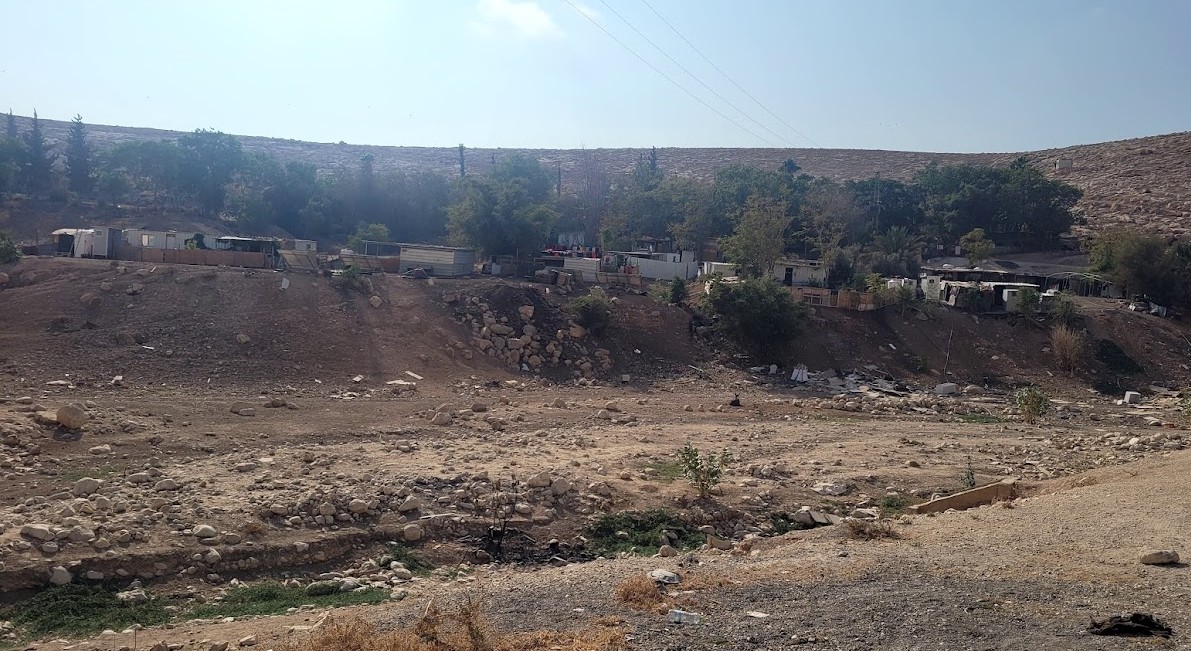
From Anata we continued south to Mishor Adumim on Road 437, along which Palestinian traffic from the Dead Sea area bypasses Jerusalem. If the E1 bloc is built, it will play a central role in redirecting Palestinian traffic onto apartheid roads toward Bethlehem, Hebron, Ramallah, and Nablus. Throughout the road we saw many Bedouin communities in the valleys, and across the hills several new outposts that had recently been established. Will these Bedouin communities be expelled?
We returned to Jerusalem from Mishor Adumim via Highway 1.

Location Description
'Anata / Al-'Isawiya
See all reports for this place-
'Anata / Al-'Isawiya
A checkpoint on the Eastern Ring Road (4370) opened to traffic at the end of 2018 and connects Route 437 to Route 1 inside Jerusalem. Passing of Palestinians is prohibited except for blue identity cards. Staffed by Border Police from 5:30 a.m. to evening.
-
Checkpoint Shu'afat camp / Anata-Shu'afat (Jerusalem)
See all reports for this place-
The Shu’afat checkpoint is located in the northern part of East Jerusalem at the exit from the village of Anata and the Shu’afat refugee camp, which are located in the area annexed to Jerusalem in 1967. The refugee camp borders the Shu’afat neighborhood to the west, Pisgat Ze’ev to the north, the French Hill neighborhood to the south and the planned expansion of Ma’aleh Adumim to E-1 in the east. It was established in 1966 for 1948 refugees from the West Bank and was populated after the Six Day War by persons who had been expelled from the Jewish Quarter. Today its population comprises some 25,000 people holding blue ID cards and some 15,000 people with Palestinian ID cards. The camp lacks adequate infrastructure and services, and suffers from poverty, neglect and overcrowding. All its buildings are connected to the public electricity and water infrastructure, but not all are connected to the sewer system. The camp’s services are provided by UNRWA, except for those such as health clinics and transportation of pupils to schools in Jerusalem. In 2005, the Israeli High Court of Justice rejected a suit by the residents requesting that the route of the separation fence be drawn such that the camp would remain on the Israeli side, but conditioned its approval of the route on the establishment of a convenient and rapid crossing facility for the inhabitants of the neighborhood, most of whom are residents of Jerusalem.
A temporary checkpoint operated there until December, 2011. It was extremely congested during rush hours, and dangerous for pedestrians (especially children) because of inadequate safety provisions. The new checkpoint was inaugurated south of the old one, for public and private transportation and for pedestrians, intended solely for the residents of the camp – holders of blue ID cards, and those with Palestinian ID cards who possess appropriate permits. There are five vehicle inspection stations at the checkpoint, and two for pedestrians (one of which is currently closed) where scanners have been installed but are not yet operating. According to the army, representatives of government agencies will also be present to provide services to residents of the neighbourhood. The pedestrian lanes are very long, located far from the small parking lots, and accessible through only a single revolving gate.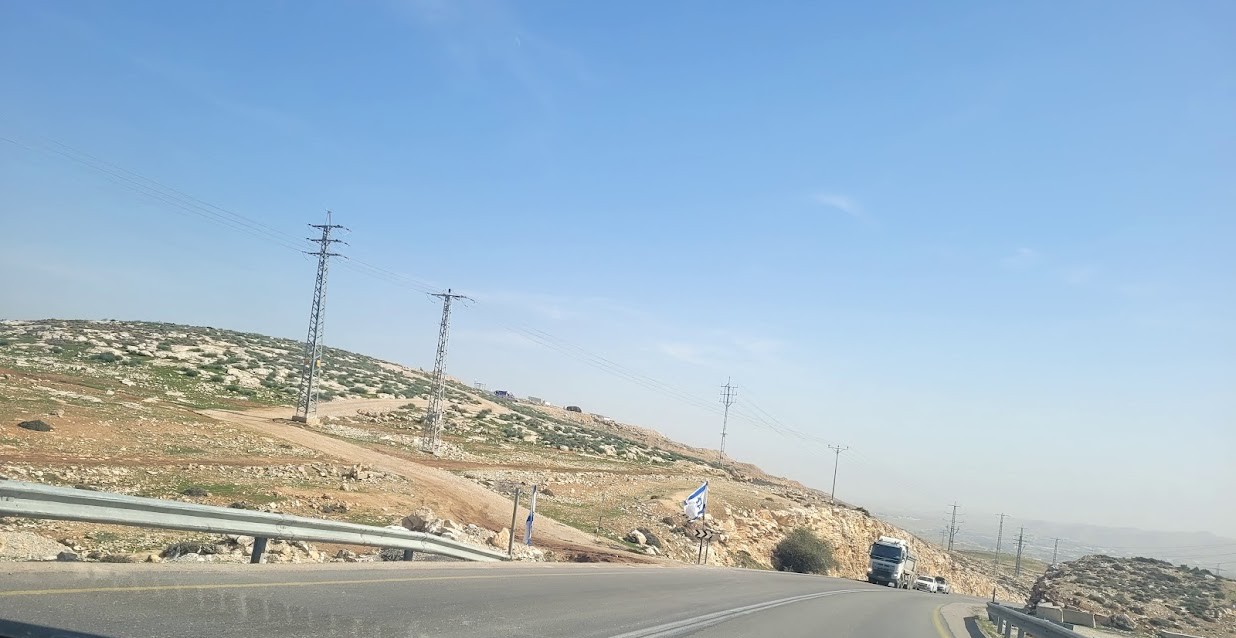 Anat TuegJan-25-2026Anata: A new outpost has been built south of the junction
-
Ras Abu Sbitan (Olive Terminal)
See all reports for this place-
A large checkpoint/crossing to the area of a-Tur, Abu Dis and the Old City; only for pedestrians. Located on Jerusalem’s municipal boundary.
One of the major crossings in Jerusalem’s central sector. It is located on the separation fence between the northern portion of the al-Ezariya neighborhood and the neighborhood of a-Tur and the rest of East Jerusalem. It is manned by Border Police soldiers and private security companies and operates 24 hours a day. Palestinians are forbidden to go through, other than permanent residents of East Jerusalem (holders of blue ID cards) and holders of work and commercial permits who are allowed through only on foot.
-