
South Hebron
South Hebron Hills, and Hebron the city, Oct.26,2005 Shlomit, Leah S. (reporting), 7.00-10.20New location of Sansana checkpoint , moved southward, right before the left turn to Sansana. Lots of construction work all around.In general, road 60 as well as 317 are empty, no Palestinian vehicles. As a consequence of the bombing at Gush Etzion junction, soldiers from various units reinforce the guard. Young girls from the settlements sit waiting for rides at settlement junctions, reading books.Durra junction/El Fawwar: vehicle entrance blocked in both directions, quite heavy pedestrian traffic from East to West, to Hebron, along the many taxis waiting on both sides. A soldier (from squad commanders’ course): “ Sometimes they throw rocks. Give us trouble, don’t listen to us but I understand them.”At Har Manoach too, at the entrance to the Hebron L&CA there are manned military vehicles on guard.Sheep Junction: quite heavy pedestrian traffic only, in the direction of Hebron. In this direction there are no soldiers at all.Refreshing novelty at roads 60 and 317 junction: large poster of “Bells – another Approach of Mercy” organization (they rehabilitate financially ruined families by guidance and instruction in financial management). We entered the town of Hebron via the northern entrance to Kiryat Arba (Elias Gate named after an Ethiopean Aliya activist that had been living there) without any difficulty. Contrary to our previous visit there, this time it was totally quiet even according to the soldiers report, who had spent there all the holidays (BP and Nahal). Eventually it turned out to be the silence between storms – between the announcement of the “Peace Now” movement about a demonstration planned for the coming afternoon under the slogan of “evacuate Hebron now” and the establishment of illegal outposts on the outskirts of Kiryat Arba and on the “Prayers’ Route” to the Machpela Caves and the following riots involving the army and the police , visitors members of left-wing organizations and Palestinian citizens. It is possible that since we were both wearing skirts, we were mistaken by soldiers and passing-by settlers for religious settler “good girls”.We won’t repeat the description of the terrible general situation of the city of Hebron we will just add what we have observed today.Near Beit Hadassa a man and two women from the TIPH (Temporary International Presence in Hebron) organization tell us that at that spot children throw rocks not only at Palestinians but at vehicles of international organizations as well. We explained them in English about our organization. Tel Roumeida : sign on one of the settlers’ caravan: “No chance I enroll to the Israeli Expulsion Forces ( a pun on IDF)” . When asked how he felt about this, a soldier said:” It does nothing to me, I am left-wing too.” Similar to our conversation with the soldier at Durra, this only proves how important our presence is to the soldiers either as encouragement to those share our views or as a restraint to those who don’t. At the same place two Palestinian women exit their home in the direction of the town, on their house’s gate an inscription is sprayed: “Kahana was right. Death to Arabs” We hand out to Palestinian passers by tickets in Arabic containing information on The Civil Rights Centre, greeting them :” Sabbah-el-Hir”. On our descent to Tarpa’t Square we are stopped by one of them talking to us in fluent Hebrew mainly to point out that peace will come from the simple people on both sides and not from the leaders, through right education. He is a butcher in the Kassba but he can’t always open his shop. For years he has been working in a slaughterhouse in Jerusalem under a rabbi’s (!) supervision. He tells us about a Jew from Tel Aviv who used to come to Hebron bringing clothes and food but once was kidnapped by the Islamic Jihad until Palestinian acquaintances intervened on his behalf and was released. That man still continues his activity as before. Back to Beit Hadassa: On the hill across the settlers’ water pipe and next the Palestinians are fixing the path. The settlers have warned suspecting Palestinian sabotage of the water pipe so soldiers, accompanied by TIPH observers, went up there to inquire. This pipe seems a possible focus of friction and settlers’ provocation in order to escalate the situation and bring to the evacuation of further Palestinian houses. The same settler who photographed me during my previous visit took my picture this time again. Shiyuch junction: as usual, only pedestrians are crossing plus a horse drawn cart speeding from East to West! Hebron-Halhoul Bridge open to traffic. Humanitarian crossing open too. Sair junction blocked by big concrete cubes , on the other side taxis are waiting. A soldier (engineering unit) checks the papers of all pedestrians crossing, meanwhile taxis from Hebron to Abu-Dis are waiting in line for checkup, cars with Israeli license-plates overtake of course at a dangerous speed. The soldier stops one of them and a Palestinian passenger is told to get off for checkup. The soldier seems tough and a bit hostile: “why do you approach the car and talk to them, it’s dangerous! We check them one by one because of the bombings and as you know a woman hid a grenade under a baby.” Back via road 317, quiet and deserted, no Palestinian vehicles. Zief junction blocked by spikes and soldiers.
Hebron
See all reports for this place-
According to Wye Plantation Accords (1997), Hebron is divided in two: H1 is under Palestinian Authority control, H2 is under Israeli control. In Hebron there are 170,000 Palestinian citizens, 60,000 of them in H2. Between the two areas are permanent checkpoints, manned at all hours, preventing Palestinian movement between them and controlling passage of permit holders such as teachers and schoolchildren. Some 800 Jews live in Avraham Avinu Quarter and Tel Rumeida, on Givat HaAvot and in the wholesale market.
Checkpoints observed in H2:
- Bet Hameriva CP- manned with a pillbox
- Kapisha quarter CP (the northern side of Zion axis) - manned with a pillbox
- The 160 turn CP (the southern side of Zion axis) - manned with a pillbox
- Avraham Avinu quarter - watch station
- The pharmacy CP - checking inside a caravan with a magnometer
- Tarpat (1929) CP - checking inside a caravan with a magnometer
- Tel Rumeida CP - guarding station
- Beit Hadassah CP - guarding station
Three checkpoints around the Tomb of the Patriarchs
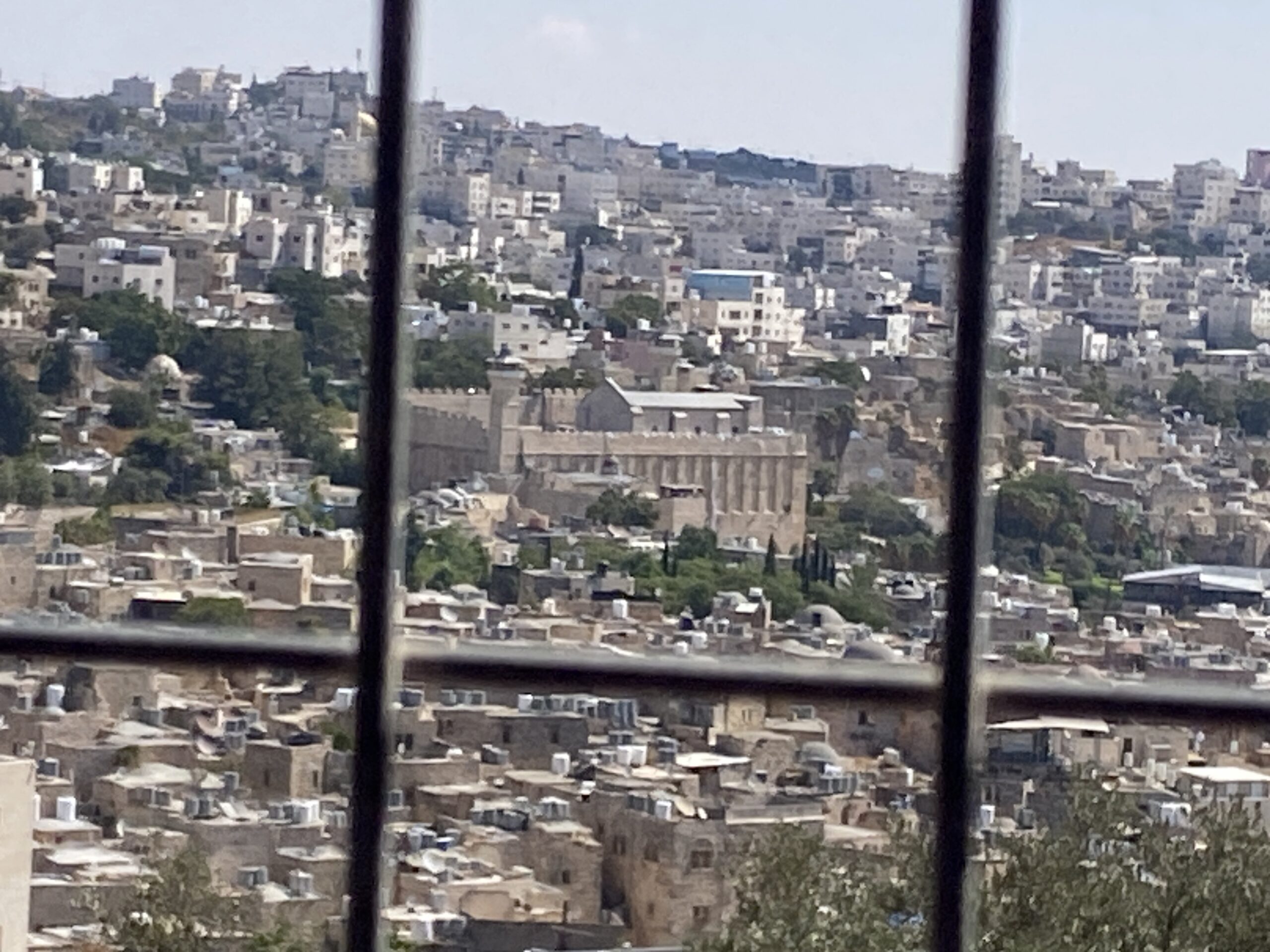 Yael ZoranSep-24-2026Hebron and the Cave of the Patriarchs from Beit Hashalom
-
South Hebron Hills
See all reports for this place-
South Hebron Hills
South Hebron Hills is a large area in the West Bank's southern part.
Yatta is a major city in this area: right in the border zone between the fertile region of Hebron and its surroundings and the desert of the Hebron Hills. Yatta has about 64,000 inhabitants.
The surrounding villages are called Masafer Yatta (Yatta's daughter villages). Their inhabitants subsist on livestock and agriculture. Agriculture is possible only in small plots, especially near streams. Most of the area consists of rocky terraces.Since the beginning of the 1980s, many settlements have been established on the agricultural land cultivated by the Palestinians in the South Hebron Hills region: Carmel, Maon, Susia, Masadot Yehuda, Othniel, and more. Since the settlements were established and Palestinians cultivation areas have been reduced; the residents of the South Hebron Hills have been suffering from harassment by the settlers. Attempts to evict and demolish houses have continued, along with withholding water and electricity. The military and police usually refrain from intervening in violent incidents between settlers and Palestinians do not enforce the law when it comes to the investigation of extensive violent Jewish settlers. The harassment in the South Hebron Hills includes attacking and attempting to burn residential tents, harassing dogs, harming herds, and preventing access to pastures.
There are several checkpoints in the South Hebron Hills, on Routes 317 and 60. In most of them, no military presence is apparent, but rather an array of pillboxes monitor the villages. Roadblocks are frequently set up according to the settlers and the army's needs. These are located at the Zif Junction, the Dura-al Fawwar crossing, and the Sheep Junction at the southern entrance to Hebron.
Updated April 2022
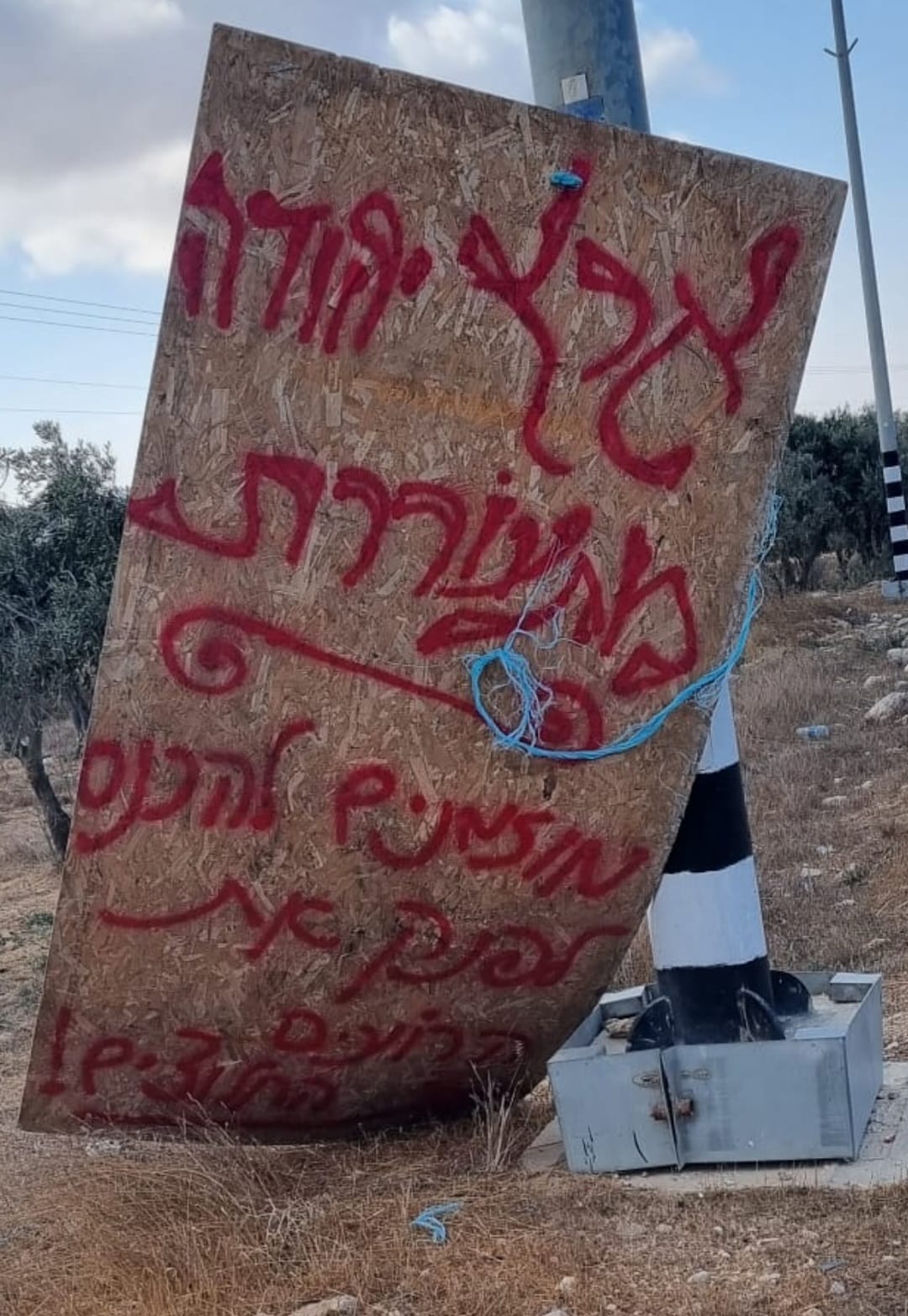 Smadar BeckerOct-17-2026A sign placed by those who call themselves the Pioneer Shepherds, at the outpost adjacent to Qawawis
-
