
South Hebron
Hebron and its Environs Tuesday 5/7/05Observers: Micky, Nina, Elisheva, Raya, Tal, Orit, Susan, Hagit (reporting)We left Kiryat Gat at 0900 and returned to Beersheva at 1430Summary: Hebron is encircled.On the way to Tarqumiya we saw the convoy of buses with the prisoners’ families escorted by the blue police. It was 9:20, which means there must have been a considerable delay. At Tarqumiya there was a long queue of vehicles waiting at the Motor Licensing Office , which was processing them slowly. Two lorries were involved in unloading and loading back-to back and we spoke to small children on holiday who said they worked there. The soldiers look very bored.Idhna –Taarqumiya Thw pillbox is manned as usual. The gates both to Idhna and to Tarqumiya were open and there was taxi traffic between the two villages. We met a representative of the Forum of Bereaved Families who told us that he had had a meeting with Yosi Beilin and with Rami Elhanan recently in Jerusalem, and that he had received a one-day permit to enter Israel. He cant come in regularly since he is on the GSS’ black list. He thought that the reason for this is that they are afraid he will avenge the death of his brother -he is accompanied by a yarmulke-wearing friend from Moshav Aderet-and as he said himself, you can wreak vengeance anywhere. We gave him the phone number of the Center for the Defense of the Individual and also the number of Firas from the Civil Rights’ Organization. We asked him not to place his hopes too high. Meanwhile he was finding it hard to make a living.There was not a single Palestinian vehicle to be seen along the entire length of route 35- complete apartheid was maintained on this road in order to protect the settlements Adora and Telem .Halhul- Hebron bridge The gate from route 35 is closed as usual, the pillbox is manned and the traffic across the bridge is thin, because only cars from Halhul and Hebron can use the bridge. Cars from Jerusalem and Ramallah cannot use it because entry into Halhul from route 60 is blocked.The Humanitarian gate- the Ucafim (Saddles) Junction- routes 35-60. Three DCO men with blue ceramic vests ( the color differentiates DCO men from ordinary soldiers) are imposing the encirclement (keter) of Hebron-applying thr criteria for entry and exit from the city. Only humanitarian cases can enter. The deputy mayor of Hebron is allowed out, but a taxi which comes from East Jerusalem to take a sick child to Hadassah Hospital is not allowed to enter Hebron. We help in arranging a ‘back –to –back’ solution to the problem but don’t wait to see if it works. It seems that the presence of a large group like ours- 8 women – hassles the soldiers and so we leave quickly. As long as the closure of Hebron persists ordinary shifts should spend a lot of time there.East Halhul Junction- barbed wire is stretched across the road. The entry to Halhul is blocked. There are taxis waiting on wither side of the wire. The entrance to Sair is open-and the taxis go round that way- there are absolutely no Palestinian vehicles at all on route 60. Shiyuch- Hebron- the girls’ school: Just as we arrived we saw a humvee arrest a boy of 18 who looks younger – he is handcuffed and then blindfolded with a flannel cloth. The boy was quickly put into the Humveee and they drove away. We had no time to find out what had happened. There was considerable pedestrian traffic from Shiyuch and a lot of taxis on either side. We traced the father of the arrested boy- a taxi driver who was transporting biscuits. The father gave us the ID number of his son and we promised to try and find out what where he had been taken and how long he was going to be detained. We gave the father the phone numbers of M. from BeTselem, and of the Center for the Defence of the Individual, and also mine. It is 11:14 ( the time is on the photo we took). The father says that the boy was arrested when the soldiers took his ID; and he is also of the right age to be a suspect. As we continued our tour I phoned the Operations of Judea brigade –they had no information- only now as the report is being written, I have found out that the boy’s name has been passed to the Red Cross. He will be held for a week and interrogated –and afterwards threy’ll see…I reported this to the boy’s father.Hebron: The guard at Kiryat Arba (who already recognizes us) let us through without problems. Hebron is covered in orange bunting. Otherwise the usual sights greeet us. We conclude from the fact that a house on the Worshippers’ Axis which had been swathed with military netting was now free of it, that the army no longer occupied the building. There are cameras all along the axis –which take photos from every possible angle. Palestinian kids are flying kites. In the square at the end of the axis a man wearing a large black skull cap was lecturing 4 young paratroopers. We decided not to to approach to listen to what he what saying- why ‘make trouble’? Our driver I. parked by the Machpela Cave and we pass through the CP manned by border police near the entrance for Palestinian worshippers and enter Shuhada street. Some of the graffiti had been blacked out (did our photographs have a hand in this?). On entering the quarter of the Patriarch Abraham a paratrooper from 890 regiment manning the CP tells us that his training in playing “catch” in third grade is more important to him here than his training as a fighter. Only that morning he had been involved in running after the settlers’ children who were harassing the Arabs. There no Palestinians to be seen at the entrance into the quarter. We saw again the depressing sight of the Sharabi family’s house and it’s wall. We leave the Patriarch Abrahams’ quarter and continue towards the Casba .The soldier at the CP feels positively threatened by us and tells us off his own bat that we are not allowed to be there –he refuses to let us explain and we decide not to insist. Other soldiers are already reporting our presence over the phone. In front of Beit Shneiurson there is another CP and we were again told by a soldier that we had no right to be there . We called I. to come and get us and meanwhile a military patrol came up to us and asked, politely, if we wanted to go to Tel Rumeida in which case they would escort us there. They feared a confrontation between us and the settlers. We decided not to make use of the soldiers’ services. On our way out of Hebron in the minibus I. our driver, recognized the driver of the ambulance belonging to the Jewish quarter in Hebron- who initiated the attack on the women on the last shift which entered Hebron. On our way out of Kiryat Arba the guard came over to speak to us and referred to us as “the extremist leftwingers” in a heavy Russian accent, It was very funny.Route 60: All the usual barriers are in place. Beni Naim is also closed off. Route 356 on the way to Yatta. A hired car with a family including a baby were trying to pass. Imagining they were stuck we stopped to ask if we could help . “No no no –there’s no need” they quickly said, clearly afraid of us and our intentions. Zif Junction: The gate was closed and a family (parents plus three kids) on its way to spend the holidays in Ramallah was transferring from car to car . The driver from East Jerusalem who was to take them on their way had a permit to drive on route 60.Tawani. S. from Umm Tuba wanted to know what was happening with his complaints to the police. We gave him once again the phone numbers of Adv. Neta Amar…S. told us that that Firas from Human Rights was already in touch with the villagers’ representatives about all the villagers being on the GSS black list.Congo CP (turn-off to Arad): >From afar we saw detained cars and 4 Palestinians standing next to them. It turned out that they had no IDs and their cars were without license plates, etc., etc – it was impossible to help them. We gave them water and reminded the soldiers that they are not allowed to detain Palestinians for more than 3 hours and were about to leave when we discovered that the soldiers had taken their cell phones away from them. We asked the soldiers for an explanation and were told by the regimental CO who arrived at that moment that the reason the phones were taken was in order to defend the soldiers from the Palestinians. Had the latter retained the phones they could have called up their friends to come and attack the soldiers. The only thing we could do in the situation was to try to make sure that the cell phones were eventually returned. One of us (Micki) left her cell phone number so if there are problems she’ll hear about it.Between Congo CP and Susya CP we saw a bulldozer and military vehicles stopping – presumably the earth barriers along the sides of road were about to be topped up..
Hebron
See all reports for this place-
According to Wye Plantation Accords (1997), Hebron is divided in two: H1 is under Palestinian Authority control, H2 is under Israeli control. In Hebron there are 170,000 Palestinian citizens, 60,000 of them in H2. Between the two areas are permanent checkpoints, manned at all hours, preventing Palestinian movement between them and controlling passage of permit holders such as teachers and schoolchildren. Some 800 Jews live in Avraham Avinu Quarter and Tel Rumeida, on Givat HaAvot and in the wholesale market.
Checkpoints observed in H2:
- Bet Hameriva CP- manned with a pillbox
- Kapisha quarter CP (the northern side of Zion axis) - manned with a pillbox
- The 160 turn CP (the southern side of Zion axis) - manned with a pillbox
- Avraham Avinu quarter - watch station
- The pharmacy CP - checking inside a caravan with a magnometer
- Tarpat (1929) CP - checking inside a caravan with a magnometer
- Tel Rumeida CP - guarding station
- Beit Hadassah CP - guarding station
Three checkpoints around the Tomb of the Patriarchs
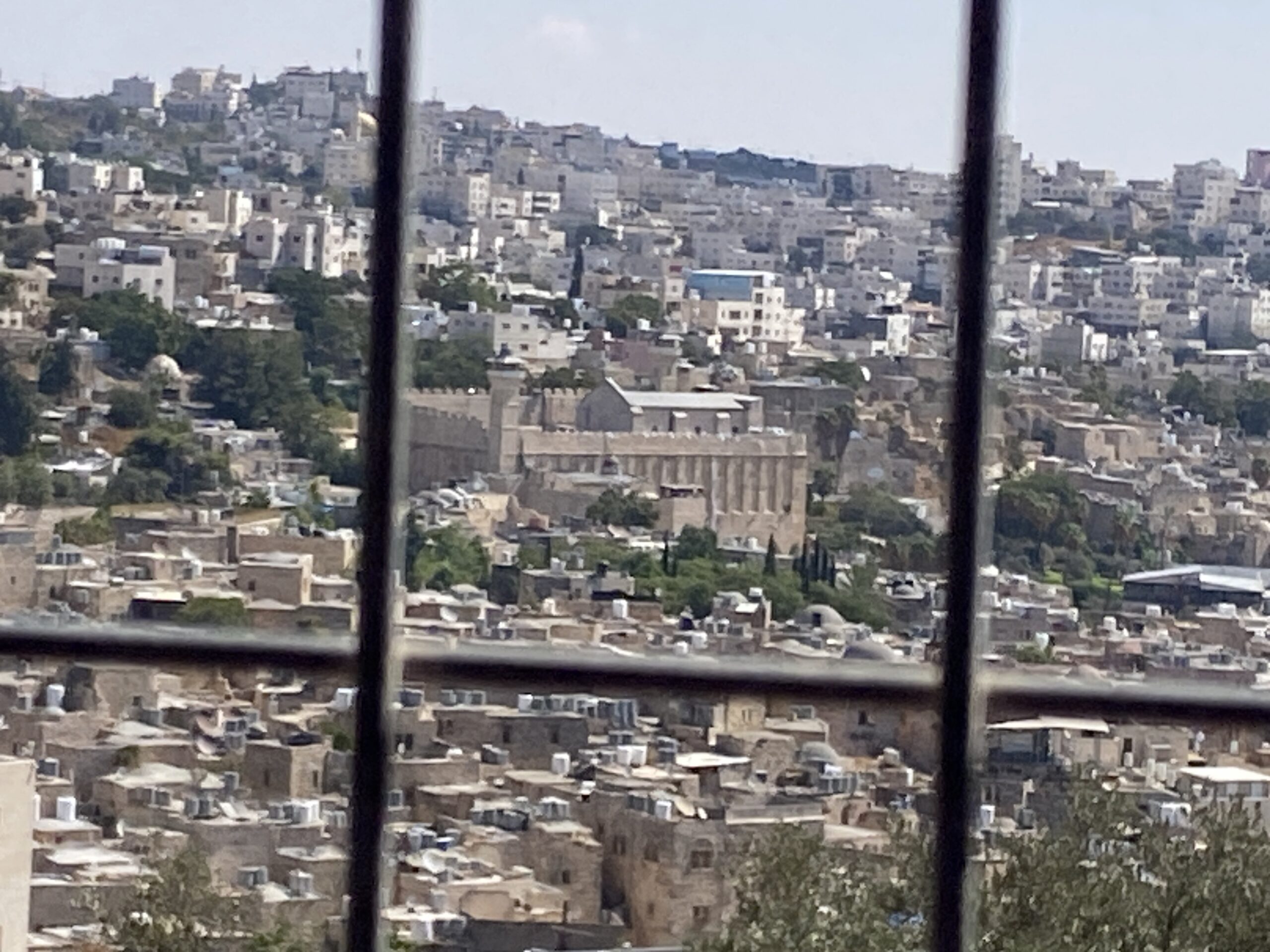 Yael ZoranSep-24-2026Hebron and the Cave of the Patriarchs from Beit Hashalom
-
Jerusalem
See all reports for this place-
The places in East Jerusalem which are visited routinely by MachsomWatch women are Silwan and Sheikh Jarrah. During the month of Ramadan, also the Old City and its environs are monitored.
-
