South Hebron, AM
South Hebron /Halhul South and East 6/6/04 AMObservers; Sarit H., Gili P., Miri D., Elena L (reporting)We left Shoket at 6:35. Just before the turn-off to Kramim from route 60 we saw a BP jeep at the side fo the road and two soldiers on foot facing Beersheba. They seemed to be waiting for 4 (Palestinian?) men holding bundles who were walking towards them from the direction of Shoket. We didn’t stop and on the way back at 8:45 the jeep was gone. 6:50 Shim’a CP: The usual checking of vehicles in both directions. We were allowed through without any problems. The soldiers seemed to know who we were. 7:00 Dura – al Fawwar crossroad. There were no soldiers on the ground , one was seen in the pillbox. Cars and pedestrians (very few of either) were moving freely in both directions.On route 60, after the Dura-al Fawwar crossroad, we saw 2 BP jeeps facing south and a van/minibus with an Israeli license plate. The driver of the van was being detained/questioned by BPs. He too was gone by the time we returned. 7:07 Sheep’s Crossing. No army. Very little movement in either direction (Yatta & Hebron).On the way to Halhul we began to see vehicles- mainly lorries with Palestinian license plates on route 60. We overtook a Hummer driving very slowly, obviously on patrol. Shiyuch crossing : The dirt barrier round the girl’s school has been made higher. It must be very difficult to scramble over it now. We saw no pupils since the holdidays have begun. There were no soldiers on either side of the crossing. Ras al-Jura CP: manned by 2 soldiers. One or two vehicles were being checked and were passed through. It seemed very peaceful. 7:18 Halhul–Hebron bridge: Pedestrian movement was free in both directions. The soldiers were reservists and they told us that they were only doing spot checks now. They were very polite but told us that as Israelis we were not allowed on the bridge at all since it was Area A. They said they would allow us to stand on it if we stayed next to them. But we wanted to talk to the taxi drivers at either end of the bridge .Sarit rang Tweezer and he confirmed that the bridge was Area A. (According to the map it does seem to be A). We began to move away and the company commander, who had been summoned by the soldiers, arrived. He said we could go and talk to the waiting taxi drivers if a soldier accompanied us or, alternatively, they could ask a taxi-driver to come to us while we continued to stand close by the army post in the middle of the bridge. We politely declined both options of course. He had not heard of Machsomwatch . We gave him the Letter to the Soldier. The soldiers told us that a completely smashed-up car which we had seen, just off the (closed) side-road leading to the bridge, had been blown up “the day before yesterday, ie Friday, because it “had stood there without anyone claiming it for 4 whole days”. I., our driver, said it had not been there last Thursday when MachsomWatchers had visited the bridge.7:45 : The “humanitarian roadblock” (on the Hebron side) or the “Okfim (detours) roadblock”. It is about 2 kms from Halhul bridge on the way back to route 60. Soldiers were checking cars and vans coming out of Hebron and they said ambulances also crossed there if necessary. One of them had spoken to us already on the bridge. Halhul East . It was open to pedestrians and cars. There were no soldiers 8:00 Shiyuch crossing. Now, as against an hour earlier, on the Shiyuch side there were army jeeps and soldiers. 8 young menwere sitting on the wall, having being detained. While we were wating to cross the road on foot a Palestinian man came across to us and showed us his ID which said he was handicapped; he complained of having had it taken from him and of his having had to stand 10 minutes in the sun, despite his handicap (he said he had a heart problem). Since he now had his ID back, he apparently only wanted to let off steam. (I nonetheless took his name and phone number).The eight detainees also were held for only 10 minutes (including the 5 minutes which they themselves said they had already been waiting for, before we arrived).The soldiers, who were courteous, said that the checking was because there had been alerts. They had never heard of MachsomWatch and we explained what we were doing. A sergeant major (in the regular army and apparently the man in charge) made a note of our website. On the way back Sheep’s crossing and the Dura -al Fawwar crossing continued open and without soldiers.8:45 we arrived back at Shoket
Hebron
See all reports for this place-
According to Wye Plantation Accords (1997), Hebron is divided in two: H1 is under Palestinian Authority control, H2 is under Israeli control. In Hebron there are 170,000 Palestinian citizens, 60,000 of them in H2. Between the two areas are permanent checkpoints, manned at all hours, preventing Palestinian movement between them and controlling passage of permit holders such as teachers and schoolchildren. Some 800 Jews live in Avraham Avinu Quarter and Tel Rumeida, on Givat HaAvot and in the wholesale market.
Checkpoints observed in H2:
- Bet Hameriva CP- manned with a pillbox
- Kapisha quarter CP (the northern side of Zion axis) - manned with a pillbox
- The 160 turn CP (the southern side of Zion axis) - manned with a pillbox
- Avraham Avinu quarter - watch station
- The pharmacy CP - checking inside a caravan with a magnometer
- Tarpat (1929) CP - checking inside a caravan with a magnometer
- Tel Rumeida CP - guarding station
- Beit Hadassah CP - guarding station
Three checkpoints around the Tomb of the Patriarchs
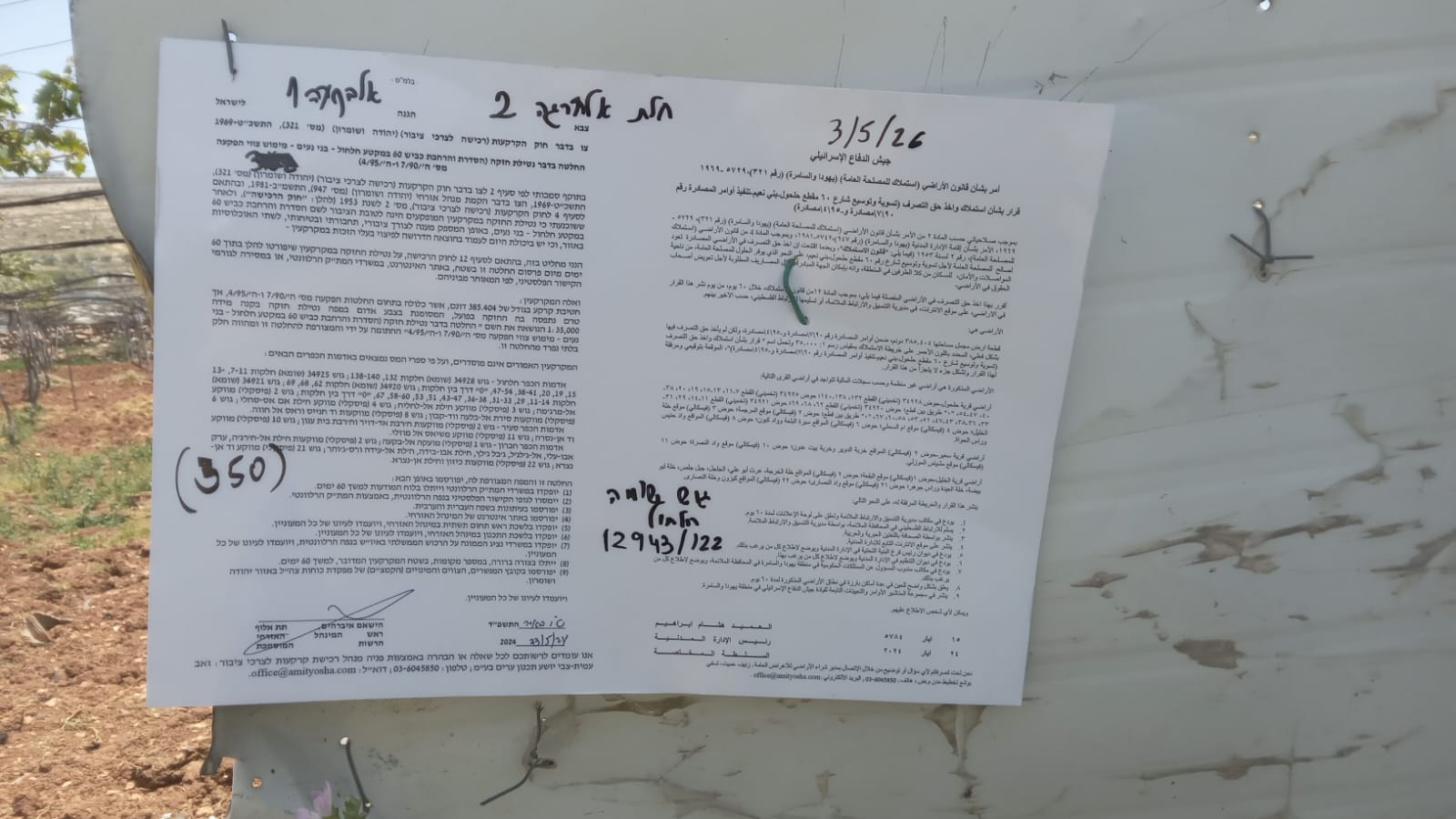 Muhammad D.May-13-2026Hebron - Request for compensation for land expropriation
-