
South Hebron Hills


Michal (reporting and photographing)
I will start with explanations of the photos and then I will write about them in the context of our shift.
The first photo is from 2018 taken by those who could then get close to Hagai Nissim’s farm near the settlement Negohot. Below are shots taken from afar in the hope that you will be able to see the expansion work being done in the settlement Negohot A and B.
The Jadallah family is situated in the middle of the valley in a small village called Fukeikis.
We drove there via Route 358, from where we turned right to a checkpoint designed to monitor those coming to Negohot. At the entrance, a wave of Shalom and a friendly smile were enough for the soldiers to raise the yellow gate.
We went to visit the Jadallah family who live in the valley between the two Negohots and who suffer from the settler Hagai Nissim, who arrived there about two and a half years ago. From their home you can clearly see how the two settlements are expanding and new neighborhoods are being built. Also a new way paved over “their heads”, above their house. Which seems to be intended to connect the settlements in the future or to facilitate access to a new neighborhood to be built.
We need to continue to observe
The family says that the last incident with the settler’s stray dogs was about a month ago. The father of the family, despite being 67 years old, was barred from entering Israel, as a result of a lawsuit he had about killing Hagai Nissim’s dog who arrived at various times and had actually entered his home with the settler watching this. The dog was greatly feared by the inhabitants of the house. By the way, a dog is an impure animal to many of the Palestinians as it is to some of the religious Jews.
At his trial he received probation because of the dog for one year. Maybe our friends will be able to help him.
We tried to get out through that checkpoint, and were detained. After a conversation between the soldier and an unknown source (the Ravshats, Military Security Coordinator?), We were told that we could not get out of there, and that next time any entrance to this road required the approval of the Ravshats. The fact that the same soldier had allowed us through before made no different. The logic of the army.
Apparently the big brother saw us watching them and entering the house of the family and that turned us into undesirables
It turns out that we are in good company: Amira Hass, when she was there, also had to turn around and go back through Highway 60, which is much further away.
We have a little illustration of the “cage” in which the Palestinians are.
South Hebron Hills
See all reports for this place-
South Hebron Hills
South Hebron Hills is a large area in the West Bank's southern part.
Yatta is a major city in this area: right in the border zone between the fertile region of Hebron and its surroundings and the desert of the Hebron Hills. Yatta has about 64,000 inhabitants.
The surrounding villages are called Masafer Yatta (Yatta's daughter villages). Their inhabitants subsist on livestock and agriculture. Agriculture is possible only in small plots, especially near streams. Most of the area consists of rocky terraces.Since the beginning of the 1980s, many settlements have been established on the agricultural land cultivated by the Palestinians in the South Hebron Hills region: Carmel, Maon, Susia, Masadot Yehuda, Othniel, and more. Since the settlements were established and Palestinians cultivation areas have been reduced; the residents of the South Hebron Hills have been suffering from harassment by the settlers. Attempts to evict and demolish houses have continued, along with withholding water and electricity. The military and police usually refrain from intervening in violent incidents between settlers and Palestinians do not enforce the law when it comes to the investigation of extensive violent Jewish settlers. The harassment in the South Hebron Hills includes attacking and attempting to burn residential tents, harassing dogs, harming herds, and preventing access to pastures.
There are several checkpoints in the South Hebron Hills, on Routes 317 and 60. In most of them, no military presence is apparent, but rather an array of pillboxes monitor the villages. Roadblocks are frequently set up according to the settlers and the army's needs. These are located at the Zif Junction, the Dura-al Fawwar crossing, and the Sheep Junction at the southern entrance to Hebron.
Updated April 2022
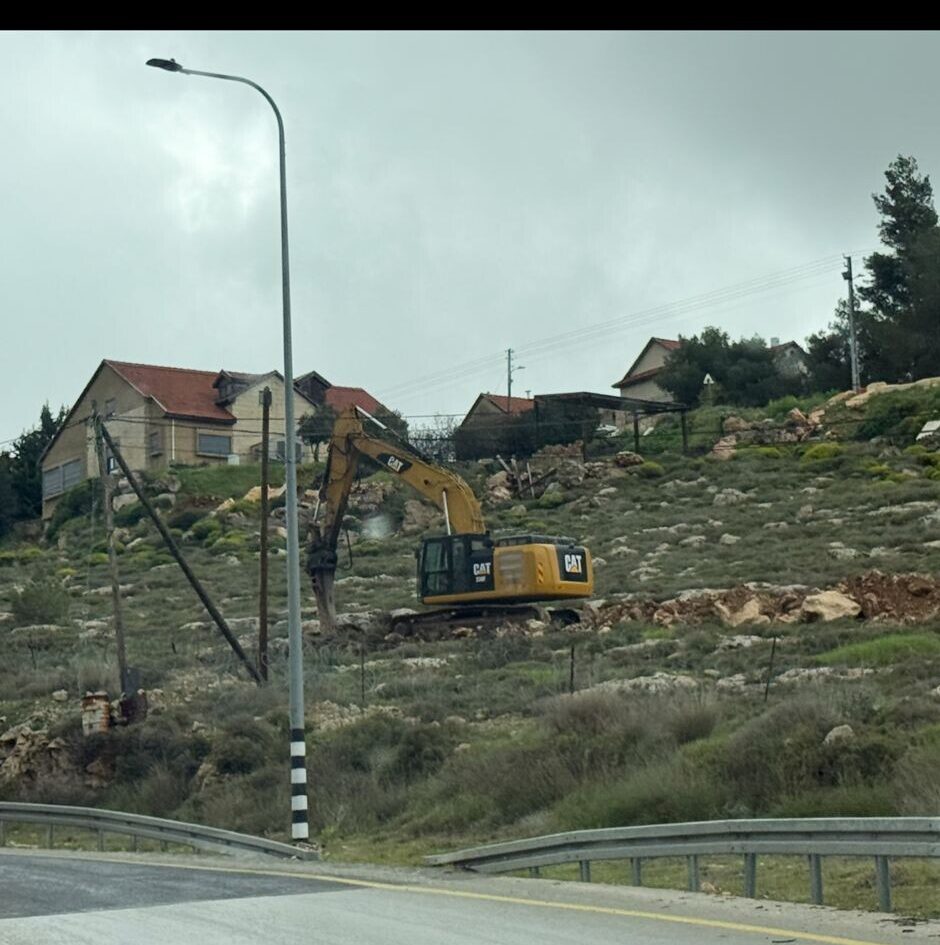 MuhammadFeb-24-2026South Hebron Hill, Beit Hagai: Paving an internal security road
-