
South Hebron Hills
Huda’s kindergarten
Our purpose: Activities in the Hashem al Darraj kindergarten, together with Huda
On the way to Hashem al Darraj – We were happy to see that the final section of the road, which had been a dirt track, was now paved with asphalt. Now the entire road to the village is paved and the ride goes more quickly. We wonder who paved it. We forgot to ask.
Next to the kindergarten – a donkey with containers of water. Area residents obtain water here (reminding us that none of the villages in the area receive piped water).
The kindergarten children play outside. There are many – perhaps forty or more.
We met Ha’ola, the young assistant, in the courtyard. Huda and Amana, the older assistant, are inside.
The kindergarten is clean and extremely well-organized. It obviously underwent a facelift for the new year. The vegetation outside is also flourishing (given it’s a desert). Huda says there are many children, 45 or even more. She suggests we not conduct activities today because most of the children are new and it would be better for them first to see and get accustomed to us. And, in fact, some of the children come in, inspect us, and the brave ones shake hands. So we accepted the suggestion and sat to talk about the new year. Huda and Ha’ola say they’ve begin planning what to do this year. Huda tells us they’ll talk about cleanliness. We were glad to learn they’re making an effort to add content to the activities. Huda says one of them opens the kindergarten each morning at 07:30 and the second arrives by 08:00. The day begins with morning exercises outside. Then the children are divided between Ha’ola (those younger than 5) and Huda (the older ones). Huda’s thinking about asking the parents of about ten three-year-old children not to send them to kindergarten because they’re too young. We discussed it; perhaps she’ll consider accepting them.
We toured the kindergarten, talked about adding designated play areas. Huda and Ha’ola liked the idea very much and we promised to help introduce them and begin activities in two weeks. We’ll be glad of any help we can get. We’ll also investigate the possibility of transporting the children. The distances are very long, and when the weather worsens the children don’t come, especially the younger ones.
We left feeling satisfied; perhaps we’ve also played some role in the obvious improvement in the way the kindergarten is being run.
South Hebron Hills
See all reports for this place-
South Hebron Hills
South Hebron Hills is a large area in the West Bank's southern part.
Yatta is a major city in this area: right in the border zone between the fertile region of Hebron and its surroundings and the desert of the Hebron Hills. Yatta has about 64,000 inhabitants.
The surrounding villages are called Masafer Yatta (Yatta's daughter villages). Their inhabitants subsist on livestock and agriculture. Agriculture is possible only in small plots, especially near streams. Most of the area consists of rocky terraces.Since the beginning of the 1980s, many settlements have been established on the agricultural land cultivated by the Palestinians in the South Hebron Hills region: Carmel, Maon, Susia, Masadot Yehuda, Othniel, and more. Since the settlements were established and Palestinians cultivation areas have been reduced; the residents of the South Hebron Hills have been suffering from harassment by the settlers. Attempts to evict and demolish houses have continued, along with withholding water and electricity. The military and police usually refrain from intervening in violent incidents between settlers and Palestinians do not enforce the law when it comes to the investigation of extensive violent Jewish settlers. The harassment in the South Hebron Hills includes attacking and attempting to burn residential tents, harassing dogs, harming herds, and preventing access to pastures.
There are several checkpoints in the South Hebron Hills, on Routes 317 and 60. In most of them, no military presence is apparent, but rather an array of pillboxes monitor the villages. Roadblocks are frequently set up according to the settlers and the army's needs. These are located at the Zif Junction, the Dura-al Fawwar crossing, and the Sheep Junction at the southern entrance to Hebron.
Updated April 2022
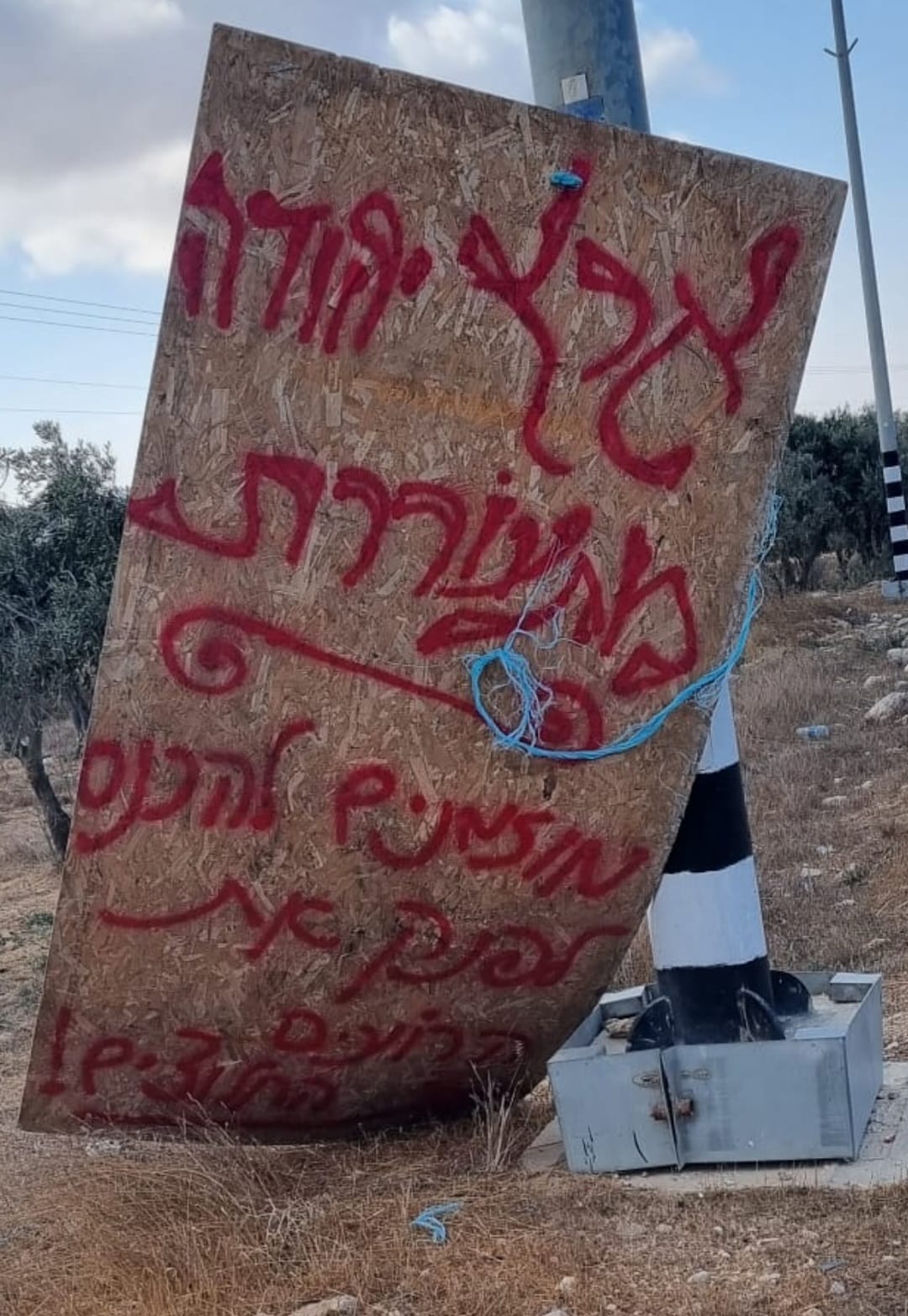 Smadar BeckerOct-17-2026A sign placed by those who call themselves the Pioneer Shepherds, at the outpost adjacent to Qawawis
-
