
South Hebron Hills
South and West Hebron Hills Thursday morning, 28 October 2004Watchers: Mira B, Yeela (reporting in English) Hagit B (reporting in Hebrew)Left at 6:30 am. Returned at 11:45 am.General: because of lack of time we drove only on Rd 60 and Rd 35. (we did not go to Hirbat Tawani), and on the Palestinian roads – on the way to Beit Awa. The army is in the pillboxes – Dura – Al-Fawwar, Shayuch-Seir, Halhul bridge. The girls’ school – there is no military and as usual crossing Rd 60 is extremely dangerous. At Dura and al-Fawwar – we met a school principal (woman) who talked to us in English, and also showed us that the crossing is dangerous to pedestrians, as they must share a single lane with cars when going through the barricade. A pedestrian crossing needs to be opened at that spot. At the Sheep Jct. a taxi driver complained that his papers were taken. others complained about a certain military jeep crew that seemed to enjoy making them sit on the ground, taking their papers and driving away, only to return two hours later, making them go from one place to another, and they even tore up one driver’s license papers. They gave us the jeep’s license #; we will try and see what we can find out and help.The road section that is open only to pedestrians is exceptionally long, and we need to ask the military to allow taxis to get closer to the road, so that the women with children in their arms, old people, and others do not need to suffer so much.East Halhul-Seir – a serious traffic jam. a jeep of Border Plice and a jeep of Nahal soldiers are doing random checks of IDs. (They are not the reason for the traffic jam, rather the fact that at the barricade only one car from each direction can pass at any time)Halhul bridge – the entrance from Rd 35 is blocked again.On Rd 35 there electric works are in process, installing road lamps to illuminate Beit Hagai jct. and the barricade in al Jura. Soldiers are securing the electricity workers, no one is detained.Beit Awa – we scheduled a meeting with the council chair and M., the town lawyer. We arrived at the town via dirt roads, as we did not want to cross through Idna, the children throw stones there at Israeli cars. The roads are in bad shape, we understood the anger of the Palestinians, at the prohibition on using the available good roads. M. told us it took him 8 hours to drive to Ramallah – what ordinarily would be a two hour drive, because of the need to drive through these long and difficult roads, and because of the road blocks on the way. M. took us to see the layout of the [Separation Fence] wall. The Israeli Supreme Court ordered a halt to the constrction of the wall. The petition is given by three towns by the Green Line: Beit Awa, Sika and Kum. Amir Fishbein is their representative, we will contact him to see how we can help. Instead of directly on the Green Line, which would also be a natural location, as it is along the wadi [ravine], the wall is planned to be built 300 meters into Palestinian territory and 25 meters from the town’s school, and directly on top of the graveyard. It is not reasonable and not understandable. There already is a road along the Green Line, so why is so much money being spent on building this new one? There is already the difficult and distressing sight of uprooted olive trees. We promised to visit again, and to do all we can to publicize their predicament to the Israeli public. Summary – So few people moving about? Where is everybody?
South Hebron Hills
See all reports for this place-
South Hebron Hills
South Hebron Hills is a large area in the West Bank's southern part.
Yatta is a major city in this area: right in the border zone between the fertile region of Hebron and its surroundings and the desert of the Hebron Hills. Yatta has about 64,000 inhabitants.
The surrounding villages are called Masafer Yatta (Yatta's daughter villages). Their inhabitants subsist on livestock and agriculture. Agriculture is possible only in small plots, especially near streams. Most of the area consists of rocky terraces.Since the beginning of the 1980s, many settlements have been established on the agricultural land cultivated by the Palestinians in the South Hebron Hills region: Carmel, Maon, Susia, Masadot Yehuda, Othniel, and more. Since the settlements were established and Palestinians cultivation areas have been reduced; the residents of the South Hebron Hills have been suffering from harassment by the settlers. Attempts to evict and demolish houses have continued, along with withholding water and electricity. The military and police usually refrain from intervening in violent incidents between settlers and Palestinians do not enforce the law when it comes to the investigation of extensive violent Jewish settlers. The harassment in the South Hebron Hills includes attacking and attempting to burn residential tents, harassing dogs, harming herds, and preventing access to pastures.
There are several checkpoints in the South Hebron Hills, on Routes 317 and 60. In most of them, no military presence is apparent, but rather an array of pillboxes monitor the villages. Roadblocks are frequently set up according to the settlers and the army's needs. These are located at the Zif Junction, the Dura-al Fawwar crossing, and the Sheep Junction at the southern entrance to Hebron.
Updated April 2022
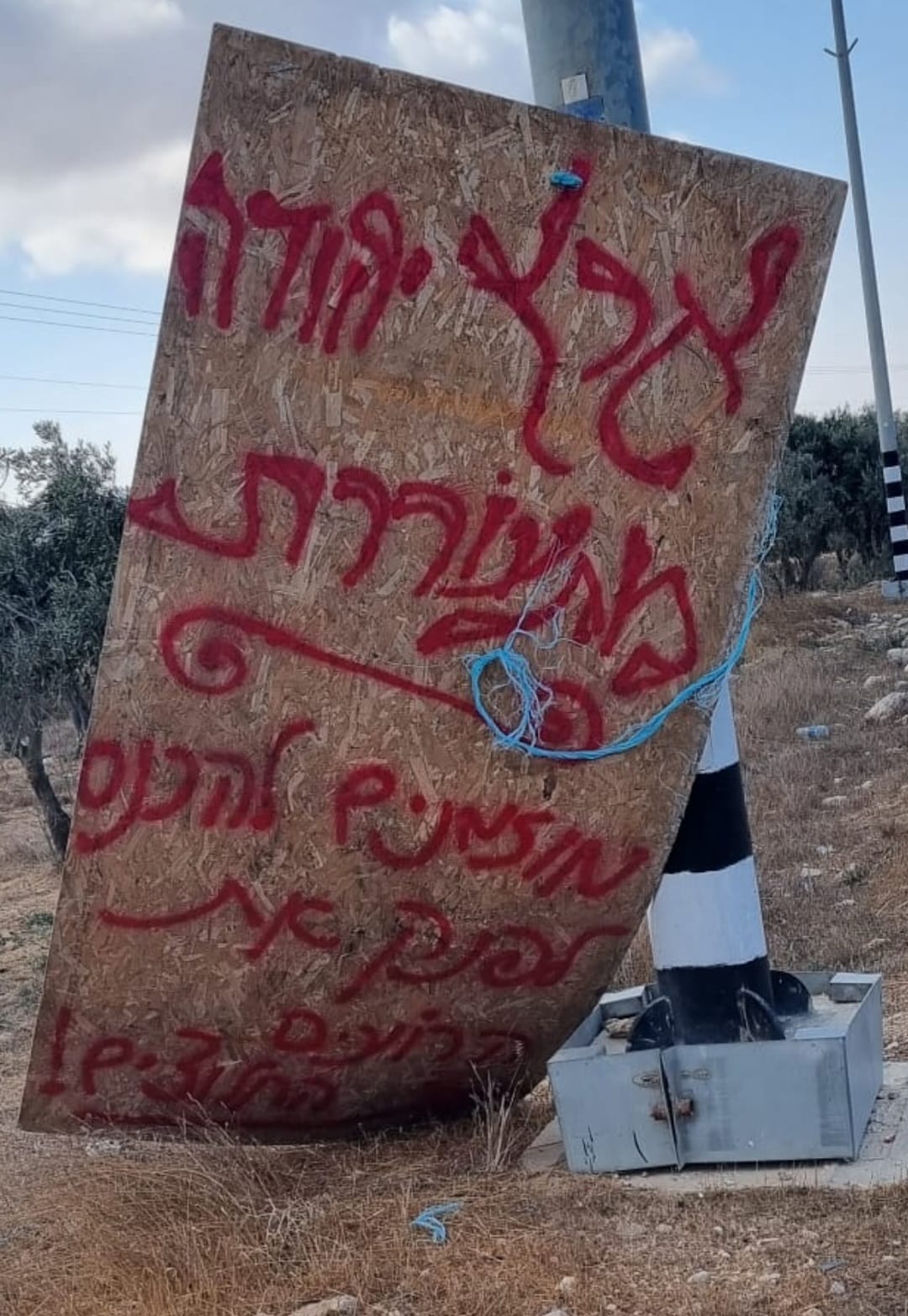 Smadar BeckerOct-17-2026A sign placed by those who call themselves the Pioneer Shepherds, at the outpost adjacent to Qawawis
-
