
South Hebron Hills
South Hebron Hills and Hebron Sunday 27.11.05 AMObservers: Dana L, Elena L (reporting)6:30 -10:00Summary : A quiet shift. A member of ISM gave us interesting information about what had happened on Saturday (the festival of the matriarch Sarah’s burial place). We also learned of a new custom of ‘Women in Green’: harassing the Palestinians on Wednesdays. We saw no detainees either in Hebron or at the CPs outside the city.We got to Hebron in time to see the schoolgirls and their teachers climb the dangerous steps to Cordoba school and we saw older girls on their way to al –Yakubiya high school beyond the Tel Romeida CP, in the Palestinian section of the city. We also saw a lot of little boys coming down from the top of Tel Romeida rise but we weren’t certain where their school was. Volunteers of international organizations such as CPT and ISM were already stationed at intervals along the road to watch over the passage of the schoolchildren.An Australian ISM volunteer told us that during the jamboree on Saturday when hundreds of settlers came to Hebron to celebrate the festival marking Abraham’s purchase of Sarah’s burial place, a bunch of settler teenagers (female) began to shove and hit a group of Palestinian little girls and young teenagers who were walking in the Tel Romeida quarter . The Australian volunteer (named Mary) tried to protect the Palestinians by putting her arm round the shoulders of the girl nearest to the settlers. This did not have any effect on the most aggressive of the settler girls who lashed out again, hit Mary and knocked her to the ground (she was still feeling bruised when she spoke to us). A complaint was laid with the police. There is a video showing what happened and so perhaps this time the police wont be able to argue that there is no way of identifying the attacker. It is worth noting that Mary is 74 years old. Thus do “observant” Jews “honor the old”!Shuhada street was completely deserted.8:20 Pharmacy CP: We saw schoolboys passing through the Xray machine. Two CPT volunteers told us that about 40 minutes earlier a schoolboy had been separated from his fellows and taken away in an army jeep. Dana went and asked the soldiers what had happened to the boy. It emerged that it was a matter of an “educational lesson”. The boy had been a bit wild in his behavior among his friends and so the soldiers had seen fit to separate him from them – the jeep had taken him away for a short while and then had returned him to the CP which he then passed through; i.e., even when it is not a question of behavior towards the soldiers themselves, some of them are still keen on “reeducating” the Palestinians.The volunteers also told us that it seems that the ‘Women in Green’ have decided to make a habit of coming to Hebron every Wednesday in order to harass the pupils and teachers of Cordoba school when classes end (they were there on 23/11 and on the Wednesday before that) . The harassment takes the form of “photographing them aggressively” One of the CPT volunteers was the woman whom a man, who accompanied the Women in Green, had earnestly hoped “would die of cancer” (see the report on this that was sent to our network)Dahariya: closedSansana: the two large tents have been relocated (one behind the other rather than side by side) and a high dirt barricade has been freshly built around them in the form of a large square. It is thus impossible to see if any detainees are sitting in the tents except when approaching Sansana from the north. There were no detainees when on our way back to Shoket.Dura- Al Fawwar crossing: Apen to cars. No soldiers on the ground and no rolling CP on route 60.Sheep’s Crossing: open as usual only to pedestrians. No soldiers.Shiyukh –Hebron: DittoZif CP : the gate is closed. No rolling CP and no soldiers.
Hebron
See all reports for this place-
According to Wye Plantation Accords (1997), Hebron is divided in two: H1 is under Palestinian Authority control, H2 is under Israeli control. In Hebron there are 170,000 Palestinian citizens, 60,000 of them in H2. Between the two areas are permanent checkpoints, manned at all hours, preventing Palestinian movement between them and controlling passage of permit holders such as teachers and schoolchildren. Some 800 Jews live in Avraham Avinu Quarter and Tel Rumeida, on Givat HaAvot and in the wholesale market.
Checkpoints observed in H2:
- Bet Hameriva CP- manned with a pillbox
- Kapisha quarter CP (the northern side of Zion axis) - manned with a pillbox
- The 160 turn CP (the southern side of Zion axis) - manned with a pillbox
- Avraham Avinu quarter - watch station
- The pharmacy CP - checking inside a caravan with a magnometer
- Tarpat (1929) CP - checking inside a caravan with a magnometer
- Tel Rumeida CP - guarding station
- Beit Hadassah CP - guarding station
Three checkpoints around the Tomb of the Patriarchs
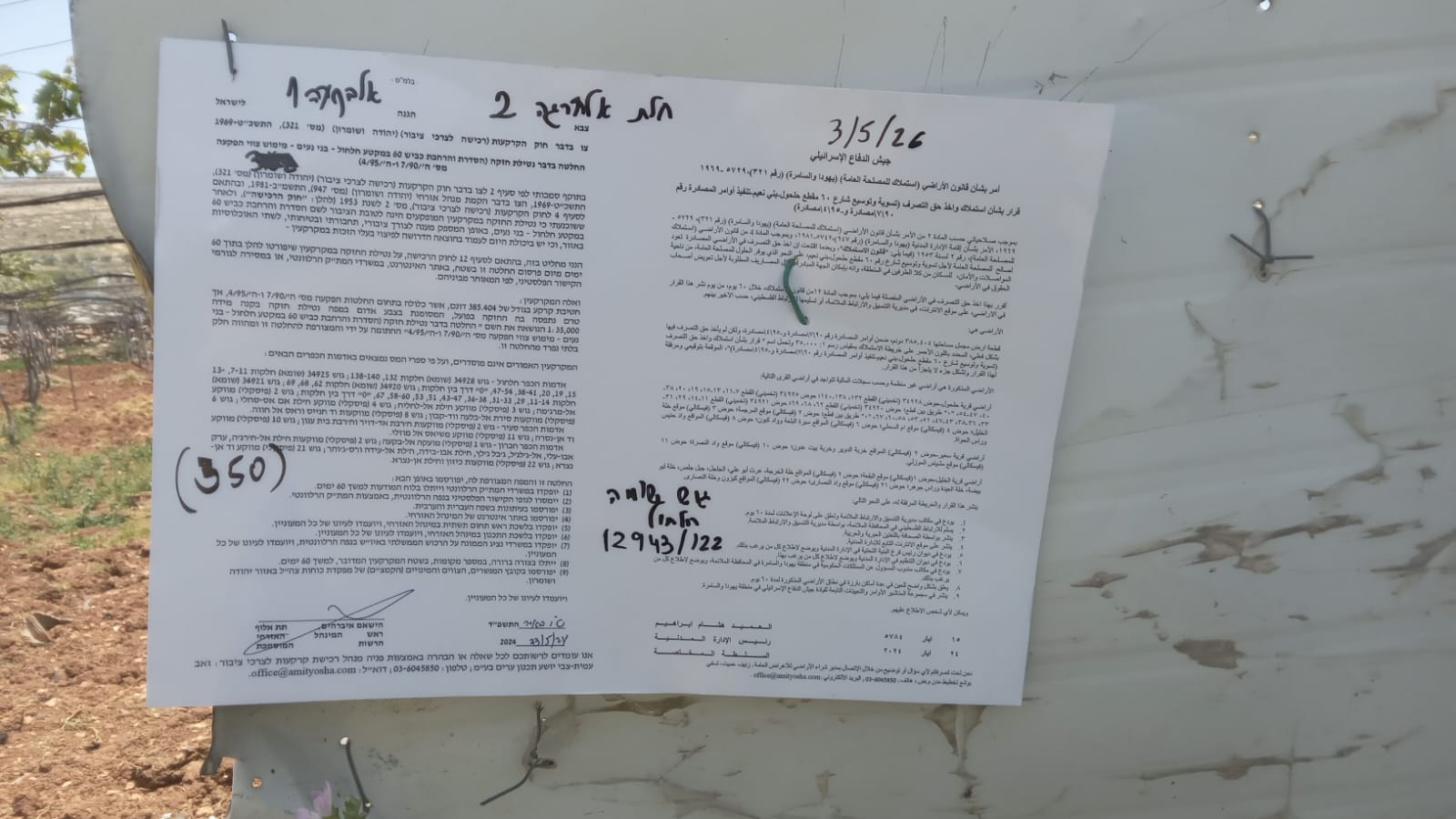 Muhammad D.May-13-2026Hebron - Request for compensation for land expropriation
-
South Hebron Hills
See all reports for this place-
South Hebron Hills
South Hebron Hills is a large area in the West Bank's southern part.
Yatta is a major city in this area: right in the border zone between the fertile region of Hebron and its surroundings and the desert of the Hebron Hills. Yatta has about 64,000 inhabitants.
The surrounding villages are called Masafer Yatta (Yatta's daughter villages). Their inhabitants subsist on livestock and agriculture. Agriculture is possible only in small plots, especially near streams. Most of the area consists of rocky terraces.Since the beginning of the 1980s, many settlements have been established on the agricultural land cultivated by the Palestinians in the South Hebron Hills region: Carmel, Maon, Susia, Masadot Yehuda, Othniel, and more. Since the settlements were established and Palestinians cultivation areas have been reduced; the residents of the South Hebron Hills have been suffering from harassment by the settlers. Attempts to evict and demolish houses have continued, along with withholding water and electricity. The military and police usually refrain from intervening in violent incidents between settlers and Palestinians do not enforce the law when it comes to the investigation of extensive violent Jewish settlers. The harassment in the South Hebron Hills includes attacking and attempting to burn residential tents, harassing dogs, harming herds, and preventing access to pastures.
There are several checkpoints in the South Hebron Hills, on Routes 317 and 60. In most of them, no military presence is apparent, but rather an array of pillboxes monitor the villages. Roadblocks are frequently set up according to the settlers and the army's needs. These are located at the Zif Junction, the Dura-al Fawwar crossing, and the Sheep Junction at the southern entrance to Hebron.
Updated April 2022
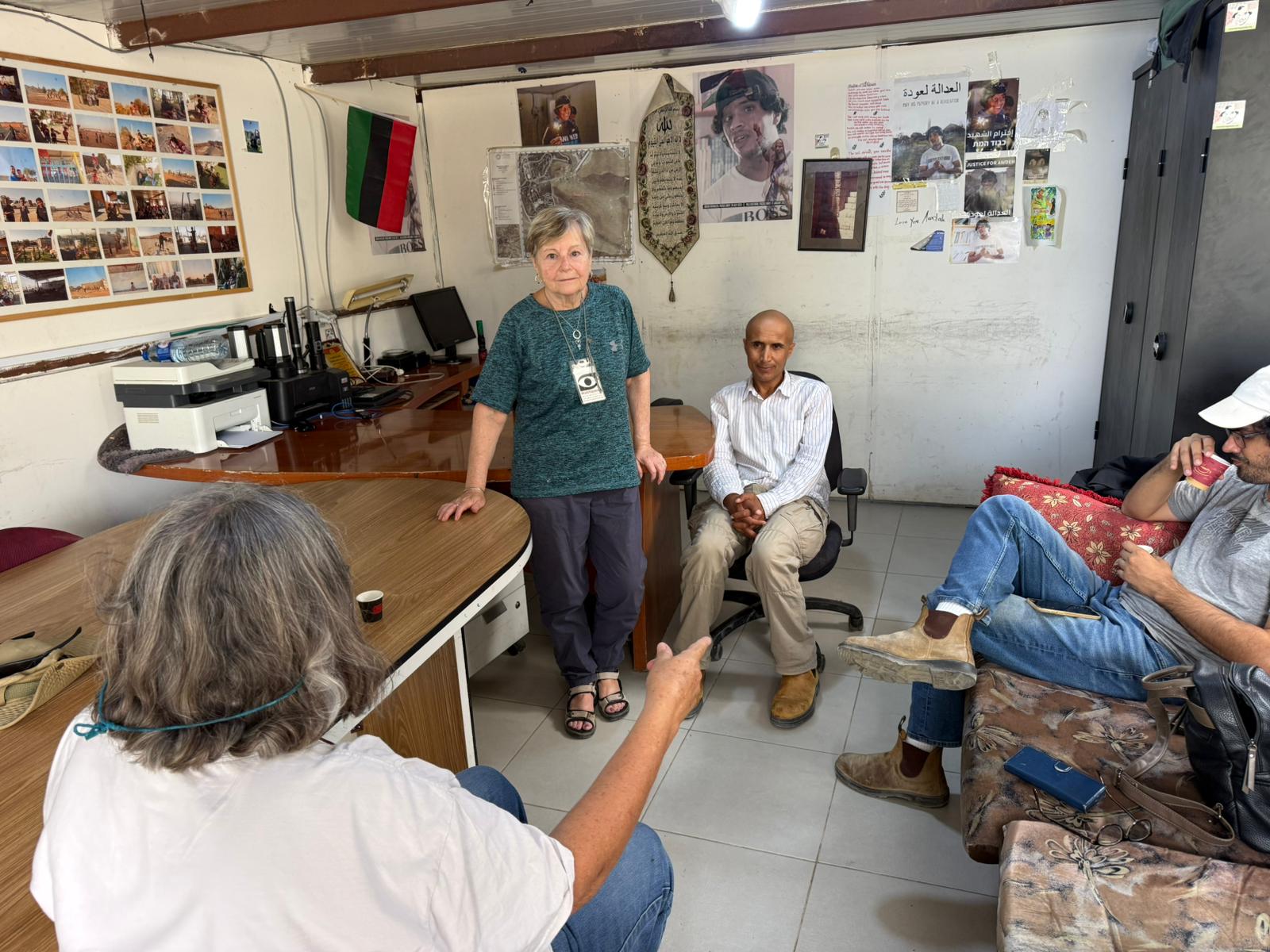 Muhammad D.Aug-30-2026Umm al-Khair, Smadar with Eid, Or and Timna, in the Situation Room
-
