
South Hebron Hills, Simia
Today we again witnessed the occupation at its most active.
While driving, we noticed a large gathering in the village of Simia (located in Area C).
It turned out that the army was there with heavy tools and trucks, and evacuating a transportable caravan from the outskirts of the village, tomorrow morning to be opened as a school for the village children. Until now, the children have gone to school in the neighboring village on the mountain beyond the bustling and dangerous Route 60, which has no safe passage for them. The village had not receive any eviction orders in preparation for this. Present, here apart from the villagers, were representatives of the local authority of the South Hebron Hills including the person in charge of education, as well as representatives of Combatants for Peace from the village, Farhan and Kader.
When we contacted the responsible officer who was present, she explained that this is a transportable structure, and therefore there is no obligation to give an evacuation order in advance. Now the building was loaded onto a truck and it began to move in order to transport it and all the accompanying equipment to be stored in Gush Etzion (just as we saw a few months ago at the Jabour family near Susiya). What next? The village would be able to release the confiscated equipment when the time came for certain procedures and when they had paid a large sum (perhaps the value of the equipment itself).
Kader told us that tomorrow they are starting to build the same building in the same place, and when we asked, “it will be destroyed again,” he replied: “Never mind. We will build again and again. Nothing will stop us.”
When we left the field after a long stay the group of teachers (women and men) who were supposed to teach tomorrow at the school, arrived.
Two representatives of a foreign organization (Christian?) who live in Yatta were also with us and were interested in the event and also interested in us.
We continued north to El Fawwar junction, the entrance to ‘Abda was blocked
On the way we stopped at the vegetable field near the road and bought some of their produce. The farmers no longer try to install a shed and a sales stand as they did in the past, because the army destroys and confiscates everything.
They ran to the loaded truck to fetch the vegetables we asked for, and were happy to make a few shekels.
Dura Al-Fawwar Junction
See all reports for this place-
Junction on Route 60: west - the town of El Dura, east - the Al Fawwar refugee camp. There is a manned pillbox at the junction. From time to time the army sets up flying checkpoints at the entrance to El Fawwar and Al Dura. Al-Fawwar is a large refugee camp (7,000 inhabitants in 2007) established in 1949 to accommodate Palestinian refugees from Be'er Sheva and Beit Jubrin and environs. There are many incidents of stone-throwing. In the vicinity of the pillbox there are excellent agricultural areas, Farmers set up stalls adjacent to the plots close to the road. In recent months the civil administration has set up dirt embankments thereby blocking access to the stalls, and making it impossible for the farmers to sell their vegetables. Updated April 2021, Michal T.
-
South Hebron Hills
See all reports for this place-
South Hebron Hills
South Hebron Hills is a large area in the West Bank's southern part.
Yatta is a major city in this area: right in the border zone between the fertile region of Hebron and its surroundings and the desert of the Hebron Hills. Yatta has about 64,000 inhabitants.
The surrounding villages are called Masafer Yatta (Yatta's daughter villages). Their inhabitants subsist on livestock and agriculture. Agriculture is possible only in small plots, especially near streams. Most of the area consists of rocky terraces.Since the beginning of the 1980s, many settlements have been established on the agricultural land cultivated by the Palestinians in the South Hebron Hills region: Carmel, Maon, Susia, Masadot Yehuda, Othniel, and more. Since the settlements were established and Palestinians cultivation areas have been reduced; the residents of the South Hebron Hills have been suffering from harassment by the settlers. Attempts to evict and demolish houses have continued, along with withholding water and electricity. The military and police usually refrain from intervening in violent incidents between settlers and Palestinians do not enforce the law when it comes to the investigation of extensive violent Jewish settlers. The harassment in the South Hebron Hills includes attacking and attempting to burn residential tents, harassing dogs, harming herds, and preventing access to pastures.
There are several checkpoints in the South Hebron Hills, on Routes 317 and 60. In most of them, no military presence is apparent, but rather an array of pillboxes monitor the villages. Roadblocks are frequently set up according to the settlers and the army's needs. These are located at the Zif Junction, the Dura-al Fawwar crossing, and the Sheep Junction at the southern entrance to Hebron.
Updated April 2022
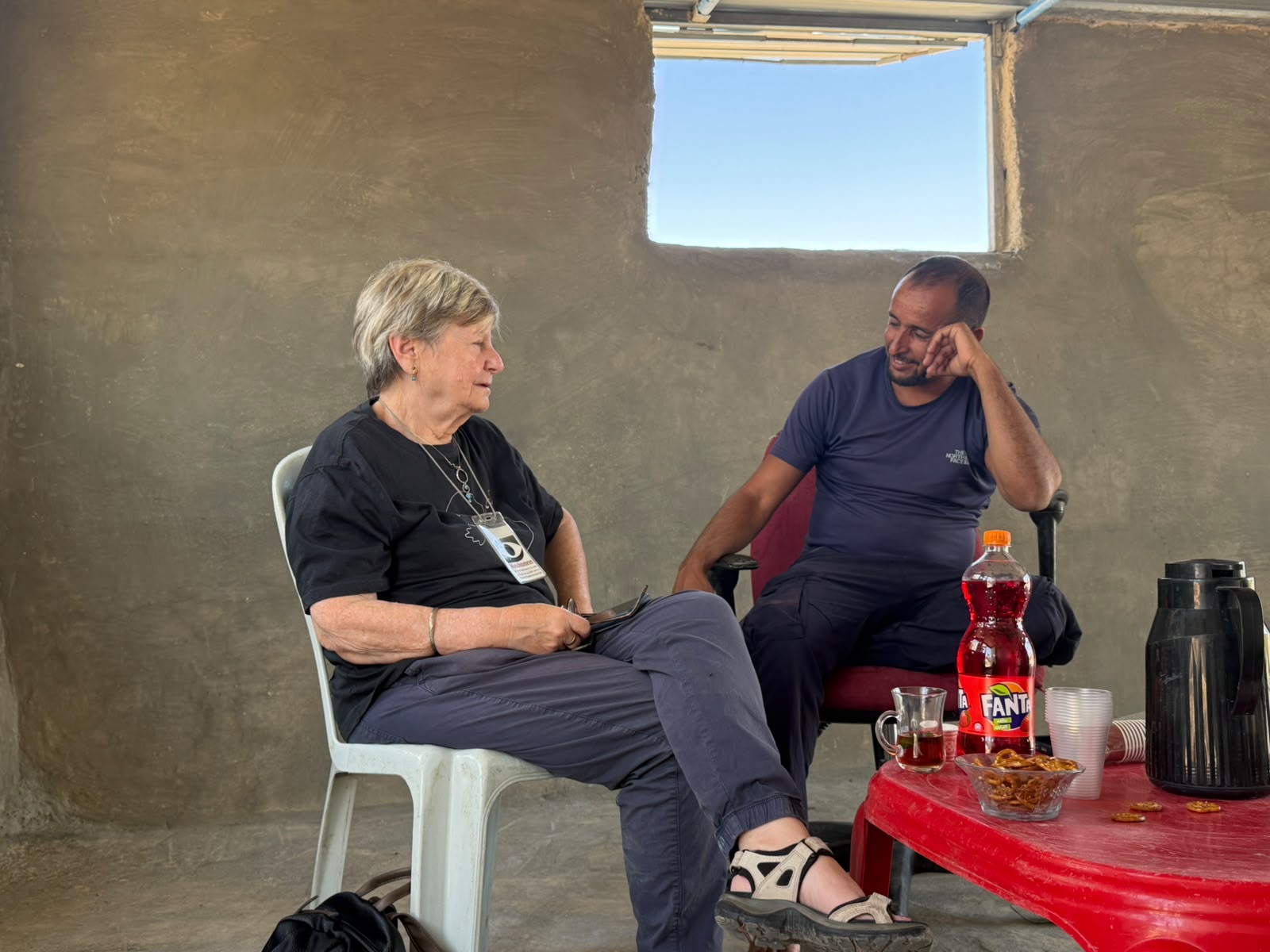 Muhammad D.Oct-10-2026Smadar with Najeh in Umm Qusa
-
