
South Hebron Hills, Simia
Simia is located on Route 60 near the entrance to Samu’a and on the other side of the road. The villagers are old friends of ours and belong to the group of Palestinian Combatants for Peace. The children of the village, about thirty in number, had to cross the dangerous Route 60 on their way to school. The villagers decided to build a school in their village and this was approved by the Palestinian Ministry of Education. Teachers from Samu’a, Dura, al Fawwar brought a Caravan. On Wednesday, Civil Administration officials confiscated and destroyed the caravan (see Hagit Sar Shalom’s report).
The Palestinians decided to start the struggle of “Sumud”, to build tents for the children who would learn in this cold. Yesterday at midnight the soldiers arrived and took more equipment, chairs and tables.
When we were there, an army jeep came and took pictures of what was going on and promised they would return.
The village of Simia is in Area C, which means that the Civil Administration has to give its approval. Only that it never gives approval. The land on which the school was built is the private prpperty of F. that donated the area.
The Palestinian Ministry of Education came for a solidarity visit.
I spoke with Knesset Member Musi Raz, who promised to follow up and also to Yotam Berger, Haaretz’s correspondent, and both of them said that there was nothing that could be (according to the laws of occupation).
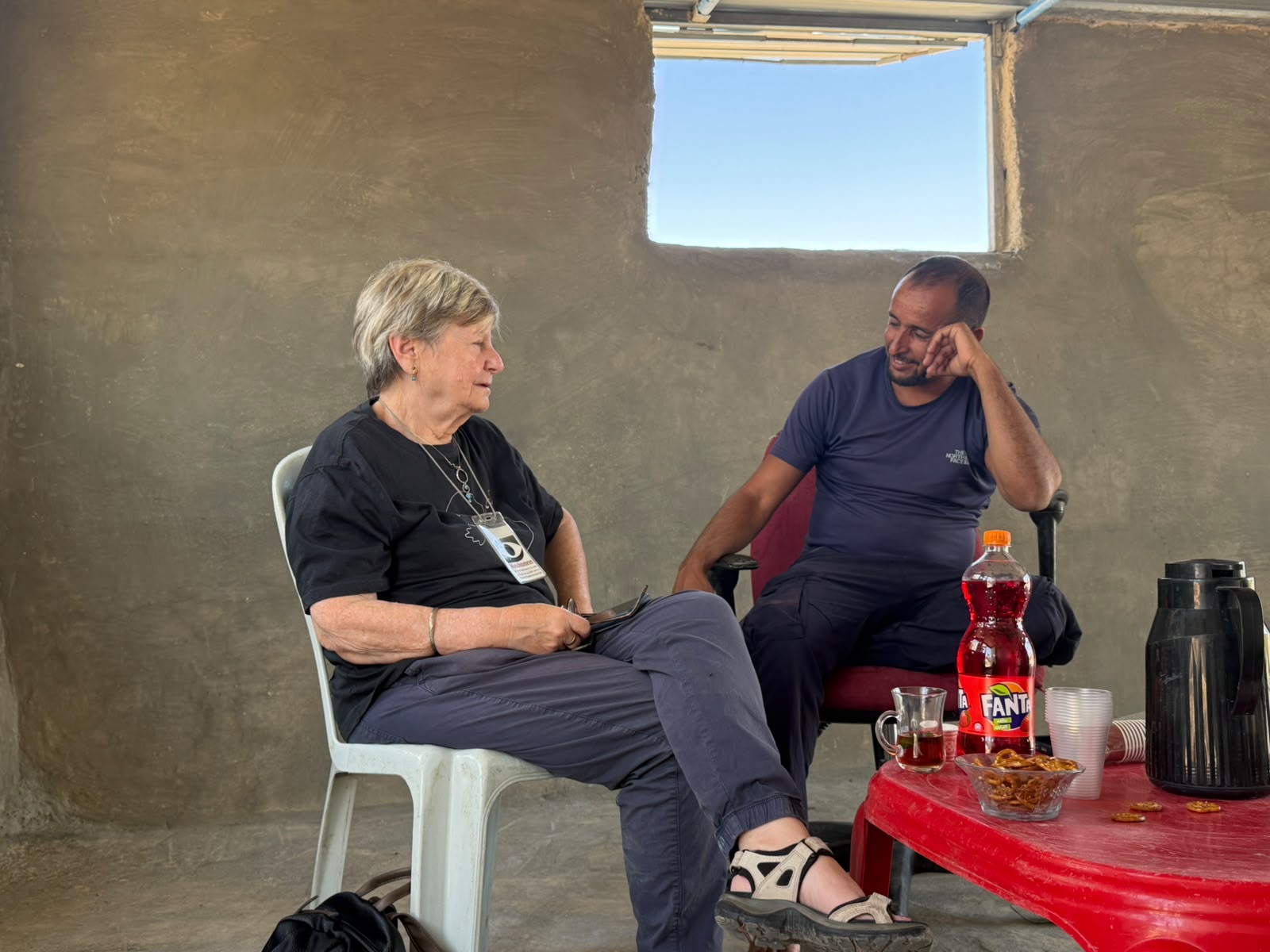
In the pictures below:
The destroyed building.
The tents which are used for the classed.
The army returns to visit.
We did not go on to Hebron. The murder yesterday at Ofra lies heavy on the heart.
South Hebron Hills
See all reports for this place-
South Hebron Hills
South Hebron Hills is a large area in the West Bank's southern part.
Yatta is a major city in this area: right in the border zone between the fertile region of Hebron and its surroundings and the desert of the Hebron Hills. Yatta has about 64,000 inhabitants.
The surrounding villages are called Masafer Yatta (Yatta's daughter villages). Their inhabitants subsist on livestock and agriculture. Agriculture is possible only in small plots, especially near streams. Most of the area consists of rocky terraces.Since the beginning of the 1980s, many settlements have been established on the agricultural land cultivated by the Palestinians in the South Hebron Hills region: Carmel, Maon, Susia, Masadot Yehuda, Othniel, and more. Since the settlements were established and Palestinians cultivation areas have been reduced; the residents of the South Hebron Hills have been suffering from harassment by the settlers. Attempts to evict and demolish houses have continued, along with withholding water and electricity. The military and police usually refrain from intervening in violent incidents between settlers and Palestinians do not enforce the law when it comes to the investigation of extensive violent Jewish settlers. The harassment in the South Hebron Hills includes attacking and attempting to burn residential tents, harassing dogs, harming herds, and preventing access to pastures.
There are several checkpoints in the South Hebron Hills, on Routes 317 and 60. In most of them, no military presence is apparent, but rather an array of pillboxes monitor the villages. Roadblocks are frequently set up according to the settlers and the army's needs. These are located at the Zif Junction, the Dura-al Fawwar crossing, and the Sheep Junction at the southern entrance to Hebron.
Updated April 2022
 Muhammad D.Oct-10-2026Smadar with Najeh in Umm Qusa
-
