
South Hebron Hills, Thu 11.4.13, Morning
Purpose of the shift: Participation in a workshop that the organization “Music without Borders” organizes for women (kindergarten teachers?) in Southern Hebron Hills.
The workshop is organized by Fabienne, from East Jerusalem, who works in “Music without Borders”, Usually they give workshops in refugee camps – Area A – but this time, it is different. Fabienne speaks Arabic and English. A girl introduced herself as a musician, apparently from England; and another girl in tight jeans and a headscarf, as a translator.
About 20 women living in the South Hebron Hills, attend the workshop from the following villages:
Um el Hir, Hashem el Deraj, Derat, Baiwab, Zief, Nejada, Kalet el Mia, Karmel, Sussiya, Um Lasefa.
This is the third day in a 5-day workshop. The fact that they succeed in organizing and concentrating so many women from diverse backgrounds (Bedui and Falachi) is very impressive. When we entered, several women covered their faces – and then Mohamed decided to leave. When only women were left, some removed an outer garment and revealed themselves as elegant women, wearing tight pants, a sweater and a matching headscarf. Some of them wore light make up.
Of course Huda and Amana attended as well and also 3 preschool teachers from Um el Hir, who had been in Souha’s workshop. When I come in, they’re singing a song and in the center of the group one of them acts ‘old’ and tries on a scarf, which she then passes on to the next ‘old one’. Dalal from Um el Hir hands me the scarf and I have to play the ‘old one’. Later Fabienne engages the group in songs (it turned out, she had composed them), drumming with sticks, various body movements and distinguishing types of song and drumming – soft and strong. The women joined in easily and cheerfully. After an interval for juices and cookies (all too sweet for my taste) they continue. Fabienne’s aide has them singing a simple Icelandic song that sounds like mere syllables to us, but since both melody and syllables are simple, they’re easy to learn. This is a good exercise for teaching attention to styles of singing.
During the interval, several women asked me to arrange a paying job for them as a preschool teacher in their village. Rather embarrassing since I hadn’t come to represent an organization that helps like this.
On the way back, the women wanted to know where I come from and most of them didn’t believe I’m from Israel. I traveled with them in an overcrowded minibus until we reached Um el Hir where Mohamed was waiting for me. For some reason, they were also interested in my age – but I’m not going to write it here.
Pictures of the activity (Mira – Gan Huda art activity April 4th, 2013
https://picasaweb.google.com/113044451662544057850?authkey=Gv1sRgCNS_j8qy0sCOGA
South Hebron Hills
See all reports for this place-
South Hebron Hills
South Hebron Hills is a large area in the West Bank's southern part.
Yatta is a major city in this area: right in the border zone between the fertile region of Hebron and its surroundings and the desert of the Hebron Hills. Yatta has about 64,000 inhabitants.
The surrounding villages are called Masafer Yatta (Yatta's daughter villages). Their inhabitants subsist on livestock and agriculture. Agriculture is possible only in small plots, especially near streams. Most of the area consists of rocky terraces.Since the beginning of the 1980s, many settlements have been established on the agricultural land cultivated by the Palestinians in the South Hebron Hills region: Carmel, Maon, Susia, Masadot Yehuda, Othniel, and more. Since the settlements were established and Palestinians cultivation areas have been reduced; the residents of the South Hebron Hills have been suffering from harassment by the settlers. Attempts to evict and demolish houses have continued, along with withholding water and electricity. The military and police usually refrain from intervening in violent incidents between settlers and Palestinians do not enforce the law when it comes to the investigation of extensive violent Jewish settlers. The harassment in the South Hebron Hills includes attacking and attempting to burn residential tents, harassing dogs, harming herds, and preventing access to pastures.
There are several checkpoints in the South Hebron Hills, on Routes 317 and 60. In most of them, no military presence is apparent, but rather an array of pillboxes monitor the villages. Roadblocks are frequently set up according to the settlers and the army's needs. These are located at the Zif Junction, the Dura-al Fawwar crossing, and the Sheep Junction at the southern entrance to Hebron.
Updated April 2022
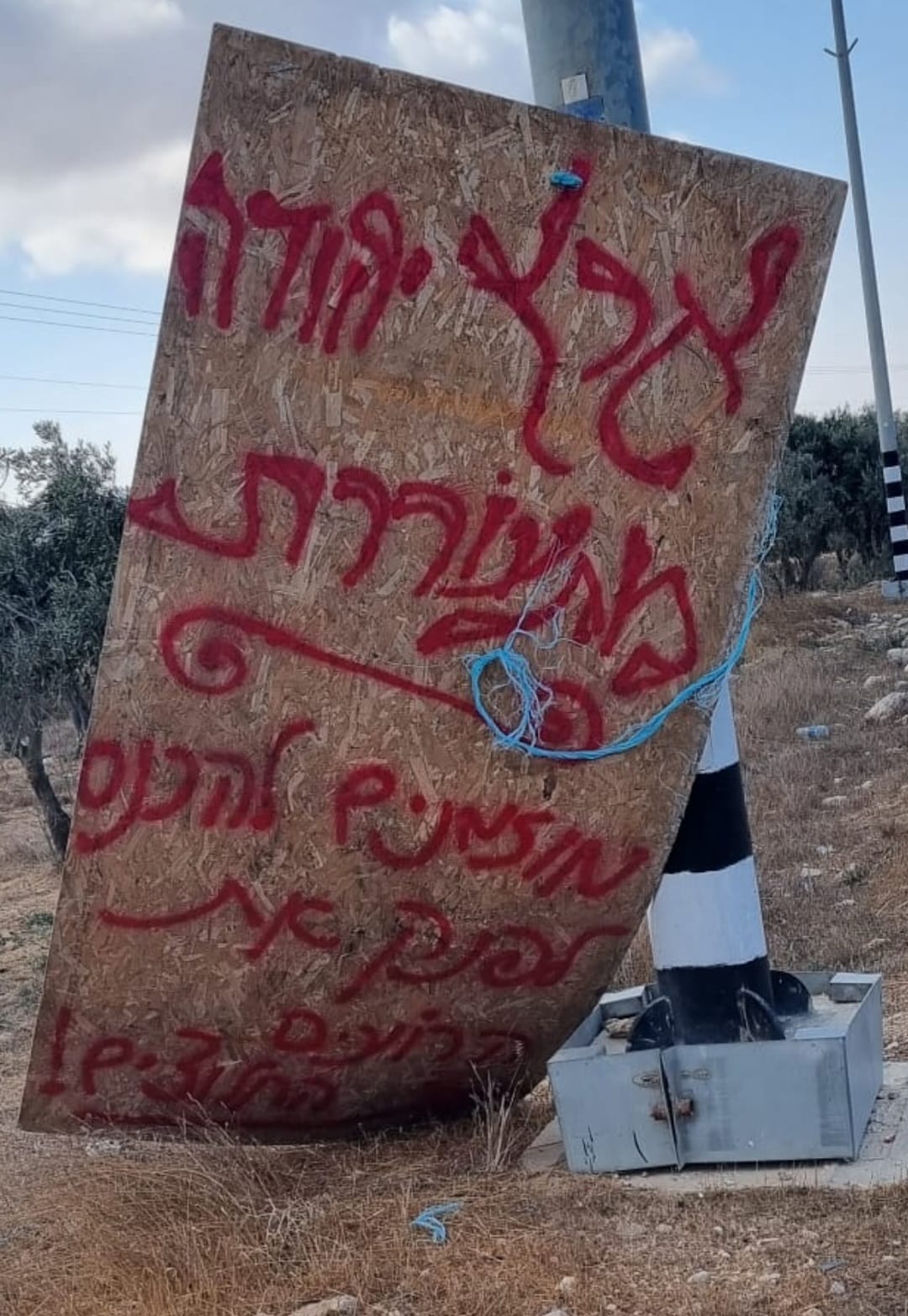 Smadar BeckerOct-17-2026A sign placed by those who call themselves the Pioneer Shepherds, at the outpost adjacent to Qawawis
-
