
South Hebron Hills, Thu 21.4.11, Morning
Translator: Charles K.
07:30-11:30
I received calls during the holiday informing me that the Israel Police hadn’t returned ID cards they’d taken from Palestinians who had been picked up because they didn’t have a permit to be in Israel. I was given the card numbers over the phone, and we left on a journey to find them. As you know, life in the occupied territories is impossible without an ID card.
At the police station dealing with the Bedouin towns and settlements, and at the Arad police station, we were able to get the cards without any particular problems (we hadn’t asked for powers of attorney forms), and drove to Khirbet Tuwwani to return them.
What can I tell you – the stalks of wheat are short; all the families are using small sickles to harvest them. Every little plot of ground is being harvested that way – the drought will lead to more and more arguments and conflicts over grazing land between the Palestinians and the settlers.
The new, “magnificent” neighborhood in the Ma’on settlement has been completed. The schoolyard is full of playground equipment, and I’m really sick of being the “nice guy” in this whole business – when will we finally be equal? When won’t the Palestinians need us any longer? Maybe we won’t have to wait for the millennium? Maybe it will happen tomorrow?
South Hebron Hills
See all reports for this place-
South Hebron Hills
South Hebron Hills is a large area in the West Bank's southern part.
Yatta is a major city in this area: right in the border zone between the fertile region of Hebron and its surroundings and the desert of the Hebron Hills. Yatta has about 64,000 inhabitants.
The surrounding villages are called Masafer Yatta (Yatta's daughter villages). Their inhabitants subsist on livestock and agriculture. Agriculture is possible only in small plots, especially near streams. Most of the area consists of rocky terraces.Since the beginning of the 1980s, many settlements have been established on the agricultural land cultivated by the Palestinians in the South Hebron Hills region: Carmel, Maon, Susia, Masadot Yehuda, Othniel, and more. Since the settlements were established and Palestinians cultivation areas have been reduced; the residents of the South Hebron Hills have been suffering from harassment by the settlers. Attempts to evict and demolish houses have continued, along with withholding water and electricity. The military and police usually refrain from intervening in violent incidents between settlers and Palestinians do not enforce the law when it comes to the investigation of extensive violent Jewish settlers. The harassment in the South Hebron Hills includes attacking and attempting to burn residential tents, harassing dogs, harming herds, and preventing access to pastures.
There are several checkpoints in the South Hebron Hills, on Routes 317 and 60. In most of them, no military presence is apparent, but rather an array of pillboxes monitor the villages. Roadblocks are frequently set up according to the settlers and the army's needs. These are located at the Zif Junction, the Dura-al Fawwar crossing, and the Sheep Junction at the southern entrance to Hebron.
Updated April 2022
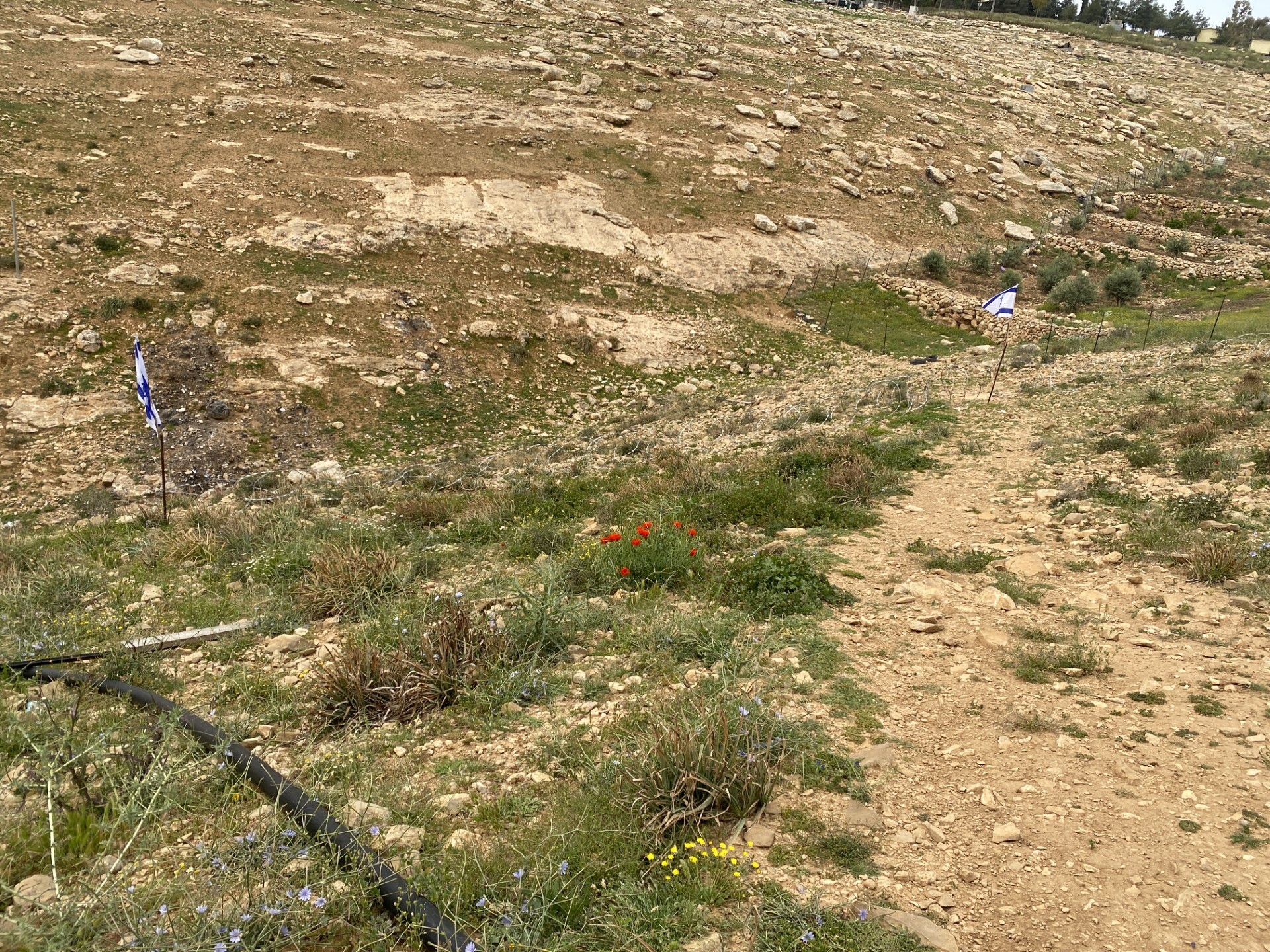 Yael ZoranApr-15-2026Between the flags, barbed wire blocks passage to the dirt path.
-