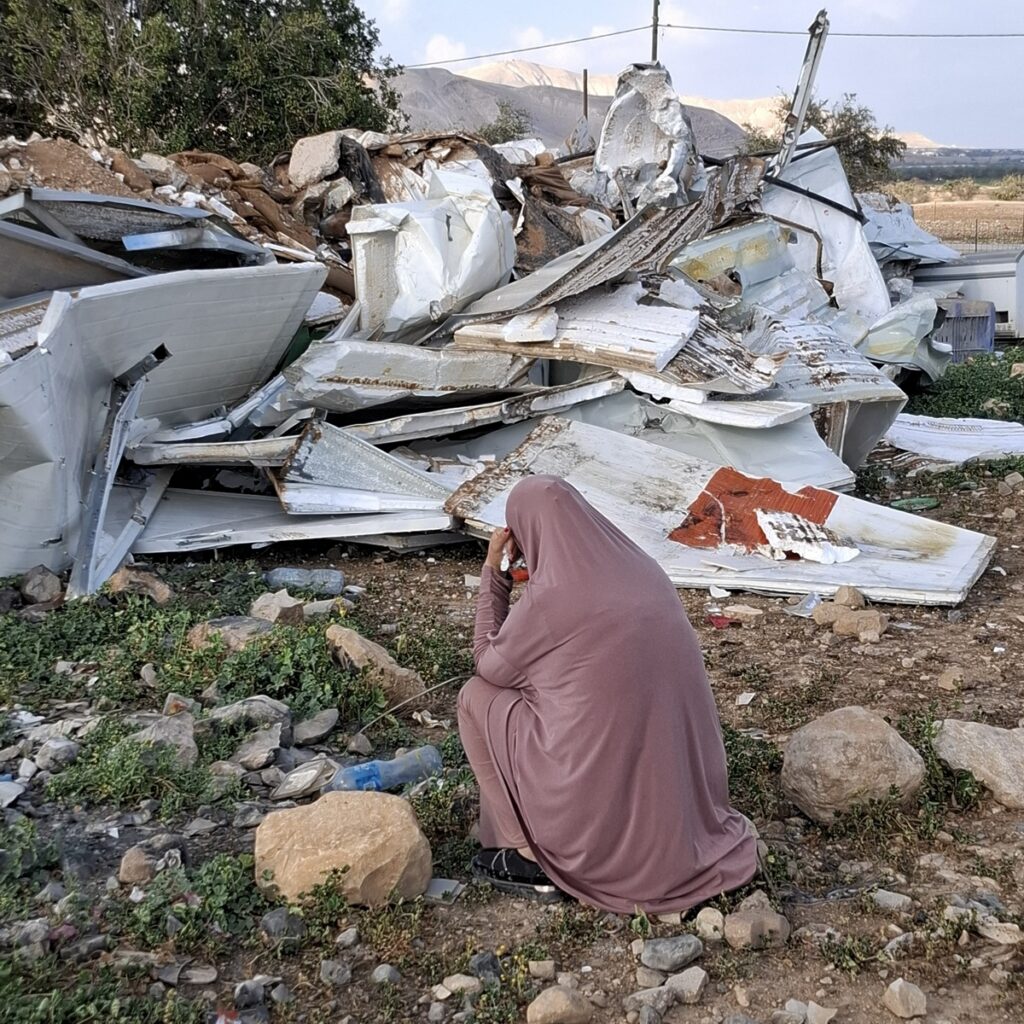
South Hebron Hills, Thu 26.8.10, Morning
Route 317
All the illegal outposts (as if the rest were legal) looked down upon us from the hill tops. The approach roads to them were paved; there were electricity and water lines; and they were protected by a number of Hummers. Some of them also have signposts. All the Palestinian villages are without signposts. To go to the Palestinian village Susiyah, one needs to guess where to turn off to the village. We entered Um-al-Khir which is situated below the fence of Carmel. Housing construction is taking place on this far side of the Carmel out of sight of the main road. Is construction really frozen?
Preschool in Khashem-al-Daraj
We picked up Eid from Um-al-Khir and continued on to Khashem-al-Daraj. We had arranged to visit with Huda ahead of time (with the help of Eid). Huda worked as a preschool teacher for 4 years before the school was built in Khashem-al-Daraj. For about two years, the school was located in a health clinic. Once the school was built, the head of the village volunteered to help. Similar preschools built by the UN in other villages closed down once UNRWA stopped paying the salaries of the teachers. Only Huda has continued to teach even though she is no longer paid by UNRWA and only occasionally receives payment from other sources.
On this visit, we were accompanied by two Israeli Bedouin preschool teachers who Yeela knows. They thought their experience in establishing preschools in their villages might be helpful to Huda. The visit was successful and Huda expressed a desire if her husband allows and we can arrange it to visit Khitam’s and Alyah’s preschools.
Educational needs
At the beginning, educational supplies were provided by some office in Hebron but this is no longer the case. The Village Groups provides some help. In the past, requests for donations were made to a children’s human rights organization.
In addition to educational materials, there is a need for sand to cover the play area. This is a yearly need because the wind scatters the sand. A low wall around the play area would help to keep the sand in this area.
Assistance in the functioning of the preschool
It is difficult to run the preschool without help, particularly because there are 30 children with different levels of educational experience. Some of the children are just entering preschool while others have been in the preschool for a year. Huda manages the situation by having one group of children play outside while she works with the others in the classroom. Khitam and Alyah suggested that a possible solution to the problem would be l to involve the mothers of the children who attend the preschool. A first step would be to organize a meeting with the mothers. Rather than a meeting of all the mothers, they suggested that Huda start with one mother – a friend – and ask her to bring 4 other mothers so that the first group consists of no more than 5 mothers. She would then continue to meet with small groups of mothers to explain the aims of the preschool and to enlist their help. They emphasized to Huda that it is a process but one that from their experience leads to the involvement of the mothers in the preschool’s daily activities.
Organization of the preschool
Khitam suggested organizing the room into activity corners: a kitchen/doll play corner, a corner to encourage reading/writing, language, creativity (painting), etc. Huda explained the difficulty of organizing the preschool without assistance.
The toys and puzzles that are available are missing parts. The workbooks have been used by previous students.
School begins at the end of Ramadan on the 14th of September. It is our intention to visit the preschool once the students are returned from summer vacation.
South Hebron Hills
See all reports for this place-
South Hebron Hills
South Hebron Hills is a large area in the West Bank's southern part.
Yatta is a major city in this area: right in the border zone between the fertile region of Hebron and its surroundings and the desert of the Hebron Hills. Yatta has about 64,000 inhabitants.
The surrounding villages are called Masafer Yatta (Yatta's daughter villages). Their inhabitants subsist on livestock and agriculture. Agriculture is possible only in small plots, especially near streams. Most of the area consists of rocky terraces.Since the beginning of the 1980s, many settlements have been established on the agricultural land cultivated by the Palestinians in the South Hebron Hills region: Carmel, Maon, Susia, Masadot Yehuda, Othniel, and more. Since the settlements were established and Palestinians cultivation areas have been reduced; the residents of the South Hebron Hills have been suffering from harassment by the settlers. Attempts to evict and demolish houses have continued, along with withholding water and electricity. The military and police usually refrain from intervening in violent incidents between settlers and Palestinians do not enforce the law when it comes to the investigation of extensive violent Jewish settlers. The harassment in the South Hebron Hills includes attacking and attempting to burn residential tents, harassing dogs, harming herds, and preventing access to pastures.
There are several checkpoints in the South Hebron Hills, on Routes 317 and 60. In most of them, no military presence is apparent, but rather an array of pillboxes monitor the villages. Roadblocks are frequently set up according to the settlers and the army's needs. These are located at the Zif Junction, the Dura-al Fawwar crossing, and the Sheep Junction at the southern entrance to Hebron.
Updated April 2022
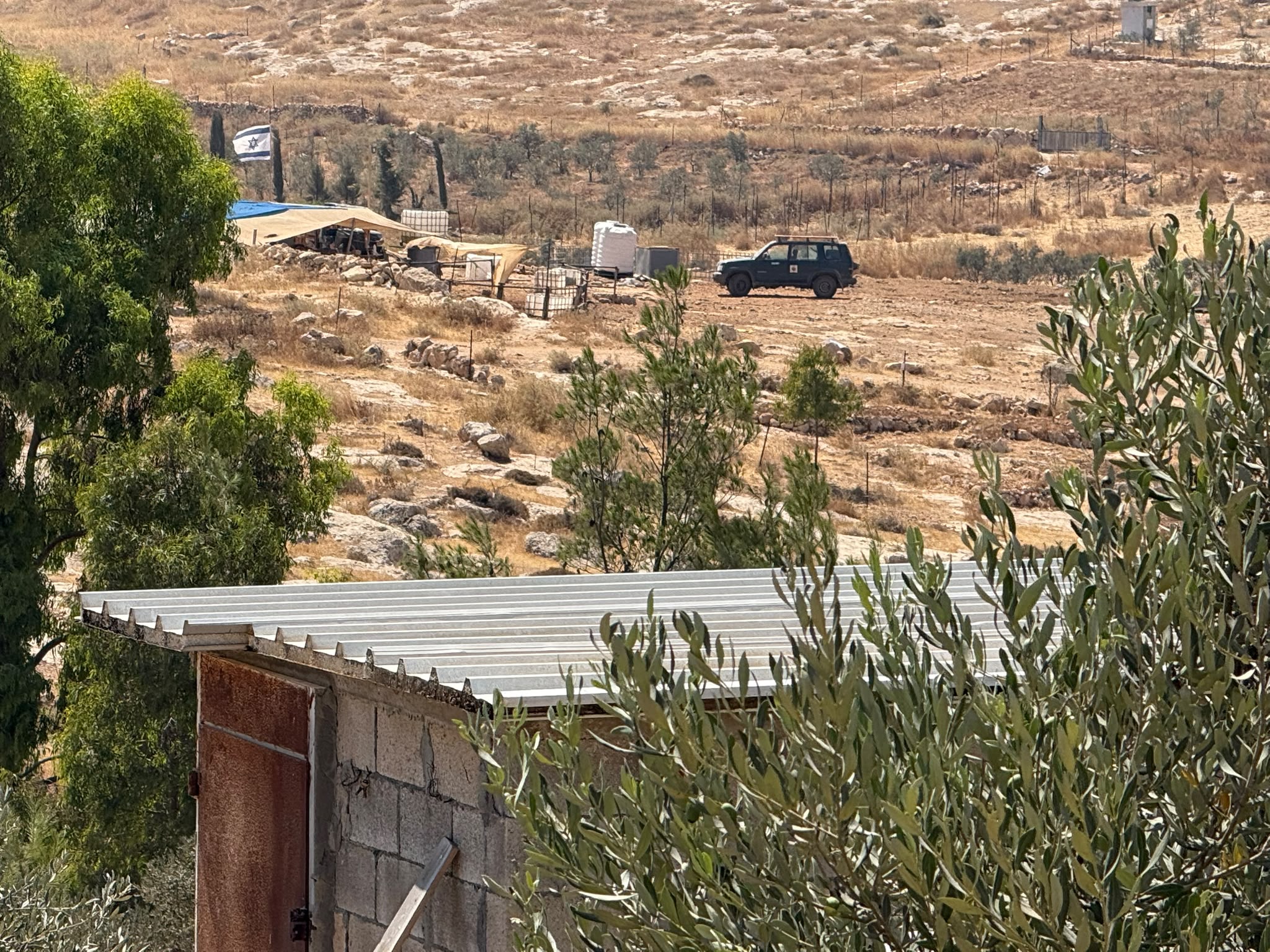 Muhammad D.Jul-23-2026The new settlement, starting June 1, 2026, opposite Khallet al-Humus.
-