
South Hebron Hills, Tue 1.5.12, Morning
Got to Kiryat Arba/Hebron on time, only to find the parking lot packed with soldiers, police, jeeps and bulldozers.
Yehudit and Muhammed arrived and we decided to follow the convoy arriving on route 60 near to the turnoff to route 317. Already even more jeeps, police, etc. waiting. A policeman came up to us in a very friendly fashion and asked if we did not remember him from the previous week when the settlers’ children were destroying the fields near Susiya and he said that there was a case being filed against them…….though I have my reservations about that.
The policeman turned to the commander saying that “Watch” had arrived but the latter gave us a weary look and said that we could go through just so long as we were careful to keep away from the vehicles. Yehudit thought that he was maybe contemptuous of us but I think he knows that it is easier to let us through and that in any case we have no power and no one is going to be very interested in any reports we may put out. Thank goodness I brought my camera.
I must say that the soldiers if not friendly were polite and most of the time allowed us to go as we wished. The higher ranks answered our questions though one did want to know if we knew what we were seeing. They had come to demolish several sheds which had been built for cattle and for milking. Thre were about 100 cows belonging to two brothers from the Rajabi family of Hebron. As well as the sheds there was an empty deserted van probably used for resting in, which one tractor enjoyed pulverizing and then pushing into the ditch. A real threat to the security of the state of Israel. Yes there are people building without permits but even if they tried to get them they would not do so. The owners said that they had received warning that the army was coming to destroy their buildings….the lieutenant colonel said that10 days ago they had been warned to take down the buildings as well and they had not done so. He also said that they had built on agricultural lands and I wanted to know if cows were not also agricultural in the broad sense of the word. That they polluted the water table. I should have asked him if the settlements such as Beitar Elite which let their sewage run down to the fields of the Palestinians below……
The pictures I hope speak for themselves (see link, below). Just think how much money it cost the government to carry out this destruction. And what was interesting was that there was no violence. Unlike the violence we see when once in a blue moon the army goes out to an illegal settlement to destroy whatever is there ….and which in the next day is built up again with no reaction from army, police or government.
The only bright part of the day was that as Yehudit and I were walking back to the road, one of the bulldozers' drivers stopped to ask which organization we were from. When we said “Machsomwatch’ he shouted in Hebrew, “ You ladies have more balls than Zahal” and drove off laughing.
South Hebron Hills
See all reports for this place-
South Hebron Hills
South Hebron Hills is a large area in the West Bank's southern part.
Yatta is a major city in this area: right in the border zone between the fertile region of Hebron and its surroundings and the desert of the Hebron Hills. Yatta has about 64,000 inhabitants.
The surrounding villages are called Masafer Yatta (Yatta's daughter villages). Their inhabitants subsist on livestock and agriculture. Agriculture is possible only in small plots, especially near streams. Most of the area consists of rocky terraces.Since the beginning of the 1980s, many settlements have been established on the agricultural land cultivated by the Palestinians in the South Hebron Hills region: Carmel, Maon, Susia, Masadot Yehuda, Othniel, and more. Since the settlements were established and Palestinians cultivation areas have been reduced; the residents of the South Hebron Hills have been suffering from harassment by the settlers. Attempts to evict and demolish houses have continued, along with withholding water and electricity. The military and police usually refrain from intervening in violent incidents between settlers and Palestinians do not enforce the law when it comes to the investigation of extensive violent Jewish settlers. The harassment in the South Hebron Hills includes attacking and attempting to burn residential tents, harassing dogs, harming herds, and preventing access to pastures.
There are several checkpoints in the South Hebron Hills, on Routes 317 and 60. In most of them, no military presence is apparent, but rather an array of pillboxes monitor the villages. Roadblocks are frequently set up according to the settlers and the army's needs. These are located at the Zif Junction, the Dura-al Fawwar crossing, and the Sheep Junction at the southern entrance to Hebron.
Updated April 2022
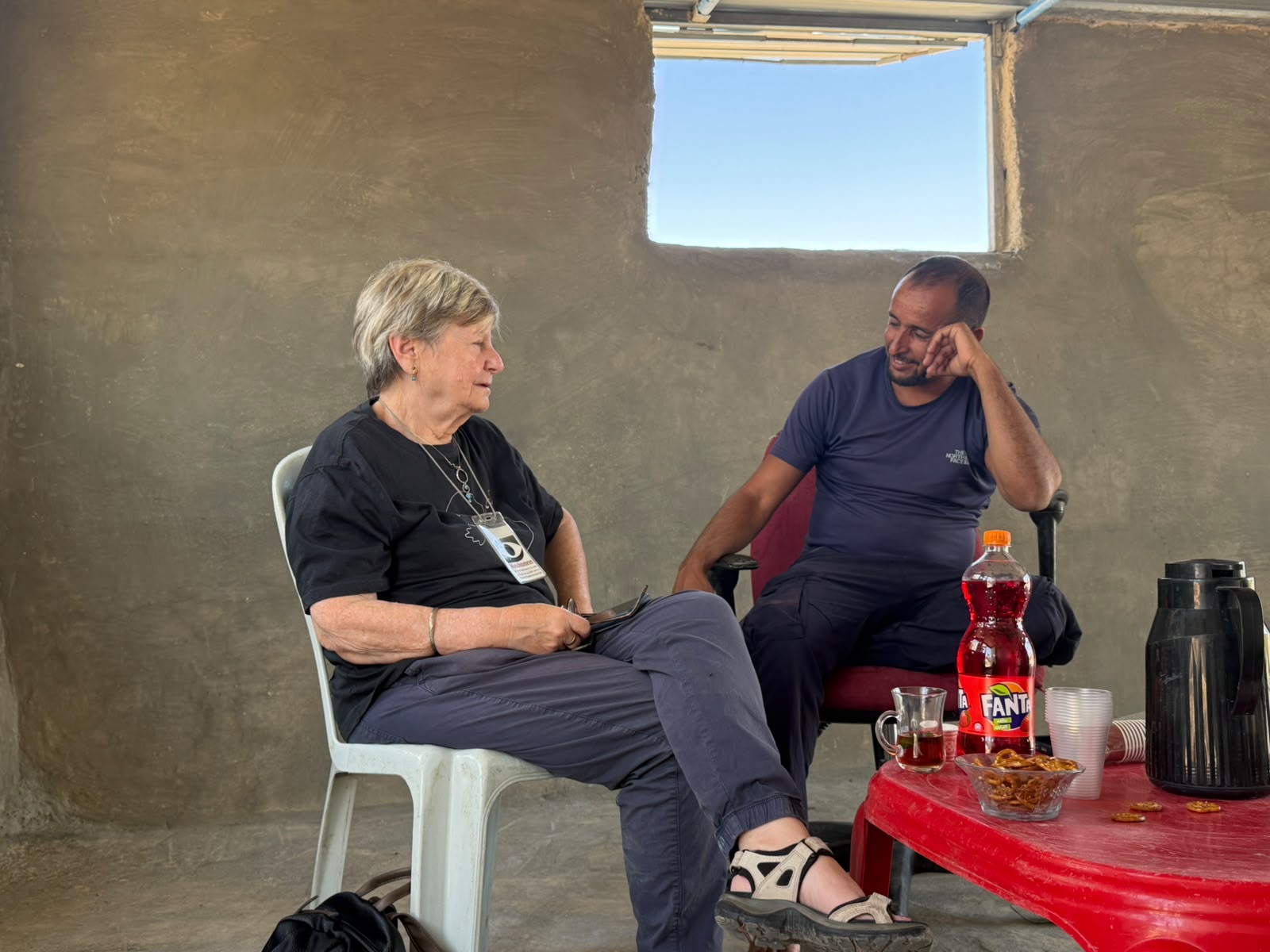 Muhammad D.Oct-10-2026Smadar with Najeh in Umm Qusa
-
