
South Hebron Morning
South Hebron Hills Sunday 5.9.04 AMObservers ; Hagit B, Elena L (reporting) We left Shoket at 6:30 and returned at 9:10.Summary: the effects of the suicide bombing in Beersheva are very evident. All measures lately taken to ease pressure on the movement of Palestinians have been cancelled. The army is present in force and the barriers which had been opened recently have been closed again.color = red> On route 60 near the turn off to Sinsana a roadblock of concrete blocks has been set up . It is manned by BP and blue policemen. The location is right on the green line –as opposed to the CP at Shim’a. It looks as if the new barrier will become permanent because the CP at Shim’a has been dismantledcolor = red>. The concrete blocks and the budke, as well as the soldiers who manned it, have gone. Although there was a soldier in the observation tower and a hummer on guard –the road beneath is now completely open. [The new location is appropriate to a frontier post and does not steal territory from the PA. It is also makes better sense than the old CP at Shim’a since it controls the exit onto route 60 from route 317 (insofar as Palestinian vehicles will ever be allowed to use it).] The turn off to Samoa (as-Samu’): the dirt barriers have been raised much higher ( in comparison to what was observed last Tuesday 31.8) A little before Otni’el the dirt barriers along the side of the road have been renewed and made higher. A lone child was seen walking along route 60 nearby on his way to school.6:55 The turn off to Dhahiriya: a military jeep was parked there.Route 60 was almost empty –we saw one military vehicle and one Israeli car driving in the direction of Beersheva.The Karma-route 60 junction: On the Karma side the dirt barriers along route 60 have been made considerably higher. 7:00 the al-Fawwar –Dura crossing: On both sides the road is blocked- on the al- Fawwar side with concrete blocks and on the Dura side with a gate. Soldiers are stationed on the Dura side. Only pedestrians are allowed to cross. We saw children walking along the edge of route 60 on their way to school in Dura and we also saw a cart and donkey traveling on route 60 towards Dura.7:07 Bani Na’im: the southern turn off is open, but the two turn offs north of it are closed (the northernmost turn off was completely open before the bombing).7:10 Ash Shuyukh -Hebron crossing (the girls’ school): Soldiers were standing on the Hebron side. Pedestrians –mainly school children were crossing route 60. We asked a soldier what the policy was towards people wanting to leave Hebron. He said that people wanting to go to Bani Na’im and other nearby villages were being let through. As for people wanting to go further afield –only humanitarian cases were allowed to go and they had to have special permits. The soldiers were not checking the papers of the pedestrians crossing route 60, but they were checking the papers of the passengers in the communal transit taxis leaving Hebron. In one instance 2 passengers in a taxi going to Jerusalem had no permits to go there and the soldier wanted to prevent them from continuing. They told him that their actual destination was on the way to Jerusalem and not the city itself. Hagit asked him why was it necessary to hold them up at Shuyukh junction when there were roadblocks at all the junctions further along the road to Jerusalem. The soldier was convinced by this argument and allowed the two men to proceed in the taxi. Indeed, a taxi driver told us that two days ago he had had to pass through 11 checkpoints and roadblocks on his route from Ash-Shuyukh junction to Jerusalem.Route 60 at this crossing is dangerous and there is no zebra crossing; a very large number of school children, some of them quite small, have to cross the road at this hour.There were two buses belonging to a Hebron company standing at the junction. They are allowed to go as far as al Hader CP. This was true before the closure. One of the drivers told us that they usually wait until the bus fills up –we did not see any great demand for the buses and it seems that most Palestinians prefer the communal taxis. We did however see a bus belonging to the company on route 60. A nice soldier standing at the barrier said to us : “We don’t have anything against you but we feel that what we are doing here is defending Israel”. Of course we answered that opinions were divided on what “defending Israel” entails. The exchange was friendly.7:35 The soldiers left – their shift had begun at 6:30. When we passed there on our way back after 8:00 they had returned. 7:40 we left Shuyukh7:45 the Humanitarian roadblock (on route 35): the gate was closed. There was a lot of military traffic on route 35 and we also saw a Palestinian bus, which had come from the north, driving along it.7:45 Two crossings between Halhul and Hebron before the Halhul- Hebron bridge were closed to cars. Taxis stood on either side and a lot of pedestrians were moving across route 35. The reason why there were so many became clear to us when we reached the Halhul-Hebron bridge. The bridge was closed on the Hebron side by a gate and on the Halhul side by barbed wire. Pedestrians moving in both directions were being checked and entry into Hebron required a permit. Everyone was being checked , women too. Three soldiers stood at either end of the bridge but most of the pedestrians came from Halhul. The queue was not large and it took about 10 minutes to reach the soldier doing the checking. An elderly man leaning on a cane was carrying X ray photos and he was asked to open the envelope, but immediately afterwards he was permitted to pass (this meant a walk of at least some 400 meters across the bridge towards the taxis). We saw a few men and women being turned back –we couldn’t see what the reason was because we were not allowed to stand next to the soldiers. Those who were turned back no doubt went to swell the numbers of the pedestrians we had seen at the two other crossings where there were no soldiers at all. The access to the bridge from route 35 was open but this was apparently done to let a hummer standing on the bridge take up its position. In any case any vehicle which used the access road to the bridge would find itself trapped between the gate and the barbed wire. We left the bridge at 8:05.8:12 the gate to Sa’ir was closed and the road to East Halhul was blocked by barbed wire.On the way back an ambulance was driving in front of us –we saw it stop at the Humanitarian crossing into Hebron. We stopped the car to see what would happen. After a very short wait the gate was opened –i.e. the humanitarian crossing was working.color = red>8:20 Sheep’s crossing Yatta- Hebron. The soldiers there made the pedestrians cross one by one in front of the hummer standing there. They did not check anyone’s papers. It seems they were afraid of being attacked if pedestrians were allowed to bunch up in groups. There was a queue of about 10 when we stopped but it soon came to an end after we got out and stood there ( post hoc ergo propter hoc?)8:45 Dura al –Fawwar crossing: a military vehicle was parked there and pedestrians were crossing in both directions. On the Dura side at the exit onto route 60 an empty Red Cross car was parked.8:50 On the turn off to Samoa ( as- Samu’), we saw an enormous bulldozer in action apparently building yet another barrier!9:05 the new roadblock at Sinsana was in action checking cars in both directions.
South Hebron Hills
See all reports for this place-
South Hebron Hills
South Hebron Hills is a large area in the West Bank's southern part.
Yatta is a major city in this area: right in the border zone between the fertile region of Hebron and its surroundings and the desert of the Hebron Hills. Yatta has about 64,000 inhabitants.
The surrounding villages are called Masafer Yatta (Yatta's daughter villages). Their inhabitants subsist on livestock and agriculture. Agriculture is possible only in small plots, especially near streams. Most of the area consists of rocky terraces.Since the beginning of the 1980s, many settlements have been established on the agricultural land cultivated by the Palestinians in the South Hebron Hills region: Carmel, Maon, Susia, Masadot Yehuda, Othniel, and more. Since the settlements were established and Palestinians cultivation areas have been reduced; the residents of the South Hebron Hills have been suffering from harassment by the settlers. Attempts to evict and demolish houses have continued, along with withholding water and electricity. The military and police usually refrain from intervening in violent incidents between settlers and Palestinians do not enforce the law when it comes to the investigation of extensive violent Jewish settlers. The harassment in the South Hebron Hills includes attacking and attempting to burn residential tents, harassing dogs, harming herds, and preventing access to pastures.
There are several checkpoints in the South Hebron Hills, on Routes 317 and 60. In most of them, no military presence is apparent, but rather an array of pillboxes monitor the villages. Roadblocks are frequently set up according to the settlers and the army's needs. These are located at the Zif Junction, the Dura-al Fawwar crossing, and the Sheep Junction at the southern entrance to Hebron.
Updated April 2022
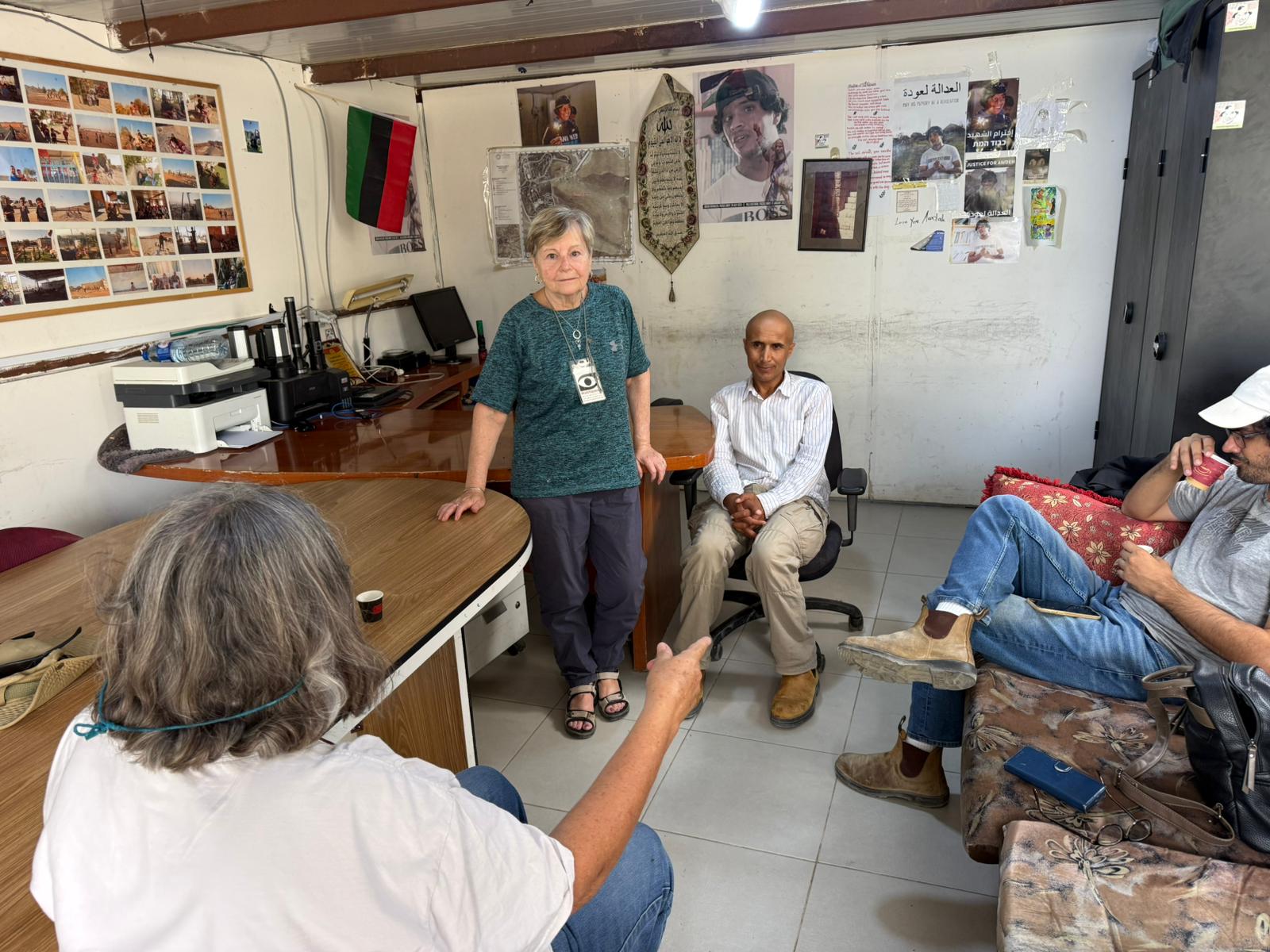 Muhammad D.Aug-30-2026Umm al-Khair, Smadar with Eid, Or and Timna, in the Situation Room
-
