Tarqumiya, AM
Tarqumiya 1/6/2004 Watchers: Dana L-A., Haya H., Tali L. (reporting) We arrived at 6:45, and the CP was bustling with activity. Lorries and cars crossed in both directions without hindrance; and even the handful of workers who arrived (relatively) late passed through without any special holdups (i.e.: according to the usual procedure, one by one, on foot, after walking some 500 meters from their waiting place until reaching the soldier at the CP). But problems arose over the passage of people wanting to visit prisoners. The passengers in two buses, headed for prisons in the Sharon and in Hadarim, were passed through quickly and they were allowed on their way (more or less) on time. However, 2 other buses and a minibus, the passengers of which wanted to visit Ketziot prison, were held up at the CP for many hours. It turned out that, although their transit had been arranged ahead of time, a police escort had been sent only for the first two buses (for reasons which we were unable to fathom). Ata, the Palestinian liaison officer to the Red Cross, tried , via the Red Cross offices, to organize the required escort. We spoke to Captain Hadi, the DCO Hebron and we called the Civil Administration (Operations) several times. Everyone promised to deal with the matter. We also tried to get in touch with DCO Beit El who didn’t answer our calls. We also spoke to the army’s Humanitarian Center only to be told that the Center does not work with the police. It should be noted that the soldiers at the CP told us that they too had reported the problem to the appropriate authorities and that they too had been told that it was being dealt with.About 9:15 we left the CP. The passengers were still waiting for the police escort inside the buses (they had been forbidden to “walk about the area”).At 10:15 and again at about 12:00 we called Ata to find out what had happened, and we were told that the escort had only just then arrived. Well, so what are 5 hours sub specie aeternitatis? (please read this in a cynical tone). But for us, the Israelis, who had been there only two and a half hours, the bus driver had made coffee… (Turkish coffee with hel, as it should be made… Highly recommended). While talking to the Palestinian bus drivers we were asked to report the following:1) The passage from Halhul to Hebron has been closed to motor traffic for 5 days already. 2) At the Tarqumiya–Idna junction the soldiers disturb the peace of the neighborhood (they play their radios very loudly and curse the passers-by even in the middle of the night). Let us be comforted in the construction of the Negev…
Hebron
See all reports for this place-
According to Wye Plantation Accords (1997), Hebron is divided in two: H1 is under Palestinian Authority control, H2 is under Israeli control. In Hebron there are 170,000 Palestinian citizens, 60,000 of them in H2. Between the two areas are permanent checkpoints, manned at all hours, preventing Palestinian movement between them and controlling passage of permit holders such as teachers and schoolchildren. Some 800 Jews live in Avraham Avinu Quarter and Tel Rumeida, on Givat HaAvot and in the wholesale market.
Checkpoints observed in H2:
- Bet Hameriva CP- manned with a pillbox
- Kapisha quarter CP (the northern side of Zion axis) - manned with a pillbox
- The 160 turn CP (the southern side of Zion axis) - manned with a pillbox
- Avraham Avinu quarter - watch station
- The pharmacy CP - checking inside a caravan with a magnometer
- Tarpat (1929) CP - checking inside a caravan with a magnometer
- Tel Rumeida CP - guarding station
- Beit Hadassah CP - guarding station
Three checkpoints around the Tomb of the Patriarchs
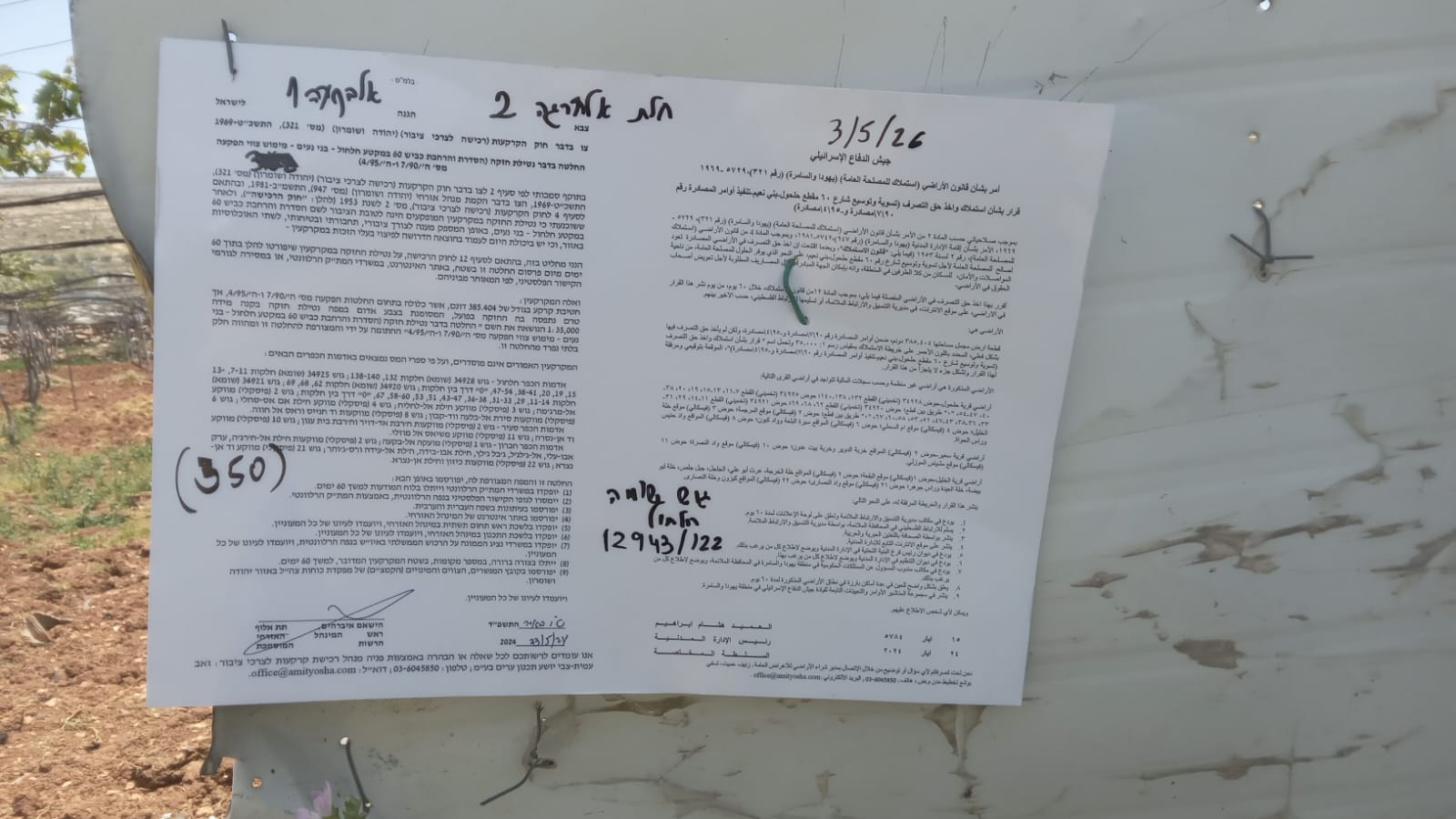 Muhammad D.May-13-2026Hebron - Request for compensation for land expropriation
-