
Tawamin - a violent attack by settlers


Following an article written by a peace activist about what was happening, we went to Tawamin, a place east of Susiya. Luckily Muhammad has a 4 × 4 car and we all got there.
There lived the Mor family who returned to live in the family caves, because this is their land with the olive groves and the areas where they graze their flocks. Following what I told about the family about a month ago near A-Tuwani and two weeks later her son Harun was shot by a soldier in a struggle for an old generator and is now lying completely paralyzed in Hebron. Here, too, attempts to expel them from their land continue. The settlers are very active on the issue. The army protects them especially of course and backs up their behavior.
This is how it looks from the pictures.
After a few minutes of adjusting to the darkness and the smell of smoke, we sat with the people. They said they had been here for decades. The man who looks about 60 years old says that he was born in this cave and that his grandparents also lived here. In 2001 a settler was killed and the army, without holding an investigation shot and killed his cousin saying that he was the murderer. The area was then declared a closed army area and 60 people were driven out and the caves destroyed. And they moved to Imnainzil near the checkpoint of Mezadot Yehuda.
In 2011, after a long legal battle, it was legally decided that they had the right to return and live there by the authorities and with permission, and have in addition to legal document which states that they are the owners of the land and there is also the confirmation from from the state. But the settlers are not interested and they come from the settlements Susiya and Mitzpe Yair, trying to expel them and dancing, praying and shouting:
“Get out of here, it’s not yours, it’s ours , it’s our land for 2000 years.
At the penultimate time, about a week ago, the settlers re-entered the cave broke the door and destroyed everything possible.
The person talking to us also tells that there was an article on Channel 12 in which the settler from Susya was very proud that they are the only settlement in the area which has no fence. Also that they have already taken 4,000 dunams from the Palestinians. Only the Mor family remains like a knife in their throats and that they too will be expelled from their land and the settlers will take everything.
The Palestinian says: I told the army that I will not move from here. From here only to the grave will they take me.
When we left, police arrived. According to the people the blue police are treating them decently and have come to see what the situation was, because they saw a crowd of settlers from Susiya on this desolate hill overlooking their home, lighting fires. We did not confront them for good or for bad.
From there we drove to Abu Safi Hagar who lives in the valley at the foot of Mitzpe Yair where they told us of a lone settler named Israel Kaplan. Abu Safi says that the settler is not harassing him, but that his neighbor is constantly being attacked by the settler and his dogs, as we reported about two months ago.
The corona does not kill human evil and apparently does not even weaken it.
South Hebron Hills
See all reports for this place-
South Hebron Hills
South Hebron Hills is a large area in the West Bank's southern part.
Yatta is a major city in this area: right in the border zone between the fertile region of Hebron and its surroundings and the desert of the Hebron Hills. Yatta has about 64,000 inhabitants.
The surrounding villages are called Masafer Yatta (Yatta's daughter villages). Their inhabitants subsist on livestock and agriculture. Agriculture is possible only in small plots, especially near streams. Most of the area consists of rocky terraces.Since the beginning of the 1980s, many settlements have been established on the agricultural land cultivated by the Palestinians in the South Hebron Hills region: Carmel, Maon, Susia, Masadot Yehuda, Othniel, and more. Since the settlements were established and Palestinians cultivation areas have been reduced; the residents of the South Hebron Hills have been suffering from harassment by the settlers. Attempts to evict and demolish houses have continued, along with withholding water and electricity. The military and police usually refrain from intervening in violent incidents between settlers and Palestinians do not enforce the law when it comes to the investigation of extensive violent Jewish settlers. The harassment in the South Hebron Hills includes attacking and attempting to burn residential tents, harassing dogs, harming herds, and preventing access to pastures.
There are several checkpoints in the South Hebron Hills, on Routes 317 and 60. In most of them, no military presence is apparent, but rather an array of pillboxes monitor the villages. Roadblocks are frequently set up according to the settlers and the army's needs. These are located at the Zif Junction, the Dura-al Fawwar crossing, and the Sheep Junction at the southern entrance to Hebron.
Updated April 2022
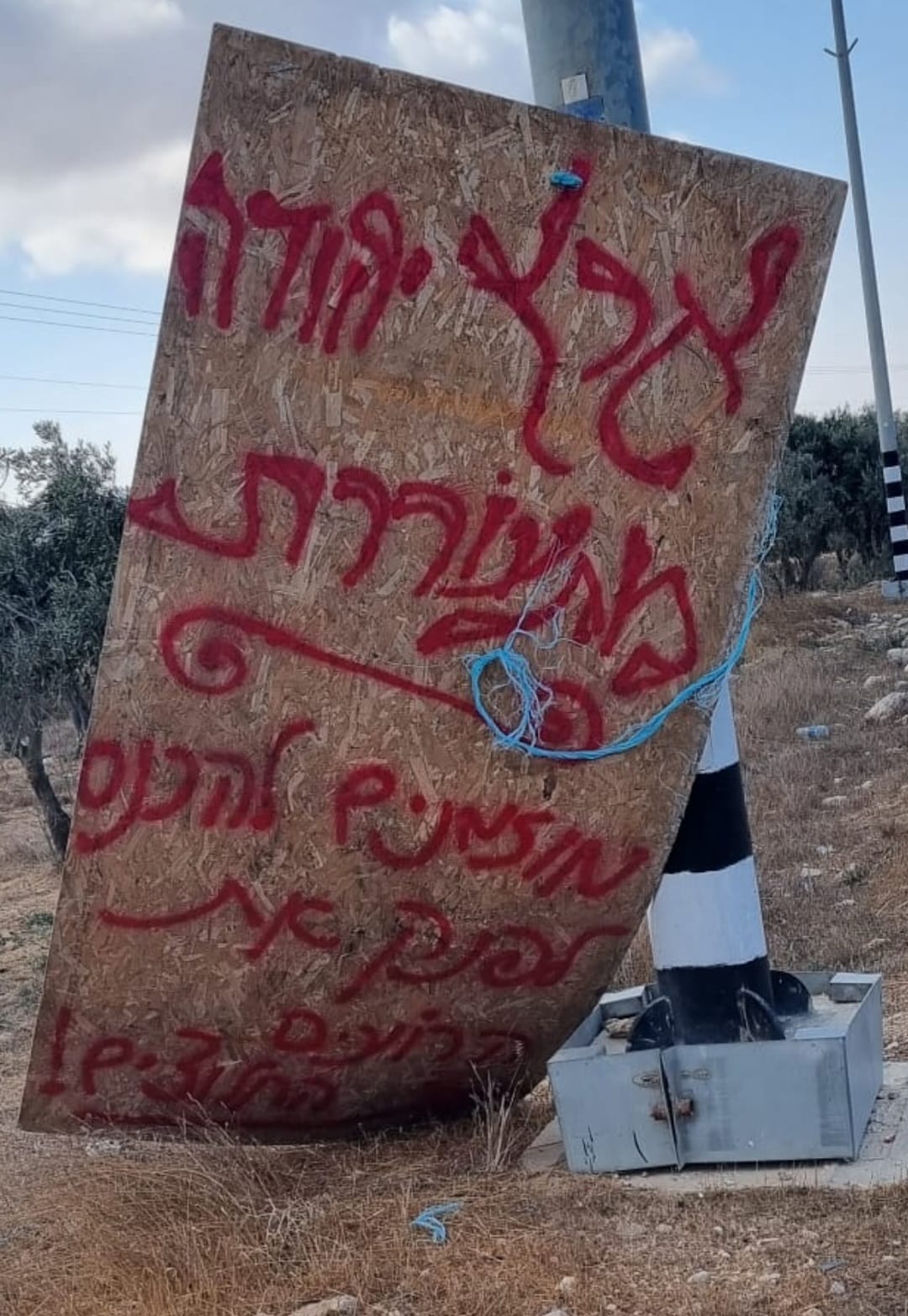 Smadar BeckerOct-17-2026A sign placed by those who call themselves the Pioneer Shepherds, at the outpost adjacent to Qawawis
-
