
The busiest morning in Qalandiya
05.30. A late start, because of road work on route 1. On the Palestinian side were long lines, extending far beyond the shed. The youth (or, rather, child) who sells cakes outside was back after some weeks’absence. The beigel seller was there, and the tea kiosk was open – and of course the lights have not yet been repaired!
As usual lately, only 4 checking stations were open, the 5th opening at about 6. The queues were orderly, though advancing slowly, the end being nowhere in sight. At 6 the soldier in the aquarium was relieved, and the sixth checking station opened. By this time there were many waiting at the humanitarian gate. Now and again the women waiting there despair and go across to the general queue, where the men let them in at the cage’s entrance. The men, of course, don’t have this option. A guard and D.C.O. officer arrive only at 6.30 – just after our second phone-call..
We went outside to check. The lines reached about half-way to the road. From a distance, at least, the traffic checkpoint seemed to be ‘reasonable.’ There doesn’t seem to be much progress on the building front, and we wondered why it was necessary to destroy the whole carpark so long in advance of building.
As we stood later at the tea kiosk, a youth asked us “why aren’t they ‘streaming’ the people.” (That is, the locals have picked up the jargon used by the police and guards controlling the checkpoint. ) Just then the policewoman arrived, and she and the guard started telling the soldier in the aquarium when to open the carousels.
A woman and an older man arrived, with 5 children, apparently on their way to a consulate. The man is the woman’s brother and has come to help her. Because of his age he does not need a permit – but catch-22 – he can enter only after 8 o’clock. We advised the woman to use the humanitarian gate and the man to join the general queue, in the hope that when he reached the checking point he would be allowed through. People in line also advised this, and let him in at the cage entrance. So the woman and the children went through the humanitarian gate with the assistance of the guard up to a checking station, the man went the normal way – and, as he didn’t return, we trust they succeeded.
We chatted with an old man who had come already before 6. His wobbly legs hardly support him. He took a piece of carton, placed it over a stone rubbish-bin and leaned against it. When the humanitarian gate opened, he was not allowed to enter. Apparently he was waiting for the D.C.O. to apply for a magnetic card. Again he approached the gate. The policewoman and guard tried to help him, explaining that the D.c.O. would open only at 8.30. The policewoman asked him why he wanted a card which would cost him money when, without one he could pass without a permit – and reach his work in Givat Zeev quickly without traffic jams. He told us he worked in construction, which rather surprised us, considering his physical state. It turned out that he assists builders: prepares tea and coffee, arranges tools, etc., earning 120 shekels a day. He needs an income, he explains, “we don’t have national insurance or pensions.”
At one point we heard the sound of heavy equipment outside. We went to look and, indeed, there was big bulldozer at work at a section of what was the parking lot, now behind a metal fence. So apparently there is some work going on! Meanwhile, inside and out the lines continued. Only at about 7.30 did they shrink enough to be inside the shed. At 7.40 we joined a line, and noticed that then the humanitarian gate closed. Immediately afterwards a woman arrived with a baby in her arms, a boy of about 11, and grandma. When they found the gate closed, we invited them to come in at the entrance to the cage. When the carousel opened, the mother and baby got through, but not the boy or grandmother. All our efforts to signal to the soldier to open the carousel for them failed. He did not understand our gestures and did not bother to open his window so as to hear us. Passage took a long time in spite of the late hour – it took us 45 minutes till we were through.
Qalandiya Checkpoint / Atarot Pass (Jerusalem)
See all reports for this place-
Click here to watch a video from Qalandiya checkpoint up to mid 2019 Three kilometers south of Ramallah, in the heart of Palestinian population. Integrates into "Jerusalem Envelope" as part of Wall that separates between northern suburbs that were annexed to Jerusalem in 1967: Kafr Aqab, Semiramis and Qalandiya, and the villages of Ar-Ram and Bir Nabala, also north of Jerusalem, and the city itself. Some residents of Kafr Aqab, Semiramis and Qalandiya have Jerusalem ID cards. A terminal operated by Israel Police has functioned since early 2006. As of August 2006, northbound pedestrians are not checked. Southbound Palestinians must carry Jerusalem IDs; holders of Palestinian Authority IDs cannot pass without special permits. Vehicular traffic from Ramallah to other West Bank areas runs to the north of Qalandiya. In February 2019, the new facility of the checkpoint was inaugurated aiming to make it like a "border crossing". The bars and barbed wire fences were replaced with walls of perforated metal panels. The check is now performed at multiple stations for face recognition and the transfer of an e-card. The rate of passage has improved and its density has generally decreased, but lack of manpower and malfunctions cause periods of stress. The development and paving of the roads has not yet been completed, the traffic of cars and pedestrians is dangerous, and t the entire vicinity of the checkpoint is filthy. In 2020 a huge pedestrian bridge was built over the vehicle crossing with severe mobility restrictions (steep stairs, long and winding route). The pedestrian access from public transport to the checkpoint from the north (Ramallah direction) is unclear, and there have been cases of people, especially people with disabilities, who accidentally reached the vehicle crossing and were shot by the soldiers at the checkpoint. In the summer of 2021, work began on a new, sunken entrance road from Qalandiya that will lead directly to Road 443 towards Jerusalem and Tel Aviv. At the same time, the runways of the old Atarot airport were demolished and infrastructure was prepared for a large bus terminal. (updated October 2021)
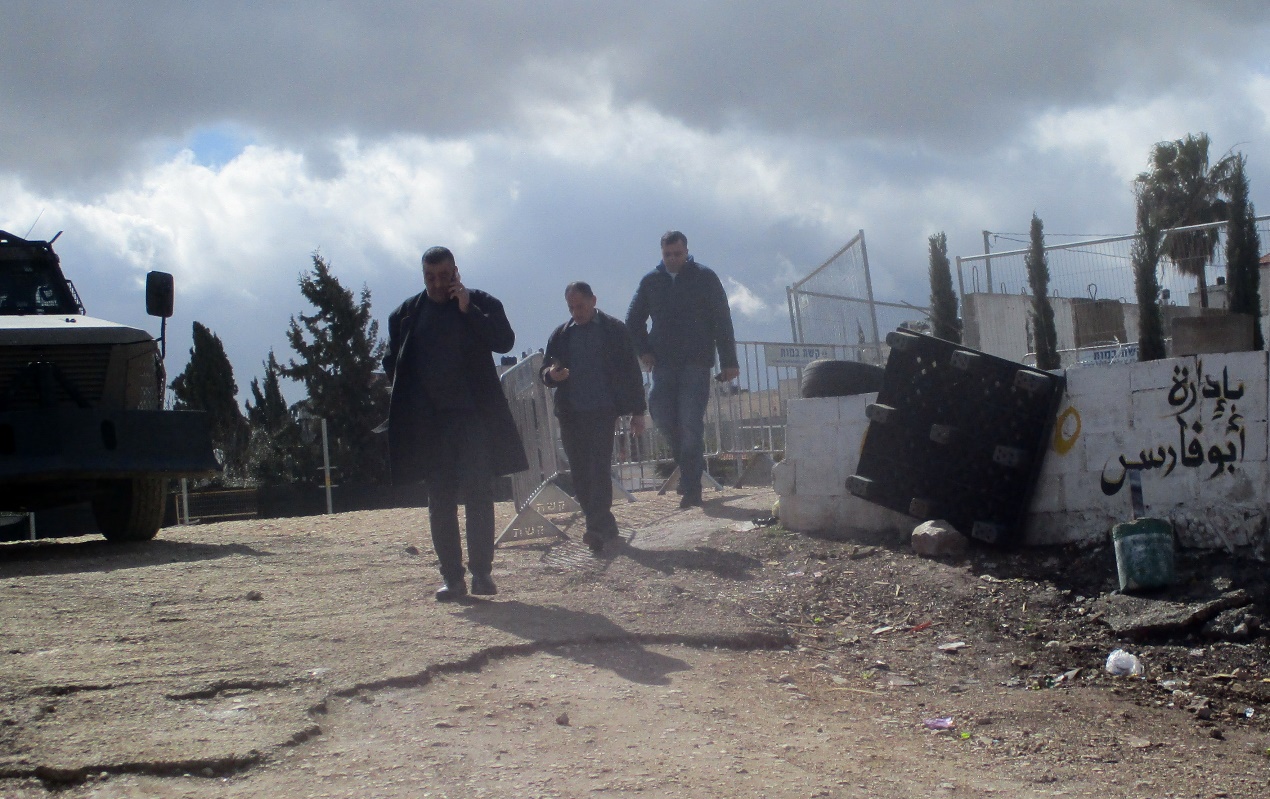 Tamar FleishmanFeb-27-2026Qalandiya: On the way to prayer
-