
The Jordan Valley: a visit to the camps
We arrived at the Ras A-Tin schoolhouse, erected about a year ago during the break in studies. Several dozen children played ball. At the end of their recess, one of the teachers rang a hand-bell and the children returned the balls (some of them emptied) to a bag at the teachers’ room door.
We were warmly welcomed by Nura, the principal, who tole us how right-wing Members of Knesset (parliamentarians) and their supporters of the Regavim association came in a motorcade and demanded that the school be demolished. The children were traumatized by this visit of these evil doers, Israel flags and hate-speak through the windows.
We then visited a random family in the encampment. We sat with a father and his children in the sun that didn’t really manage to warm up this cold day. One of the girls, Amal, 4-years-old, wore her 5th-grade brother’s schoolbag all day. After a while she opened it, took out an English workbook and showed us his homework. The conversation weas joined by family members we had visited on January 9, and another man. Apparently he lives in a neighbor community, also belonging to Ras A-Tin, except that it is located on the hilltop south of the colonist quarry of Kochav Ha-Shachar. While speaking we saw a group of about 10 children and a donkey who passed through the place and continued south. The man explained that these were children from Upper Ras A-Tin on their way home from school in Lower Ras A-Tin (about 2-3 kilometers apart). He drove with us and showed us the Upper community and adjacent to it, a new colonist outpost whose name I do not know, and whose colonists make the lives of these shepherds unbearable.
Jiftliq village, the Ka’abane family. Background (a reminder) – we first met this family 4.5 years ago, when Odeh and his wife Sarah had been married for one year and the occupation army demolished the stone house they had built for themselves. 2 lost 20-year-olds who looked 12 with a newborn baby. In August 2019 we met them at Al Hadidiya, where the family (Odeh and his wife, father, mother and all of their children) would pitch their tents all summer because of the crowding and lack of water in their permanent Jiftliq home. The army had demolished again, and confiscated the meager tents they had and left them with a 40-days-old baby girl in the searing sun. We helped them pitch new tents, but a few days later an army officer arrived accompanied by a security official and notified Odeh if the next dawn they would still be there, the army would confiscate everything they had. The same night, at 3 a.m., the family loaded onto a platform of their tractor its meager possessions and children and got on its way in the dark to return to the Jiftliq. A truck driving in the opposite direction whose driver had fallen asleep perhaps, or just didn’t see them in the dark, ran into them and killed the baby, critically wounding the mother. Other wounded were 6-years-old Hamza (in the head) and the father Najeh who fractured his arm. Sarah was taken to Hadassah Ein Kerem Hospital in Jerusalem and lay unconscious for 3 weeks in the ICU. After 3 months and many operations she returned to the village. A year later they had a daughter, who suffers from a critical syndrome called Spina-bifida, resulting in a paralyzed lower body. With Shuli’s help we are trying to get treatment or consultation in an Israeli hospital, so that the family will give her the means to cope with her incapacity and a future life in the Jordan Valley that is tough as things are anyway.
Odeh was out with the flock, grazing, so we didn’t meet him, but we did meet his parents and gave them things demanded by the hospital. They were glad to see us, Hagar gave out books to the boys, and the girl asked for notebooks and pens. The atmosphere was friendly. Aisha, the incapacitated daughter, sat on the ground and broke out in fearful screams any time one of us approached her.
The gate to Ro’i colony – which prevents Hadidiya children from getting to the road, to their school transport, and any vehicle from passing through – was open today. (14:30).
We met Nizam from Humsa, who asked us to buy roll of black and white nylon for the sheep pen which he had covered with nylon and the army confiscated two months ago. I took the opportunity to buy from him more almonds to sell in Israel (50 shekels a kilo) – at the end of the summer Humsa villagers had bought unpeeled almonds in the Galilee and fed their flock with almond peels. Since then, they call me (and anyone else they know) and want to sell us peeled almonds.
W had a short visit with Burhan. He dislocated his shoulder as he feel from the sheep pen roof that was blown away by the storm a month ago. He suffers serious pains and worst of all – has a hard time working the household farm. Daughter Ghadeer who graduated university is helping him and Samaher, his wife. Abu Halaf came down from his tent up the hill to say hello. This is a wonderful man, 87-years-old, who lives alone and grows sheep and goats. He refuses to leave, although his sons have all left and are pressuring him to lay down his shepherd’s cane and move to Tamoun. “Here I was born, and here I will die”, says he.
Al-Jiftlik
See all reports for this place-
A large Palestinian area in the Jordan Valley (in Israeli-controlled Area C), which includes a town located on two main roads: Highway 57 leading from Nablus to Adam Bridge and Highway 90, Israel's eastern longitudinal highway. Some of its residents are Bedouin who were expelled from the Negev in the 1950s. MachsomWatch women have been in regular contact with the Bedouin communities in the area for many years.
A special connection was formed with the Kaabna family, who, following the demolition of their home in 2017, fled to the village of Hadidiya, and experienced a terrible tragedy along the way. In 2019, they were expelled again from Hadidiya under threat of demolition and returned to Jiftalik.
Jiftalik is the only village in the Jordan Valley for which Israel prepared and approved master outline plans in 2005. All of them were prepared without the participation of the residents and restricted construction and development in the village to a limited part of its area, thus many demolitions are being carried out there.
Because of an inadequate water system, residents are forced to purchase water in tankers, and all requests for the construction of a reservoir have been denied.
-
Jordan Valley
See all reports for this place-
Jordan Valley The Jordan Valley is the eastern strip of the West Bank. Its area consists of almost a third of the West Bank area. About 10,000 settlers live there, about 65,000 Palestinian residents in the villages and towns. In addition, about 15,000 are scattered in small shepherd communities. These communities are living in severe distress because of two types of harassment: the military declaring some of their living areas, as fire zones, evicting them for long hours from their residence to the scorching heat of the summer and the bitter cold of the winter. The other type is abuse by rioters who cling to the grazing areas of the shepherd communities, and the declared fire areas (without being deported). The many groundwaters in the Jordan Valley belong to Mekorot and are not available to Palestinians living in the Jordan Valley. The Palestinians bring water to their needs in high-cost followers.
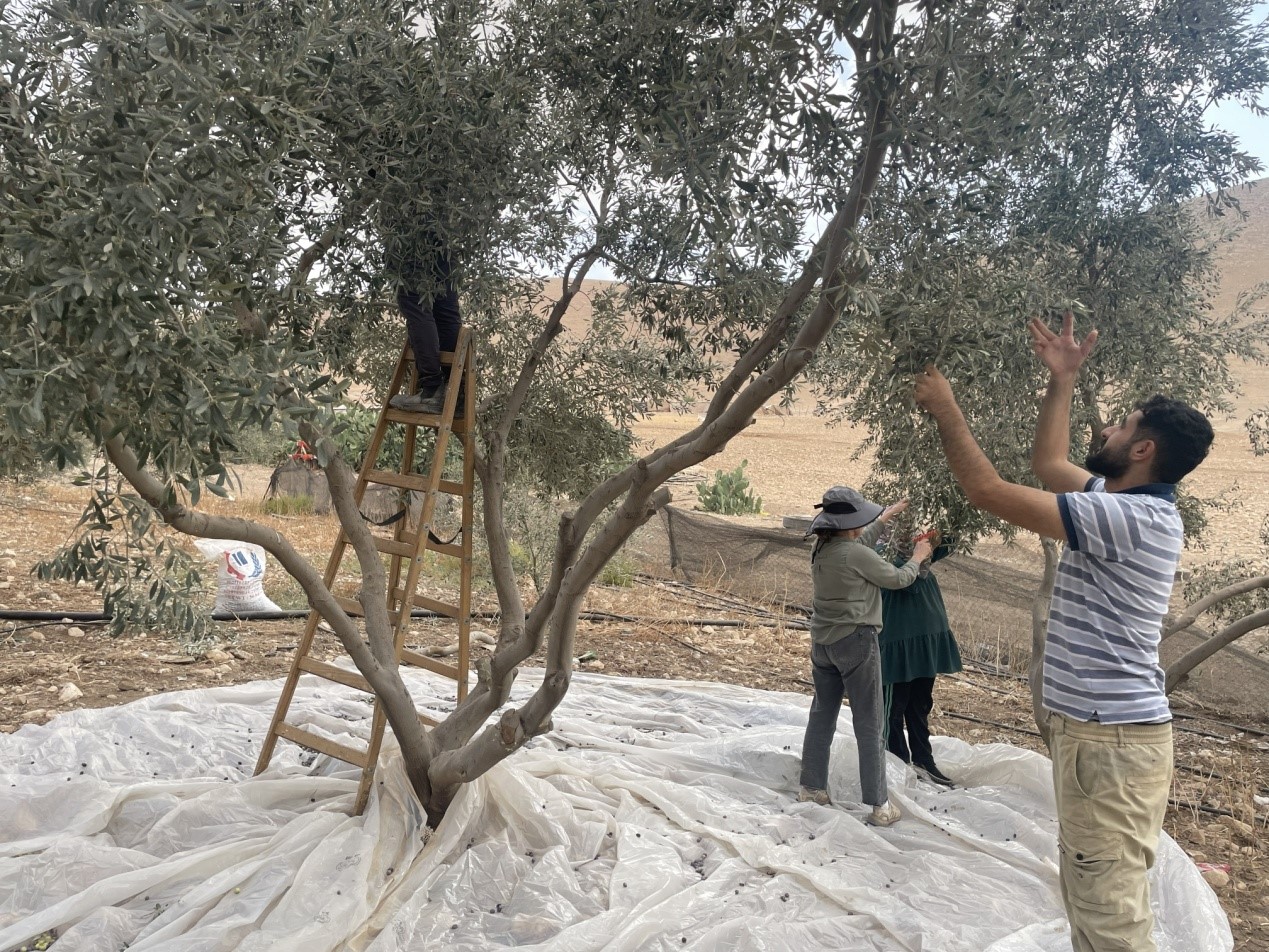 Rachel AfekOct-15-2026Olive Harvest in the Jordan Valley
-
Ras a-Tin
See all reports for this place-
Ras a-Tin
-
