
The Jordan Valley: Escorting shepherds – Khalet Makhul

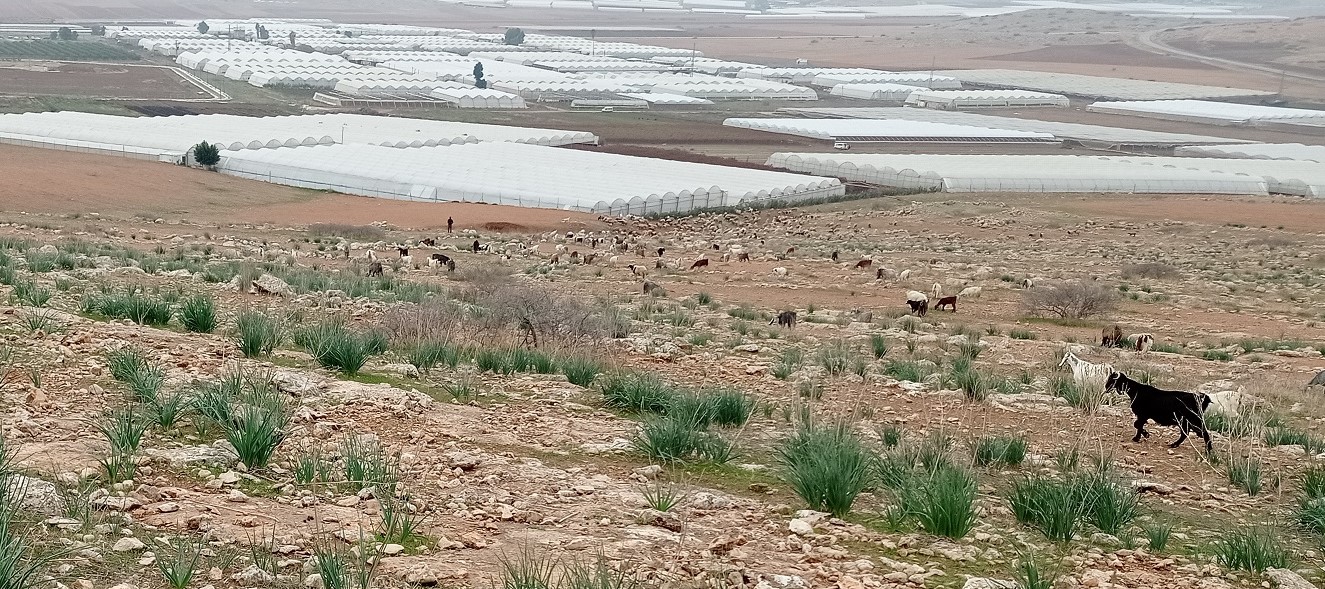
Things went calmly in the morning. Before we went out to the pasture, we filled the troughs with grains of barley. Y let the flock out of the pens and the sheep ran to the food.
The grazing land is on the hills between Makhul and the Ro’i settlement. The vegetation is already beginning to sprout but it still doesn’t provide enough nourishment for the flock. We’re waiting for the rain to come and soak into the earth. At this time of year, rosettes of chive leaves predominate. The stalks of the flowers will come out towards the spring.
The ground is covered with flintstone. Akiva’s trained eyes recognize beautifully carved flint knives, which he estimates to be from the Neolithic period. They are estimated to date from 10,000 BCE. He says that the Jordan Valley region was densely populated in the Neolithic period, citing Jericho, one of the oldest places of settlement, as an example.
Standing on the hilltop, we overlook the area where a new outpost is being established south of the Hemdat settlement. Another threat to the grazing lands that are already shrinking as the settlers take them over.
Khalet Makhul
See all reports for this place-
Khalet Makhul
A small settlement of a shepherd community located on the way to the settlement of Hemdat. Two nearby outposts make life miserable for the Palestinians, who make a living from grazing, and the army backs the settlers. As a result, the possible grazing areas are getting smaller.
The local children attend school in the settlement of Ein Al-Beida. Long lines of 3 hours sometimes stretch out at the Hamra and Tayasir checkpoints leading to the town of Tubas, making it difficult to get water, supplies, and sell the cheese, milk, and meat that the residents produce for their living.
Following a deadly attack at the Tayasir checkpoint in February 2025, the checkpoint was closed completely for the time being.
(Updated March 2025)
-
