
The residents of Kafr 'Aqab fall between the chairs
As far residents’ rights, the villagers of Kafr ‘Aqab are apparently preferred to the inhabitants of nearby Jerusalem neighborhoods. However, some blessings become curses, there are areas of life or death in which they fall between the chairs and are discriminated against because their home happens to be located on the dark side of the apartheid wall.
On the up side – most of the Kafr ‘Aqab villagers hold blue (Israeli) IDs, considered permanent Israeli residents who enjoy freedom of movement in comparison with their brothers who hold green (Palestinian) IDs, and are entitled to medical treatment in the best of Jerusalem’s hospitals.
On the down side, although they are careful to pay municipal taxes for fear that their residents’ rights be sequestered, as for police, mail and sanitation services their situation is grim. The city’s employees refrain from doing their duty and supplying municipal services, claiming security fears.
As for medical treatments, the villagers fall between the chairs: between the Palestinian Authority that is not entitled to provide such services in spite of their geographic closeness, and the distance to Israeli hospitals which makes reaching them – at times – too late.
That’s how it was during the pandemic, when five members of one family from Kafr ‘Aqeb were ill with Covid 19 and the Israeli hospital teams did not dare cross the wall. As for Food – it was provided to them by the Tanzim men who placed food packages on their doorstep.

Why am I writing all of this? Because the fellow on the stretcher is a Kafr ‘Aqeb villager was injured in a traffic accident. He received primary treatment in a clinic in his residential neighborhood, but in view of his condition doctors recommended he be hospitalized. However, reaching Jerusalem from Kafr ‘Aqeb is not direct and swift, for a Palestinian ambulance may not cross Qalandiya Checkpoint, and in order to reach it the wounded and the Ramallah medical team waited for a long time for the Jerusalem ambulance, and when it arrived and the soldiers confirmed that all its papers were in order was the injured man transferred and continued his way to Hadassah Hospital.
Crossing the Qalandiya Checkpoint in an uncrowded time of day, with all the inspections and checks involved, is supposed to take a normal person no more than ten minutes. But that day, this time-theft was such that its end could not be guessed.
When I entered the first room, the one leading to the metal-detector check, I joined a line of over fifty people – men, women and children – winding like a snake, standing with endless patience and waiting for the gate to open and lead them to the armored glass window of the girl-soldiers. However, the gate would not open.
As minutes went by I lost my patience, approached the blocked gate and managed to get the attention of the girl-soldier on the other si8de.
- I yelled, what’s going on?
- You speak Hebrew?
- Yes.
- Something’s not working.
- Well? When will you open the gate?
- It’ll take more time. You can cross in the vehicle track.
- And what about them? I asked, pointing to the people around me.
- Not them. It’ll take more time.
Time did not stop, nor did the human stream, and the place had become crowded, suffocating, a kind of human cage.
I vacated the half meter I had taken up and got out, using my privilege, joined the car of a woman and crossed the checkpoint.
And what about them? I have no idea how long they had to stand facing the locked gates.

Kufr 'Aqab
See all reports for this place-
Kufr 'Aqab
25,000 people live in this village, and since the erection of the Separation Wall, it has been disconnected from Jerusalem and become a neighborhood totally abandoned as far as law enforcement and planning and construction are concerned. The thousands of inhabitants of this undefined urban area pay municipal taxes to the city of Jerusalem but the Israeli authorities – municipality, police, and various service companies – hardly enter these places, and the Palestinian authorities avoid them too since the Oslo Accords forbid them to act within Jerusalem’s jurisdiction.
MachsomWatch teams coming to their Qalandiya vigils sometimes go through the village itself, and the organization’s tours include the enclaves north of Jerusalem.
-
Qalandiya Checkpoint / Atarot Pass (Jerusalem)
See all reports for this place-
Click here to watch a video from Qalandiya checkpoint up to mid 2019 Three kilometers south of Ramallah, in the heart of Palestinian population. Integrates into "Jerusalem Envelope" as part of Wall that separates between northern suburbs that were annexed to Jerusalem in 1967: Kafr Aqab, Semiramis and Qalandiya, and the villages of Ar-Ram and Bir Nabala, also north of Jerusalem, and the city itself. Some residents of Kafr Aqab, Semiramis and Qalandiya have Jerusalem ID cards. A terminal operated by Israel Police has functioned since early 2006. As of August 2006, northbound pedestrians are not checked. Southbound Palestinians must carry Jerusalem IDs; holders of Palestinian Authority IDs cannot pass without special permits. Vehicular traffic from Ramallah to other West Bank areas runs to the north of Qalandiya. In February 2019, the new facility of the checkpoint was inaugurated aiming to make it like a "border crossing". The bars and barbed wire fences were replaced with walls of perforated metal panels. The check is now performed at multiple stations for face recognition and the transfer of an e-card. The rate of passage has improved and its density has generally decreased, but lack of manpower and malfunctions cause periods of stress. The development and paving of the roads has not yet been completed, the traffic of cars and pedestrians is dangerous, and t the entire vicinity of the checkpoint is filthy. In 2020 a huge pedestrian bridge was built over the vehicle crossing with severe mobility restrictions (steep stairs, long and winding route). The pedestrian access from public transport to the checkpoint from the north (Ramallah direction) is unclear, and there have been cases of people, especially people with disabilities, who accidentally reached the vehicle crossing and were shot by the soldiers at the checkpoint. In the summer of 2021, work began on a new, sunken entrance road from Qalandiya that will lead directly to Road 443 towards Jerusalem and Tel Aviv. At the same time, the runways of the old Atarot airport were demolished and infrastructure was prepared for a large bus terminal. (updated October 2021)
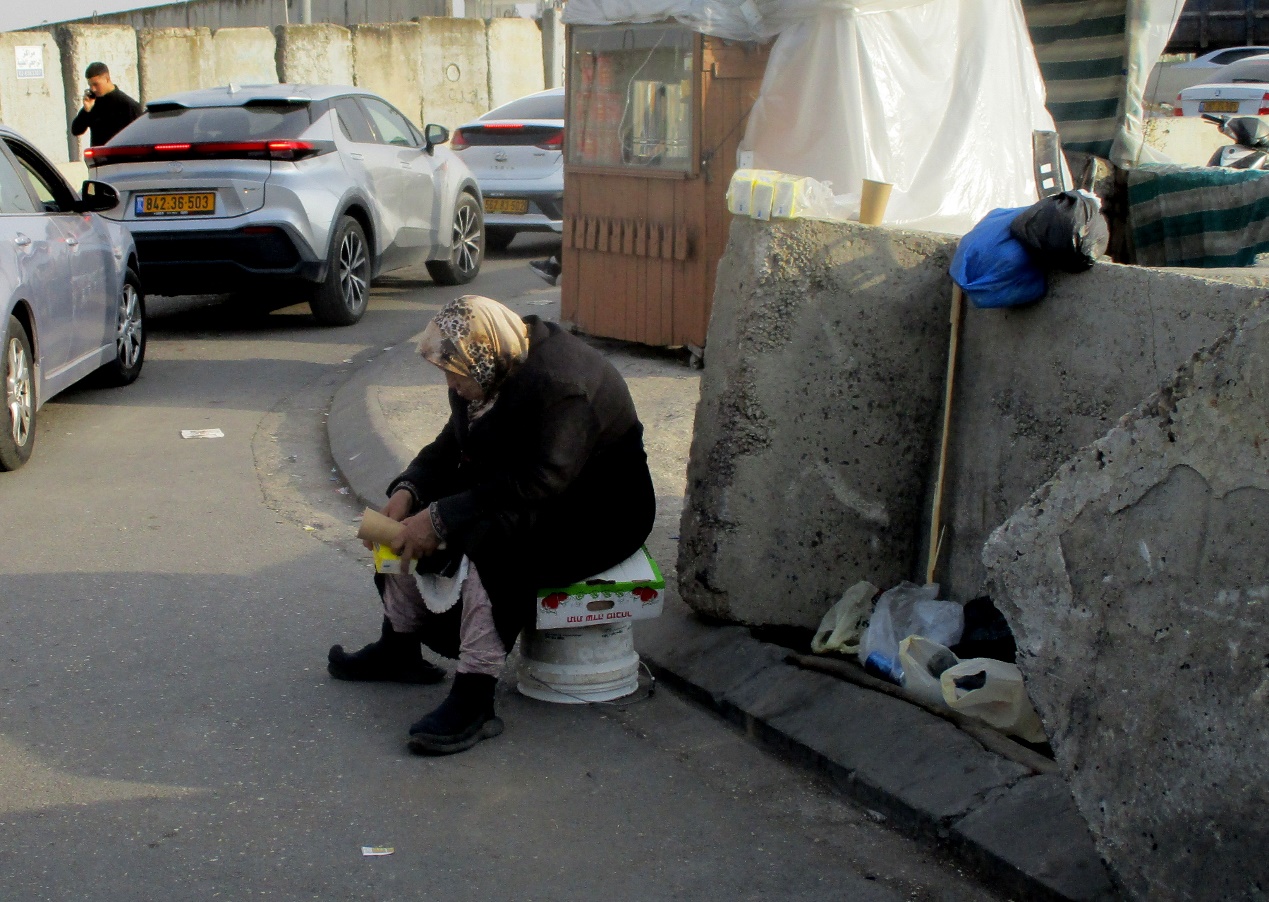 Tamar FleishmanOct-11-2026Qalandiya. Female Beggar
-
