
The transit to Gaza lest at 14:30. She should come again tomorrow
On Small Graces
As I crossed the checkpoint, between the metal detectors and the ID checking posts, a woman stood, her path blocked, carrying a motionless child on her shoulder. The child is 4-year old Abdallah, who until Thursday was hospitalized in the Intensive Care Unit and was taken by his mother to Qalandiya in order to proceed from there all the way home to Gaza.
Abdallah doesn’t see nor respond. A bit like a living dead child.
I didn’t mean to go to the DCO (Civil Administration office) – where they are pushed back in their misery, but meeting these two – seeing the defeated mother whom the soldiers barred from crossing – told the story and I stayed.
Another two men stayed who, like me, were on their way elsewhere, and like me arrived at the point where the mother and son were blocked. We stood with her, next to her.
There were quite a few soldiers and security personnel and two policemen. They all repeated that “the DCO is closed… the transport to Gaza left at 2:30 P.M. today… she should come again tomorrow.”
But the DCO usually closes at 4 P.M. and it’s not that late now, I insisted, and was not answered.
Time passed and 4 P.M. came and went. The woman whose human load was heavy almost collapsed. Give her a chair, I said There is no chair here, answered one of the security guards, and another hurried off and brought an office chair from somewhere.
The mother sat down, the child in her lap, and we – the two men and myself – stood at her sides, waiting, not knowing for what.
One single policeman whose heart was touched called a DCO officer and heard the inevitable – she should come again tomorrow.
When it appeared that all was lost, and we understood that the woman has no relatives with whom to stay in the West Bank, nor money for a hotel in Ramallah, and after the other policeman yelled “Tamar, quit your nonsense!” in response to my comment on procedures, it turned out that even the child’s medication is at home, in Gaza. “Go back to Hebron, you’ll be a permanent guest there” concluded the “nonsense-savvy” policeman.
Just then, deus-ex-machina-like, a group of visitors emerged from the depths of the checkpoint – high-ranking guests who came to get their impressions of the local wonders. I knew I had nothing to lose, so I approached them, faced the senior officer among them (a lieutenant-colonel) and asked them to get close to the child and look him in the eye. You have nothing to fear, I said. Look him in the eyes. He will not look back at you and will not even see you. The child doesn’t see.
Some whispering took place among them, and then I was told that within ten minutes everything will be sorted out.
Skeptically hoping, we continued to wait.
And indeed, after some unmeasured little while – after an hour one doesn’t bother to count minutes – confirmation came through and all five of us crossed the checkpoint.
The only thing left was to agree on the fare with a taxi driver, share the cost between us, and send the mother and son off with our blessing.
No conclusions here: this is all a ‘security’ guise for inhuman procedures.
In honor of International Woman’s Day I wish to hail Gazan woman. My reasons are numberless.
Qalandiya Checkpoint / Atarot Pass (Jerusalem)
See all reports for this place-
Click here to watch a video from Qalandiya checkpoint up to mid 2019 Three kilometers south of Ramallah, in the heart of Palestinian population. Integrates into "Jerusalem Envelope" as part of Wall that separates between northern suburbs that were annexed to Jerusalem in 1967: Kafr Aqab, Semiramis and Qalandiya, and the villages of Ar-Ram and Bir Nabala, also north of Jerusalem, and the city itself. Some residents of Kafr Aqab, Semiramis and Qalandiya have Jerusalem ID cards. A terminal operated by Israel Police has functioned since early 2006. As of August 2006, northbound pedestrians are not checked. Southbound Palestinians must carry Jerusalem IDs; holders of Palestinian Authority IDs cannot pass without special permits. Vehicular traffic from Ramallah to other West Bank areas runs to the north of Qalandiya. In February 2019, the new facility of the checkpoint was inaugurated aiming to make it like a "border crossing". The bars and barbed wire fences were replaced with walls of perforated metal panels. The check is now performed at multiple stations for face recognition and the transfer of an e-card. The rate of passage has improved and its density has generally decreased, but lack of manpower and malfunctions cause periods of stress. The development and paving of the roads has not yet been completed, the traffic of cars and pedestrians is dangerous, and t the entire vicinity of the checkpoint is filthy. In 2020 a huge pedestrian bridge was built over the vehicle crossing with severe mobility restrictions (steep stairs, long and winding route). The pedestrian access from public transport to the checkpoint from the north (Ramallah direction) is unclear, and there have been cases of people, especially people with disabilities, who accidentally reached the vehicle crossing and were shot by the soldiers at the checkpoint. In the summer of 2021, work began on a new, sunken entrance road from Qalandiya that will lead directly to Road 443 towards Jerusalem and Tel Aviv. At the same time, the runways of the old Atarot airport were demolished and infrastructure was prepared for a large bus terminal. (updated October 2021)
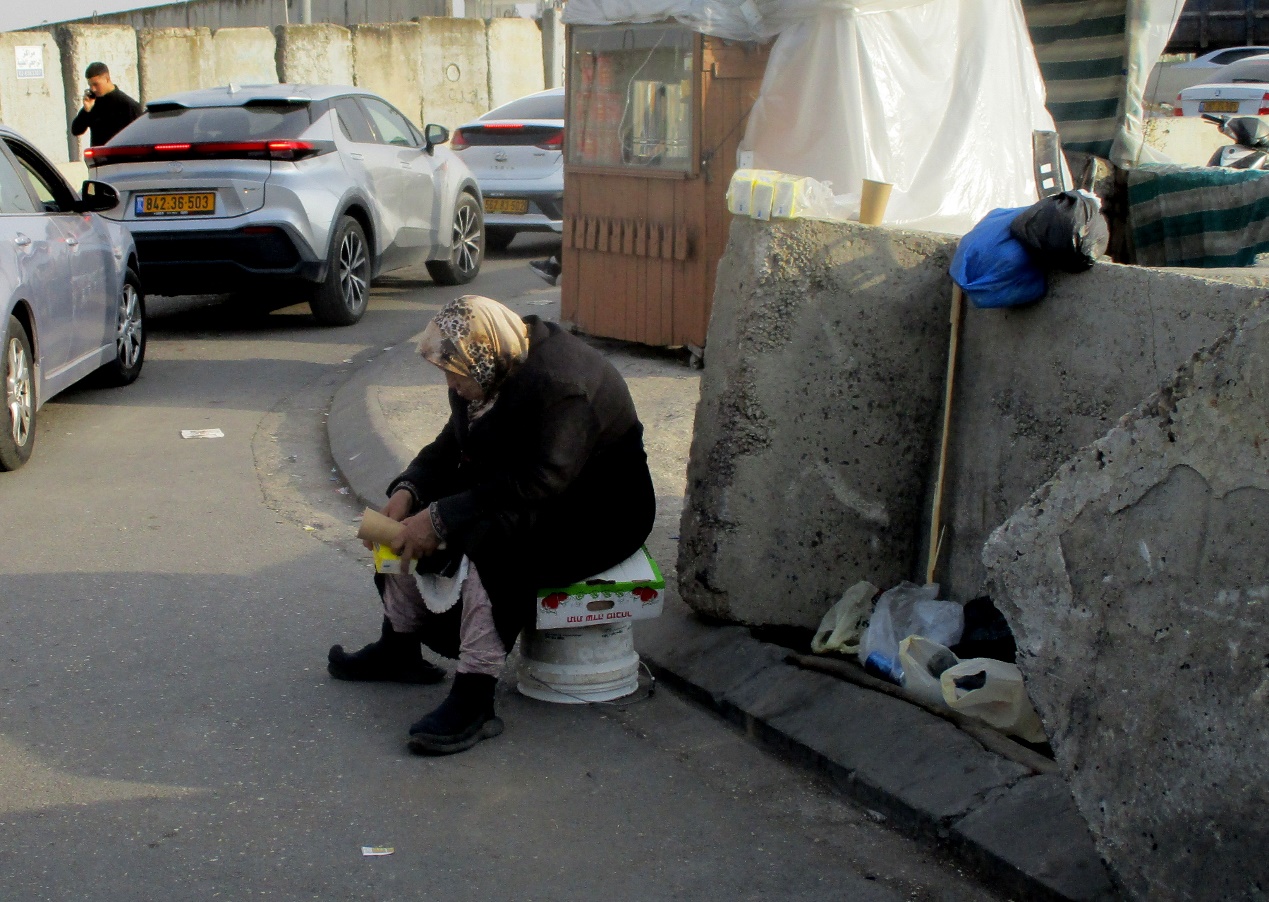 Tamar FleishmanOct-11-2026Qalandiya. Female Beggar
-
